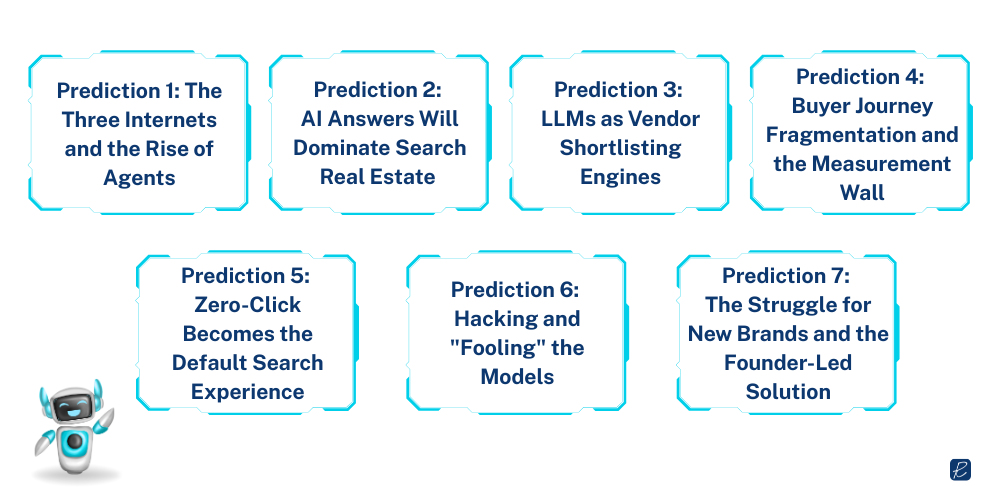
Prediction 1: The Three Internets and the Rise of Agents
The bulk of your buyers likely won’t be people but AI agents acting on their behalf. We must move beyond optimizing for humans and bots to optimizing for agents.
We are already used to humans and bots affecting how we interact with content. Now, we have a third player, which is an army of invisible agents. This creates three distinct layers of the internet:
- Humans: You and I looking at screens.
- Bots: Scrapers and scrapers scanning and reading websites.
- Agents: AI-driven entities acting on behalf of users, scanning for decision-making data.
Just as Apple created the App Store and allowed businesses to “go mobile,” we are approaching a moment where every business will have the opportunity (and necessity) to “go agent”.
We must now optimize for this agent-facing content layer because these agents will facilitate shopping and decision-making directly within LLM interfaces.
Prediction 2: AI Answers Will Dominate Search Real Estate
AI answers and generated content will replace up to 70% of the retail space on traditional search results pages. Don’t read this as just AI overviews appearing here and there; we’re talking about the entire Google screen becoming full of AI-generated information. Google’s AI Mode is a prelude to what’s to come.
While Google may be behind in this space compared to competitors, they have the infrastructure to optimize quickly. Businesses must understand that Google Search’s business model requires users to stay longer in their interface to see more ads, rather than driving clicks to websites. Consequently, the “retail space” for organic content is shrinking.
While this means we may not get as many clicks as we used to, there is a silver lining. We can increase visibility by building assets that AI assistants can easily read and extract insights from.
The goal is to build content formats that agents can easily digest and extract insights from. Even in highly oversaturated spaces, like compliance, we have proven that consistent work on “geo principles” can grow presence in AI overviews.
Prediction 3: LLMs as Vendor Shortlisting Engines
LLMs are becoming the primary engines for vendor shortlisting, judging brands based on the breadth of their digital footprint rather than just depth. More pipeline decisions will be driven from these invisible funnels.
This is perhaps the scariest prediction because all the work you have done previously aimed at visibility in places that now simply do not matter for LLMs. To rank well on search engines, we had specific frameworks. To be recommended by an LLM, the mechanism is different.
We do not know for sure everywhere they take information from, but we do know the variety of sources is much wider than Google’s traditional data sources. LLMs assess a brand based on its presence across a wide variety of sources.
Ensure your brand and product coverage extends to highly visible places available to LLMs, but also to less obvious assets. These can include help sections, documentation, and product sheets. Clean, structured data lays the foundation for accurate recommendations.
Prediction 4: Buyer Journey Fragmentation and the Measurement Wall
We are facing nonlinear discovery loops where attribution hits a “measurement wall.” If your brand story is not consistent across all touchpoints, you leave room for hallucinations.
Attribution in B2B has always been complex. Now, we have an extra layer of complexity where we cannot see the full buyer journey. Consider your own behavior with ChatGPT: you research a topic, but often you don’t get a link. You copy the text, open a browser, and search for the brand directly. Analytics tools see this as “Direct Traffic,” effectively hiding the true source.
If your narrative varies across touchpoints, LLMs may misinterpret or misrecommend your brand. We must accept that we are losing visibility into the direct impact of organic rankings, but we must maintain consistency everywhere. Marketers must also leverage new tools for AI visibility measurement.
Prediction 5: Zero-Click Becomes the Default Search Experience
Zero-click is already a reality for 60% of Google searches, and this will become the default search experience in 2026. Google and other platforms are designing experiences to keep users on their interface.
Furthermore, Google is reducing the visibility into organic traffic performance, as seen in recent updates that cut off certain measurement data. They seem to be deliberately reducing our ability to measure organic impact as they shift toward keeping user attention on their generated answers.
Marketers must manage expectations. We will see fewer hits to the website, but this does not mean we are seeing less exposure for the brand. We must find ways to measure visibility that don’t rely solely on clicks.
Prediction 6: Hacking and “Fooling” the Models
Despite their power, LLM models are still weak in some areas; they get confused easily and don’t always fact-check well. Recent experiments have shown that it is possible to invent a fake brand, create basic mentions on the web, and successfully fool multiple AI models into treating it as a real entity.
This vulnerability highlights a critical need for brand consistency. If you have a large digital footprint, went through a rebranding, or have inconsistencies in your history, you are at risk of misinterpretation.
To protect against this, you must invest in a consistent brand story and expert content across all available sources. If your narrative is solid and widely distributed, you outweigh potential “hallucinations” or negative data points. For instance, if a negative PR campaign hits, a consistent historical narrative helps the model weigh the “red zebra” noise against the “black and white zebra” facts.
Prediction 7: The Struggle for New Brands and the Founder-Led Solution
New brands will find it extremely difficult to break into LLM recommendations because models have a “native memory” bias toward established brands with history.
We hear this pattern constantly from marketers launching new brands: “How do we educate AI?“. The reality is that LLMs prioritize credibility and validity of sources, which younger brands lack.
However, there is one exception. LLMs build strong links between brands and their founders. The age of the brand wouldn’t matter if the credibility of the human does. We will see new brands recommended in 2026 and beyond largely because of the personal brands and backgrounds of their leadership.
If you are a new brand, you must use your founder’s visibility strategically. If you don’t have a personal brand, start building one now. This strengthens the semantic link between human expertise and the company, speeding up the process of getting recommended.