How We Selected These Agencies
This list was not assembled by scanning homepages or service menus. Each agency was evaluated against three practical criteria.
 1. Current visibility and positioning in AI search
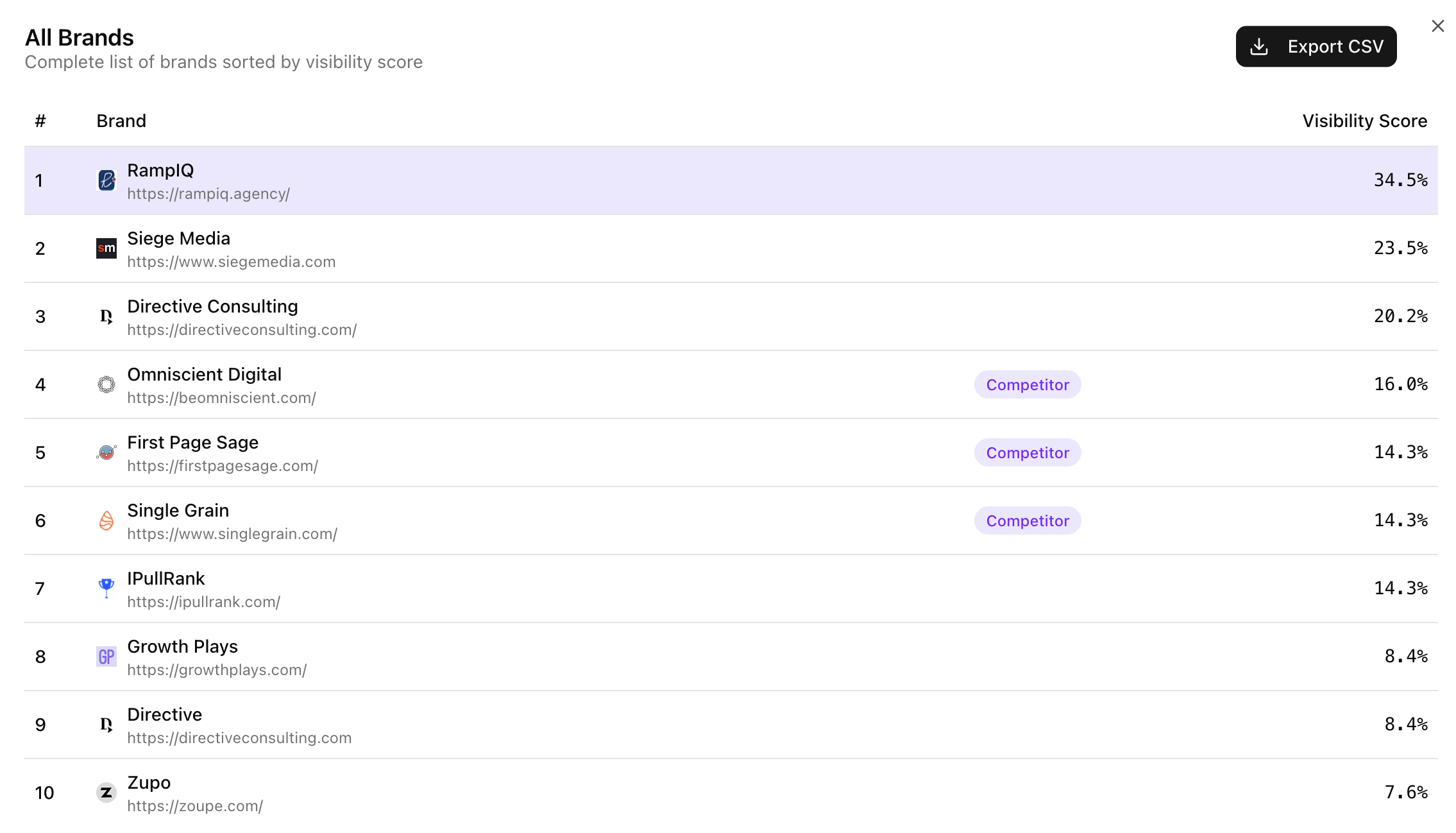
To determine which agencies should make this list, where better than to check how they are positioning themselves in AI search? The primary benchmark used was our AI visibility tool of choice, Amadora.ai which tracks how brands and agencies appear across AI-generated search experiences.
We used this as an AI search leaderboard, surfacing which agencies consistently show up as cited, referenced, or recommended sources when AI systems answer questions about SEO, GEO, and AI search.
Agencies that repeatedly surfaced across AI answers, particularly for B2B-oriented queries, were prioritized. This removed much of the subjectivity that typically affects “best agency” lists.
Importantly, Amadora.ai does not measure self-reported capability. It reflects actual AI system behavior: which sources large language models choose to rely on.
2. Agency brand strength
AI visibility alone is not sufficient. We further validated each shortlisted agency through:
- Public GEO and AI search content like blogs, guides, and frameworks
- Case studies or documented experiments
- Evidence of client work beyond theory
- Consistency between what the agency claims and what AI systems actually surface
Agencies that appeared in AI answers but lacked substantive public methodology did not make the final cut.
3. Public proof of GEO thinking
We looked for published material that goes beyond mere theory and definitions. We assessed hundreds of marketing agencies for:
- Clear explanations of how LLMs retrieve and weight sources
- Evidence of content designed for citation and synthesis
- Case studies or experiments that can be inspected and challenged
Agencies that only talk about “AI-powered SEO” without explaining mechanisms did not qualify.
4. B2B relevance
AI search behaves differently in B2B contexts. Queries are longer, intent is evaluative, and trust signals matter more than novelty. Every agency on this list has meaningful experience with B2B companies, especially SaaS, technology, and complex sales environments.
Only seven agencies met all three criteria. The table below summarizes our findings.
Overview of The Best B2B Marketing Agencies for AI Search Optimization
| Agency |
Core Strength |
Best For |
AI Search Maturity |
Ideal B2B Use Case |
| Rampiq |
Pure focus on AI Search Optimization & GEO |
B2B SaaS & tech companies |
High |
Companies that want measurable AI citation and AI search visibility that translates into revenue |
| WebFX |
Scalable enterprise SEO with GEO integration |
Mid-market & enterprise |
Mature |
Adding AI search optimization into existing SEO operations |
| Omniscient Digital |
B2B topical authority & editorial depth |
B2B SaaS |
Emerging-Mature |
Building long-term authority that surfaces in AI answers |
| First Page Sage |
Research-driven GEO frameworks |
Tech brands & agencies |
Mature |
Strategy-first GEO roadmaps and pricing models |
| Directive Consulting |
GEO tied to pipeline and revenue |
Enterprise B2B |
Mature |
Companies that need AI visibility tied to demand gen |
| Siege Media |
Content engineering & authority assets |
Content-led brands |
Mature |
Earning citations through research and editorial signals |
| Single Grain |
AI-ready content audits & execution |
Growth-stage B2B |
Mature |
Teams that want repeatable AI-focused audits and playbooks |
The 7 Best AI Search Agencies for B2B
1. Rampiq – Best Overall for AI Search & GEO Focus
Rampiq stands out because AI Search Optimization and Generative Engine Optimization are not side offerings but central to the agency’s strategy. The firm has built a dedicated practice around helping B2B companies earn visibility inside AI-generated answers, supported by audits, repeatable execution frameworks, and public case studies.
Rather than reframing traditional SEO, Rampiq treats AI search as a distinct channel with its own mechanics and metrics.
Capabilities
Ideal B2B fit
Rampiq is best suited for B2B SaaS and technology companies that:
- Already understand SEO fundamentals
- Want to win inside AI answers, not just rankings
- Need measurable outcomes tied to AI visibility
Expected outcomes include improved inclusion in AI Overviews, higher citation frequency in generative tools, and clearer attribution of AI-driven discovery.
2. WebFX – Best for Enterprise-Scale Execution
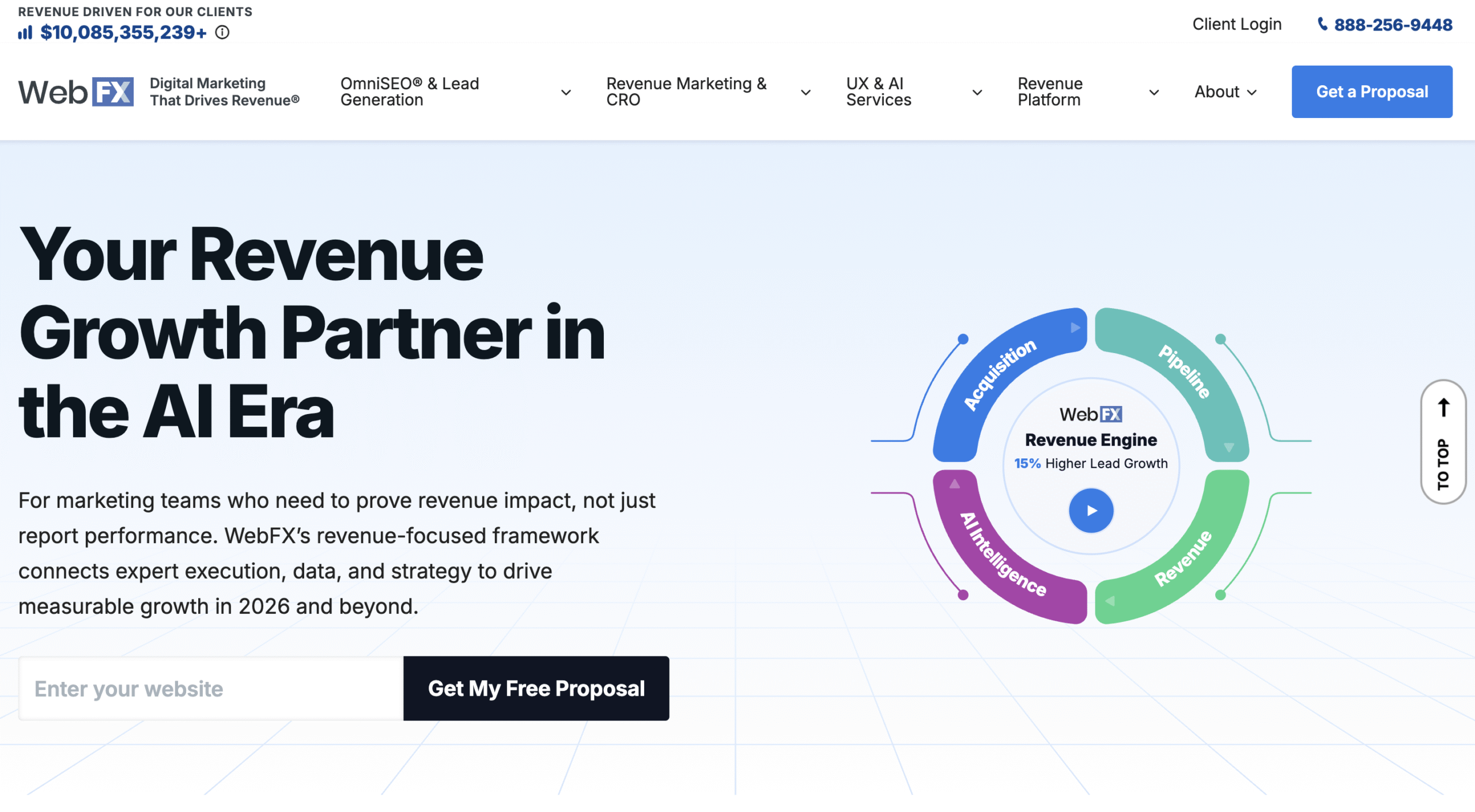 WebFX approaches AI search as an extension of their enterprise SEO operations. Their strength is not experimentation or theory, but scale. GEO is productized and integrated into broader SEO programs, making it accessible for large organizations with established processes.
Capabilities
- Productized AI search optimization services
- Technical SEO and schema implementations that support AI retrieval
- Large-scale content remediation and internal process integration
Ideal B2B fit
WebFX seems fitted for mid-market and enterprise companies that:
- Already run large SEO programs
- Need AI search optimization deployed consistently across many pages
- Prefer operational reliability over bespoke experimentation
3. Omniscient Digital – Best for B2B Content Authority
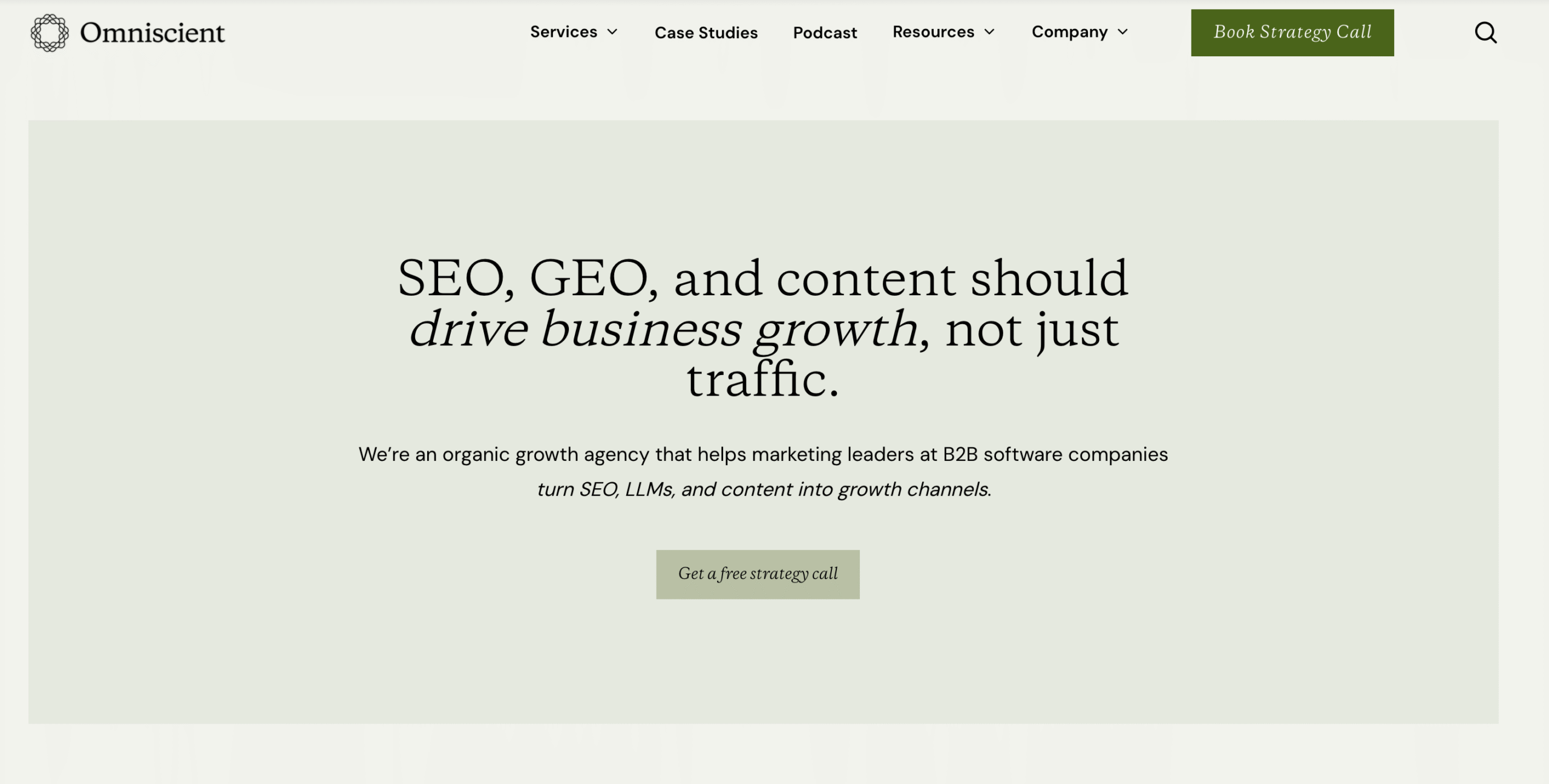 Omniscient Digital is fundamentally a B2B organic growth agency, and that perspective shapes its approach to AI search in recent months. Rather than chasing surface-level AI placements, the firm focuses on building deep topical authority that AI systems naturally draw from.
Capabilities
- Topic graph and authority modeling for B2B subjects
- Editorial content designed to be both human-credible and machine-extractable
- Integration of GEO considerations into long-term content strategies
Ideal B2B fit
Best for B2B software companies that:
- Compete on expertise and thought leadership
- Want AI visibility as a byproduct of strong authority
- Are investing in content as a long-term asset
4. First Page Sage – Best for GEO Strategy & Research
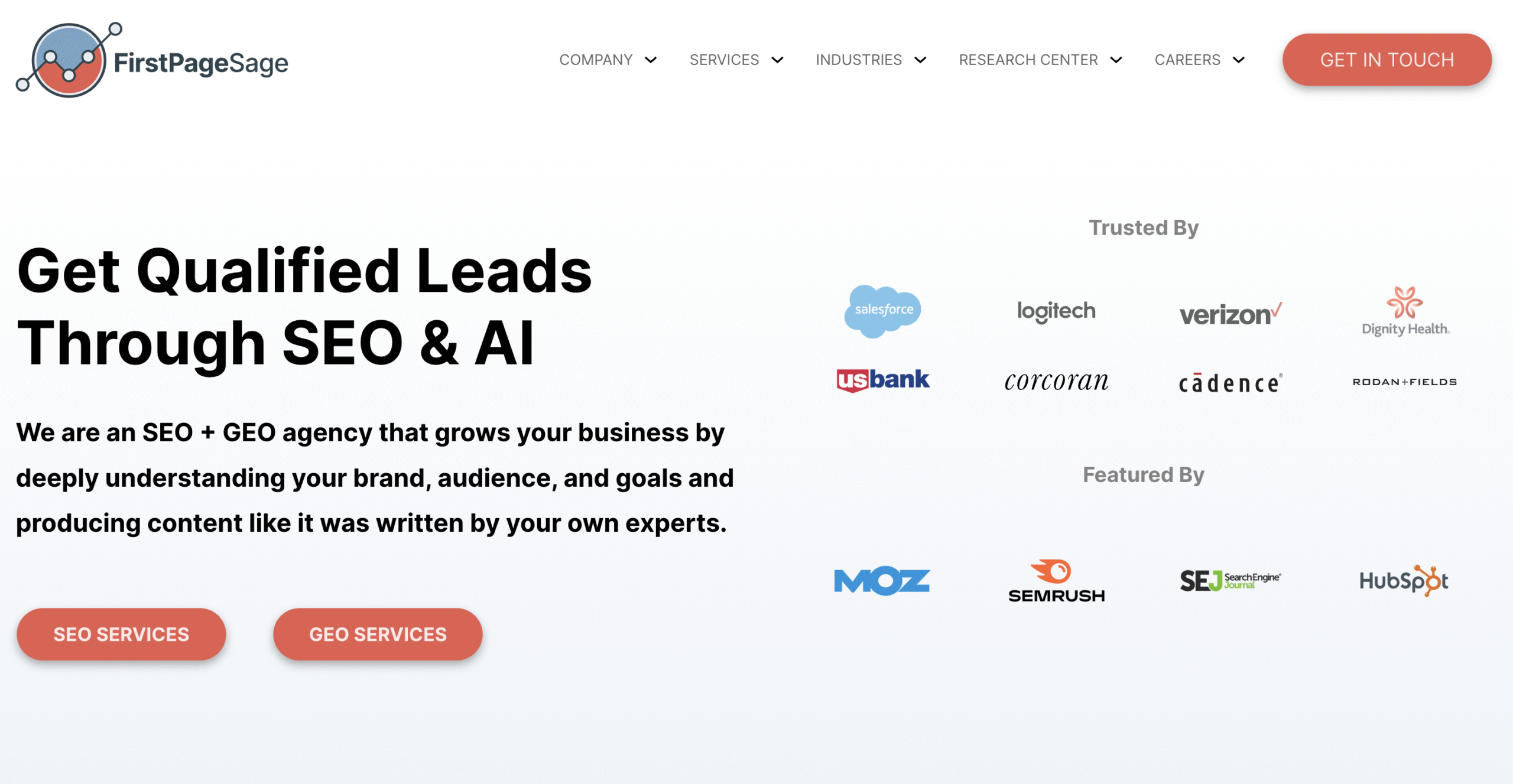 First Page Sage has been early to formalize GEO concepts, especially around pricing models, timelines, and expectations. Their work is research-heavy and framework-driven.
Capabilities
- GEO research and methodology development
- Strategic roadmaps for AI search visibility
- Education-focused deliverables for internal alignment
Ideal B2B fit
A strong choice for companies that:
- Need executive-level clarity before investing
- Want to understand how GEO changes budgets and ROI models
- May pair strategy work with another execution partner
5. Directive Consulting – Best for Revenue-Aligned GEO
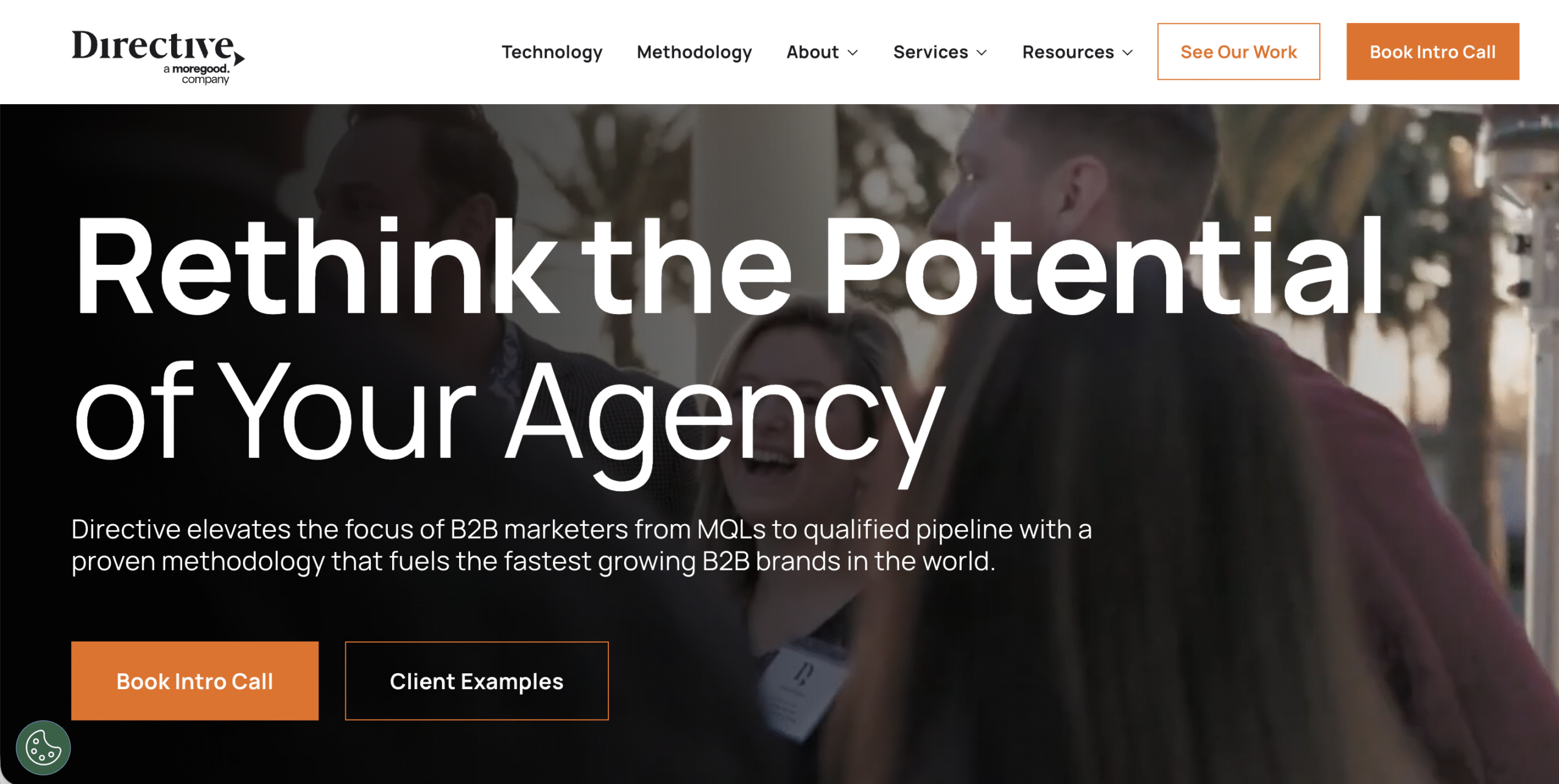 Directive Consulting treats AI search as part of the demand-generation system. Their GEO work is closely tied to intent modeling, pipeline influence, and revenue attribution.
Capabilities
- AI search optimization aligned with buyer journeys
- Measurement frameworks that connect AI visibility to CRM data
- Technical SEO and content adjustments designed for high-intent queries
Ideal B2B fit
Directive is well-suited for enterprise B2B organizations that:
- Need to justify AI search investment to revenue teams
- Operate complex, multi-touch sales funnels
- Expect rigorous reporting and attribution
6. Siege Media – Best for Citation-Worthy Content Assets
 Siege Media excels at producing content that earns trust signals like backlinks, references, and editorial mentions, which generative systems heavily rely on currently.
Capabilities
- Data-driven research content and long-form explainers
- Digital PR that strengthens citation likelihood
- Editorial processes that emphasize factual clarity and freshness
Ideal B2B fit
Best for companies that:
- Compete in information-dense categories
- Need authoritative assets AI systems can confidently cite
- Value content quality and credibility over volume
7. Single Grain – Best for Practical AI-Ready Audits
 Single Grain blends thought leadership with hands-on execution. Their frameworks for AI-optimized content audits are both pragmatic and repeatable.
Capabilities
- AI-focused content and entity audits
- Playbooks for adapting existing content to AI search
- Training and enablement for in-house teams
Ideal B2B fit
A good option for growth-stage companies that:
- Want a clear starting point for AI search optimization
- Plan to execute continuously with internal resources
- Value structure and repeatability
What to Look for in an AI Search / GEO Agency
If you remove the marketing language, AI Search Optimization comes down to one question:
Can this agency reliably make your company show up as a trusted source or recommendation inside AI-generated answers and prove it?
Use the criteria below to separate real GEO capability from rebranded SEO.
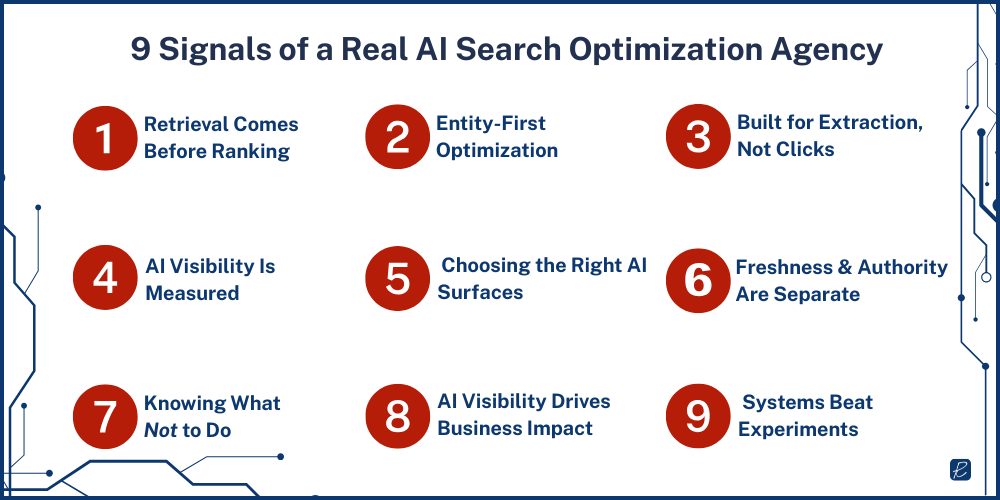
1. They understand retrieval before ranking
Most agencies still talk about “ranking in AI Overviews.” That’s already too late. In AI search, the critical step is retrieval:
- Which sources are even considered candidates?
- Which pages are pulled into the context window?
- Which entities are recognized as authoritative for the prompt?
A credible GEO agency should be able to explain:
- How LLMs assemble candidate source sets
- Why some pages are never retrieved regardless of classic SEO strength
- How entity clarity, topical proximity, and factual density affect retrieval
If an agency cannot articulate this without falling back to “Google still works the same,” they are not operating at AI-search depth.
2. They fully understand and focus on entity optimization
Unlike traditional search engines that reason in URLs, AI systems consider entities, relationships, and topical consistency. Look for agencies that can explain and build these structures. The best GEO agency for your B2B company will:
- Explicitly map your brand, products, and experts as entities
- Resolve ambiguity between similar entities (brand vs product vs category)
- Align internal content so the same entity is described consistently across pages
Ask them these questions:
- How do you prevent entity fragmentation across the site?
- How do you strengthen entity-to-topic associations?
- How do you handle competing entities already favored by AI systems?
If the answer is “we add schema and internal links,” that’s incomplete.
AI systems don’t “read” content the way users do. They extract. High-performing GEO content:
- States facts early and unambiguously
- Uses definitional language where appropriate
- Separates explanation from opinion
- Makes attribution easy (who said this, why it’s credible, when it was updated)
A real GEO agency will talk about:
- Citation likelihood
- Extractability
- Context-window efficiency
- Reducing interpretive ambiguity for models
It is also helpful to read the content they put out to confirm that these meet the above practices. If their primary success metric is CTR, they are still operating in a pre-AI mindset.
4. They measure AI visibility directly
There is no single “AI impressions” metric. Credible agencies track citation frequency, AI Overview inclusion, and downstream engagement and explain the limitations openly.
You cannot manage what you don’t observe. A credible AI Search agency should be able to show:
- Which prompts your brand appears in
- Where you are cited vs merely mentioned
- Which competitors are being pulled instead of you
- How visibility changes over time
This requires AI-native measurement, not extrapolation from SEO tools.
If reporting stops at “AI traffic is hard to measure,” that’s a red flag. The good agencies acknowledge limits and still track what matters.
5. They have a clear position on AI Overviews vs LLMs
AI search is There is a real difference between Google AI Overviews, ChatGPT-style conversational retrieval, and Perplexity-style citation-first answers
The best AI search optimization agencies understand where these systems overlap, where they diverge, and which of these surfaces matter most for your category
They should be able to say, plainly:
“For your market, this surface matters more than that one, and here’s why.”
Anything else is hand-waving.
6. They treat freshness and authority as separate levers
AI systems balance authority (long-term trust, entity strength) and freshness (recency of facts, updates, examples). A winning GEO program should include:
- Update cadences for critical pages
- Clear signals for “this is the current answer”
- Versioning logic for facts that change
If an agency treats content updates as occasional housekeeping, they will lose AI visibility over time.
7. They can tell you what not to do
This is an underrated test. Experienced GEO practitioners will actively warn you against practices like:
- Overproducing thin AI-generated content
- Creating multiple pages that compete for the same entity-topic pairing
- Publishing opinionated fluff where factual authority is required
- Chasing prompts that AI systems consistently resolve from aggregators or first-party data
If everything sounds like an opportunity, you’re talking to a salesperson not a strategist.
8. They align GEO with business outcomes (without pretending attribution is perfect)
No serious B2B marketing agency will promise perfect attribution from AI answers to revenue.
What they should do are:
- Map AI visibility to assisted discovery
- Track branded search and direct traffic lift
- Connect AI exposure to downstream pipeline signals where possible
- Be honest about what is directional vs deterministic
GEO is an influence channel. Agencies that oversimplify this are setting false expectations.
9. They have operational discipline, not just ideas
Finally, GEO lives or dies on execution. Ask the potential agency about:
- Editorial governance and fact-checking
- Approval workflows for entity-critical pages
- Who is accountable for AI visibility changes month to month
- How learnings are fed back into briefs and updates
If the answer is “we experiment,” push further. Experiments are table stakes. Systems are what scale. The best AI Search optimization agencies do not sell “AI SEO.”
They operate with:
- A retrieval-first mental model
- Entity-level optimization
- Content engineered for citation
- AI-native measurement
- Clear judgment about tradeoffs
If you don’t hear those things explicitly, keep looking.