How user behavior is shifting from search engines to AI answers
Search behavior is no longer linear. AI interfaces like ChatGPT collapse discovery, evaluation, and recommendation into a single step. For informational and early-stage B2B queries, users often never reach an actual website.
AI models now sit on top of search indexes, licensed data, and curated web sources, reshaping how information is selected and surfaced.
That’s why visibility is no longer only about “ranking pages.” It’s about being eligible for retrieval and credible enough to be cited.
SEO vs GEO comparison
| Aspect |
Traditional SEO |
GEO / AI Search |
| Primary output |
Ranked links |
Generated answers |
| Optimization target |
Pages & keywords |
Entities, topics, trust |
| Success signal |
Clicks & rankings |
Mentions, citations, recommendations |
| Core assets |
Pages & backlinks |
Content depth, brand signals, authority |
| Visibility surface |
SERPs |
AI summaries & responses |
For definitions and terminology, see our full glossary.
How Does ChatGPT Choose Sources?
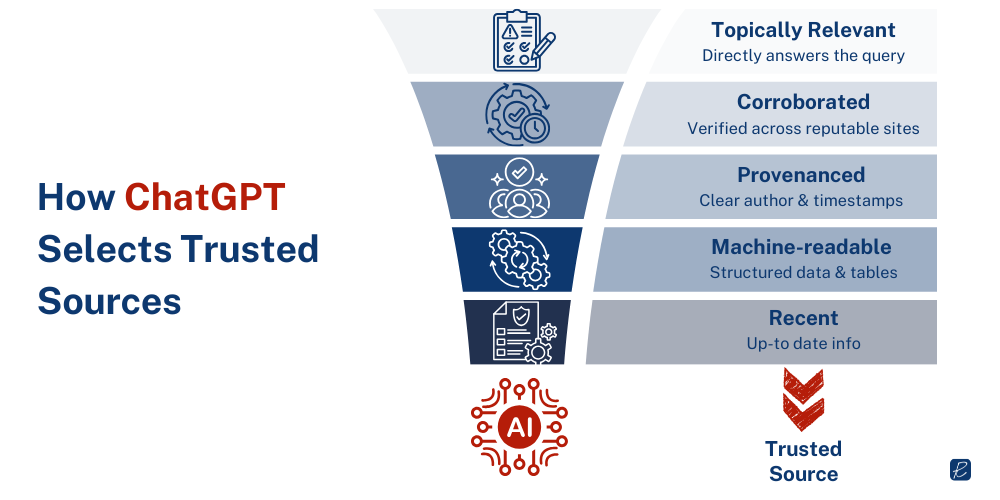 ChatGPT favors sources that are:
- Topically relevant: Content directly answers the query.
- Corroborated: The same fact appears across independent reputable sites.
- Provenanced: Clear author/organization attribution and timestamps.
- Machine-readable: Formatted logically with structured data, tables, and scannable content.
- Recent: For time-sensitive topics.
Note: Source selection varies by mode (with or without live web retrieval), prompt phrasing, and context. In retrieval-enabled answers, these factors influence what gets cited. In non-retrieval contexts, broader entity consistency and brand signals influence how your company is described.
For example, for a prompt like “best enterprise ecommerce platforms in 2026”, ChatGPT is more likely to cite a vendor comparison that (a) contains a dated summary, (b) has a visible author and methodology, and (c) is referenced by two or more industry roundups, even if that comparison isn’t the top organic search result.
How to Optimize Your SEO Strategy to Increase ChatGPT Visibility
If we reframe the question correctly, the real goal becomes:
How can I optimize my SEO strategy to increase my brand’s visibility and citation in AI-generated answers?
Below is a practical, business-aligned approach.
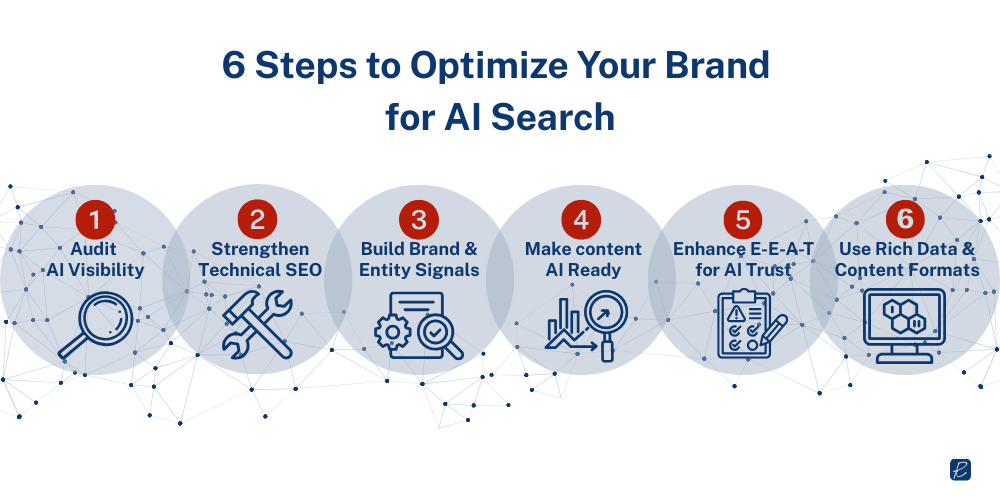
1. Audit your website to understand current ChatGPT visibility
Before you try to influence ChatGPT’s visibility, you first need to know where you already stand. An AI visibility audit reveals how AI models perceive and reference your brand across real queries and platforms. An effective AI visibility audit should answer three fundamental questions:
Does ChatGPT know your brand exists?
Where is your brand already cited, and where isn’t it?
How does ChatGPT treat your competitors currently?
When auditing brands’ AI visibility, we investigate signals that generative engines use to form answers, such as:
- Memory vs. live responses: models’ baseline understanding vs. real-time search behavior
- AI citation sources: which third-party sites, directories, and profiles feed trusted contextual signals
- Positioning drift: how closely your brand’s messaging across the web matches how AI describes it
- Content GEO readiness: whether your most important content is structured in a way that LLMs can reliably extract and reference it
- “AI search wins” mapping: where you currently appear in AI-driven features and what blocks broader visibility
- Competitive environment: where your brand stands, compared to its main competitors
An audit that combines SEO fundamentals with AI visibility signals gives you a map of influence to show you which content is already pulling weight, where your brand is misunderstood or outdated, which trust signals and third-party profiles matter most for citation, and priority areas to improve your AI visibility.
If you want a structured baseline, let us run an AI visibility audit of your company. Without this step, everything else in your AI search strategy would be more like guesswork.
2. Strengthen SEO & technical foundations
Make sure AI models can read your site’s pages reliably. ChatGPT sources and synthesizes from live web content and cached corpora. For your site’s technical foundations, focus on these aspects to win in “ChatGPT SEO”:
- Ensure crawlability and indexability
- Fix duplicate content and canonicalization
- Serve plain, parseable HTML
- Apply structured data on your web pages
- Improve performance and accessibility
- Stabilize your business’s entity signals across the web
- Harden metadata hygiene
- Audit crawl logs and assess fetch behaviour
Indexability ensures your content enters the broader web discovery ecosystem. Clean HTML and structured data ensure it can be reliably fetched and extracted by AI systems.
If your content is blocked, duplicated, or poorly structured, it’s either invisible or yields unreliable summaries, and nothing else will stick.
Tight technical foundations make your content a reliable candidate for extraction, citation, and recommendation.
3. Build strong brand & entity signals
ChatGPT doesn’t discover brands the way humans do. It recognizes entities based on consistency, repetition, and corroboration across trusted sources. If your brand is inconsistently described across the web, ChatGPT might struggle to confidently reference it.
The most impactful so-called “ChatGPT SEO” practice is to tighten external signals that define who you are and what you’re known for. Key actions that actually move the needle are:
- Standardizing your brand identity everywhere
- Maintaining well-reviewed business profiles on key, industry-relevant directories
- Presence in authoritative industry roundups and comparisons
- Participating in expert discourse on (platforms like) Reddit
- Aligning your entity signals with topical focus
Brand signals connect SEO and ChatGPT visibility. When you focus on the above items, ChatGPT will be far more likely to recommend your brand consistently and cite it more frequently in responses.
4. Make your content AI-ready
Structure your content for clarity so that ChatGPT can reliably extract, interpret, and reference your facts. ChatGPT doesn’t guess meaning well; it performs best when your content expresses ideas explicitly and predictably.
AI-ready content is designed for both human comprehension and reliable machine interpretation. It’s more about tightening clarity, structure, and context than rewriting for machines.
Here are the key aspects of our framework for producing AI-friendly content without losing human value:
- Answer the main question immediately with a clear, direct statement before adding detail or nuance.
- Define key concepts explicitly so AI systems can anchor meaning without inference.
- Use a clean, predictable structure with logical headings and short, focused sections.
- Add necessary context, even for expert topics, to help AI place your content correctly.
- Rely on concrete facts and examples rather than abstract or promotional claims.
- Strengthen your About page as a single source of truth for who you are, what you do, and why you’re credible.
- Optimize every page for depth and topical focus, avoiding thin, overlapping, or unfocused content.
- Remove vague or overly marketing-focused language that creates ambiguity.
- Use semantic HTML and simple formatting (lists, tables, definitions) to support reliable extraction.
Read the linked guide for a detailed framework with examples and templates for AI-ready content structures.
5. Enhance E-E-A-T for AI trust
Experience, expertise, authority, and trust seem to matter more in AI contexts than classic search. When ChatGPT evaluates content, it leans on the same signals that help humans judge quality. It assesses the content author(s) and publisher, their credibility, and the content’s trustworthiness.
To strengthen E-E-A-T in a way that matters for both search engines and AI systems:
- Show real authorship and credentials on every expert article or resource. Include author bios, qualifications, and context that signal domain knowledge.
- Use first-hand experience and original insights, but avoid regurgitated summaries. Include practical examples, case studies, and lessons learned to demonstrate expertise.
- Reference primary sources clearly, linking to original research, data, and reputable industry reports rather than vague assertions.
- Keep content factual and up to date, especially when industry standards or best practices evolve quickly.
- Avoid exaggerated claims or unsupported guarantees, as they reduce trust and increase ambiguity for both readers and AI models.
- Structure content to surface evidence early, so AI systems see the credibility signals before interpreting nuanced sections.
These are signals that both humans and AI systems use to prefer one source over another. For a deeper understanding of how E-E-A-T influences both traditional SEO and broader visibility, read our guide on E-E-A-T and Google SEO.
6. Use rich data and content formats
Rich data and clear content formats reduce ambiguity and improve ChatGPT’s reliability in interpreting and surfacing the data points in your content.
Publish content in formats that clarify intent and relationships:
- Use tables to compare concepts, features, or options, making differences and similarities explicit.
- Add definition blocks and short summaries to surface key facts without forcing inference.
- Structure processes and frameworks as ordered lists rather than dense paragraphs.
- Include simple visuals only when they add clarity, and always support them with descriptive text.
- Apply relevant structured data selectively to reinforce meaning.
- Surface key takeaways and constraints clearly, so AI systems can extract accurate conclusions.
When content is presented in clear, machine-friendly formats, generative systems can process it with less uncertainty, increasing the likelihood that your information is cited accurately rather than paraphrased incorrectly or ignored.
What You Need for A Winning “ChatGPT SEO” Strategy
The most important tools you need for ChatGPT visibility optimization are AI visibility tools to cover entities and AI outputs. Besides these, you don’t need a completely new tech stack. At a minimum, an effective ChatGPT or GEO setup includes the following:
- AI visibility and citation monitoring tools to check whether your brand or content appears in ChatGPT answers and in what contexts.
- Access to a ChatGPT subscription to test prompts for yourself, compare answers across phrasing variants, and observe cited sources.
- Core SEO tools remain essential, especially for indexing, backlink and mentions monitoring, topic research, and technical SEO validation.
- A rich, easy-to-extract, and cite content inventory.
How to Measure Success in ChatGPT SEO
Measurement of ChatGPT optimization success needs to focus on visibility inside the responses and downstream impact. You cannot measure these with traditional rankings because ChatGPT doesn’t surface ordered result lists; it shows answers, recommends, and cites.
The most reliable indicators of success are:
- Whether your brand, products, or content are referenced when relevant prompts are asked in ChatGPT.
- Your brand’s share of voice for high-intent prompts.
- Quality of citation contexts.
- AI-referred traffic and assisted conversions.
- Proxy SEO signals like AI Overviews presence and strong performance on informational queries.
To check these all efficiently, we use AI visibility checker, Amadora.ai. When you add your brand details and target prompts, Amadorda shows your brand’s:
- Visibility score: The percentage of your predetermined prompts that ChatGPT mentions your brand in answers
- Share of voice: Visibility score in relation to competitors
- Average position of your website in ChatGPT answers that include listed brand recommendations.
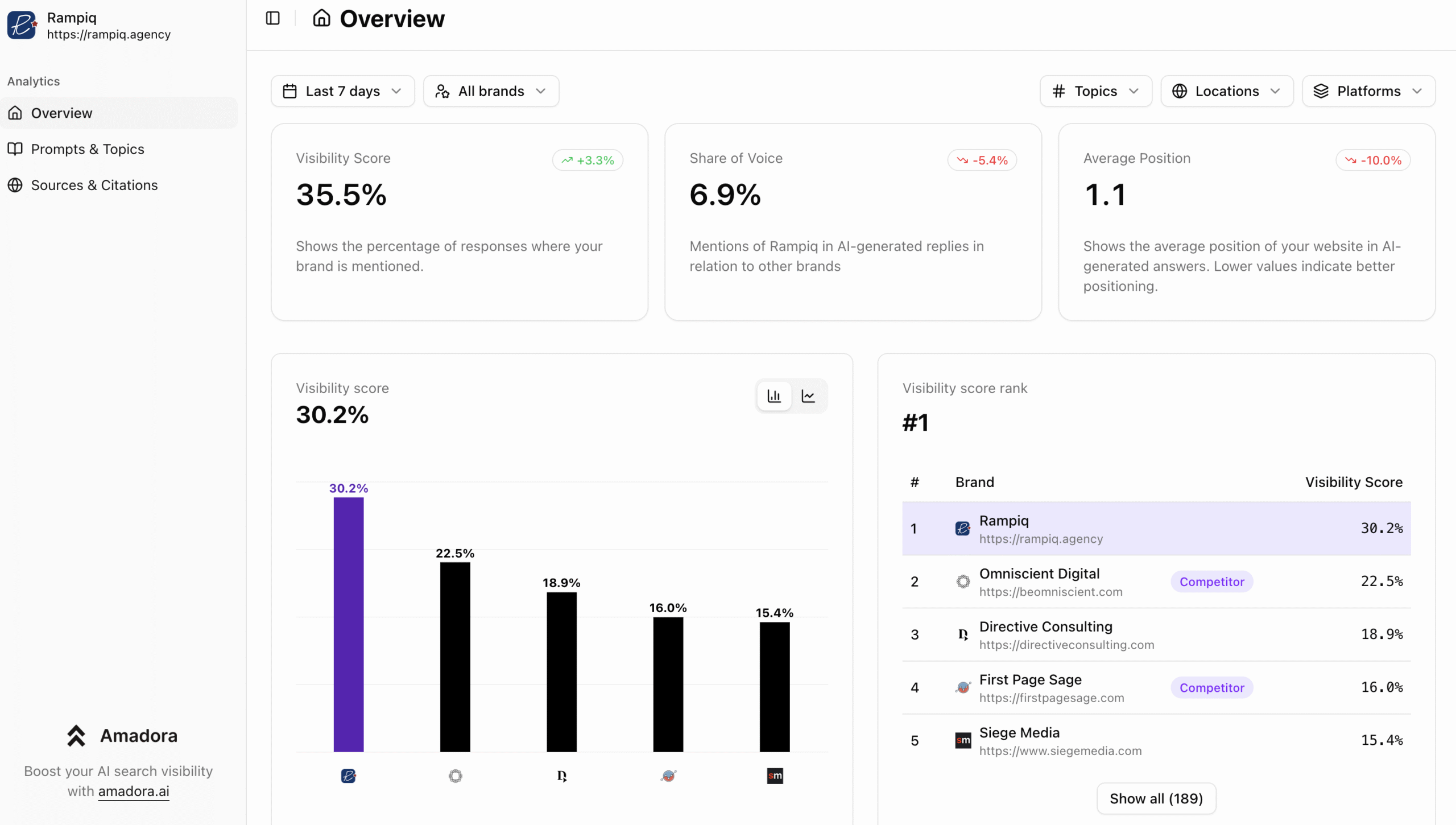 However, you must also accept measurement limitations, primarily because ChatGPT is opaque, its answers are personalized, and OpenAI does not provide insights into website performance (e.g., Google Search Console).
Rampiq’s AI search and visibility program is designed around this reality, focusing on measurable improvements.
How Rampiq Helps With “ChatGPT SEO”
Rampiq helps companies adapt their SEO strategy so their content and brand become more digestible and trustworthy for ChatGPT, which increases visibility and citability. We build the underlying signals AI engines rely on when selecting sources.
Our support includes AI visibility and GEO audits; digital PR to secure inclusion in key AI sources; entity and structured data optimization; content readiness and sourceability improvements; and citation-focused strategies. Deliverables are implementation-oriented, and performance is measurable.