What Success Looks Like in Google AI Overviews
Winning with Google AI Overviews boils down to getting cited (even without ranking in the top 10 organic results), receiving recommendations and awareness, with or without direct clicks. This means gaining more authority and influence without a user even visiting your website.
After a site migration caused a visibility drop for Case IQ, we audited citation eligibility across their priority queries. Within 90 days of restructuring pages using our AI-citation framework, the site earned AIO placements for 850+ additional queries and increased top-3 rankings by 145%. The lift came primarily from content restructuring and evidence insertion, without new backlinks.
In our AI visibility program, we focus on traditional SEO fundamentals while ensuring AI Overview ranking. Ignoring AI Overviews can cost you visibility, revenue, and share of voice. Before we proceed to the ranking tactics, we’ll briefly explain what you must know about how AIOs work.
How Google AI Overviews Work
Google’s AI Overviews synthesize multiple indexed pages and surface links behind the synthesis. They may cite pages that aren’t in the classic top-10 of the search engine results page. To be citable, content must be concise, verifiable, and structured for extraction (answer blocks, schema, and explicit evidence). This aligns with Google’s guidance to produce unique, non-commodity answers for AI search.
While page/position #1 ranking in traditional SERPs proves relevance, AIOs regularly cite pages outside the classic top-10 in many datasets. That means you can be invisible in page-one organic results, yet still be the preferred evidence for an overview and vice versa.
When Google Shows AI Overviews
AI Overviews appear in almost 55% of all Google searches, primarily triggered by long-tail complex searches, multi-layered queries, comparison searches, product research, and ‘how-to’ searches. Examples of searches for which Google searches trigger AI Overviews:
- Long-tail, complex searches: When users ask detailed questions that require nuanced answers. For example: “What is the best enterprise CRM software with native Salesforce integration under $50/user/month?”
- Multi-layered queries: When a question has multiple components or conditions that need to be addressed systematically.
- Comparison searches: When users want to weigh options, like “Salesforce Sales Cloud vs HubSpot for Enterprise.”
- Product research: Searchers seeking features, specifications, or reviews of specific products.
- How-to searches: Instructional queries like “How to effectively map your B2B SaaS customer journey.”
To know if your site or content is currently eligible for AI Overviews, we evaluate using these five signals:
- Pages and sections answer queries in the first 75 words
- Evidence is present for every claim
- Content is segmented into extractable blocks
- Brand has topical mentions externally
- Google can crawl all priority pages
If three or more are missing, your pages are unlikely to be cited consistently.
You’ll rarely see AI Overviews when it comes to local searches; they only come up for 7% of local searches. In addition, AI Overviews barely appear for navigational searches, transactional queries with immediate purchase intent, and financial or medical (YMYL) topics.
What Google Uses as Source Material for AI Overviews
During our constant research, we have observed that Google AIOs typically cite a range of content types like long explainers, comparison pages, technical PDFs, and sometimes high-quality forum threads for lived experience. We found that most of this content was found to be from authoritative websites that are relevant to the industry or ICPs of the ranked pages.
Educational and informational articles majorly dominate AI Overview citations. List-based content as well. Others include comparison content, data-driven content, FAQ-style content, and, not surprisingly, forum discussions from Q&A sites like Reddit and Quora. Forums rank when they contain genuine user experiences or practical advice that complements expert sources.
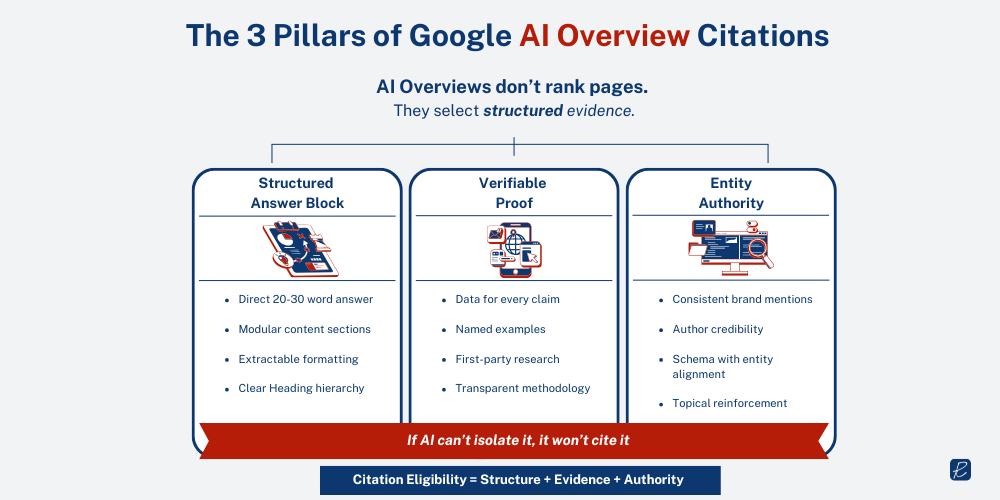
Overall, through analysis of thousands of AIO results across B2B industries, we’ve observed that Google consistently cites pages that satisfy three extraction criteria:
- Direct answerability: the page resolves the query without interpretation
- Verifiable claims: statements supported by data, sources, or methodology
- Structured segmentation: content organized so models can isolate sections instantly
 Pages that are informative but unstructured often rank organically yet never appear inside AI Overviews.
Before we proceed, we must emphasize that you can’t game AI Overviews with shortcuts… for long. The future-proof strategy that works is genuinely becoming a better, more authoritative, and more helpful resource than other competing content.
How to Write and Structure Content to Earn AI Overviews Inclusion
By focusing on the BLUF method, user intent, E-E-A-T, and proper content hierarchy, a website is well on its way to earning consistent citations in AI Overviews and driving qualified organic traffic. Here’s how we structure content at Rampiq to earn those citations:
Here’s an easy checklist to bookmark:
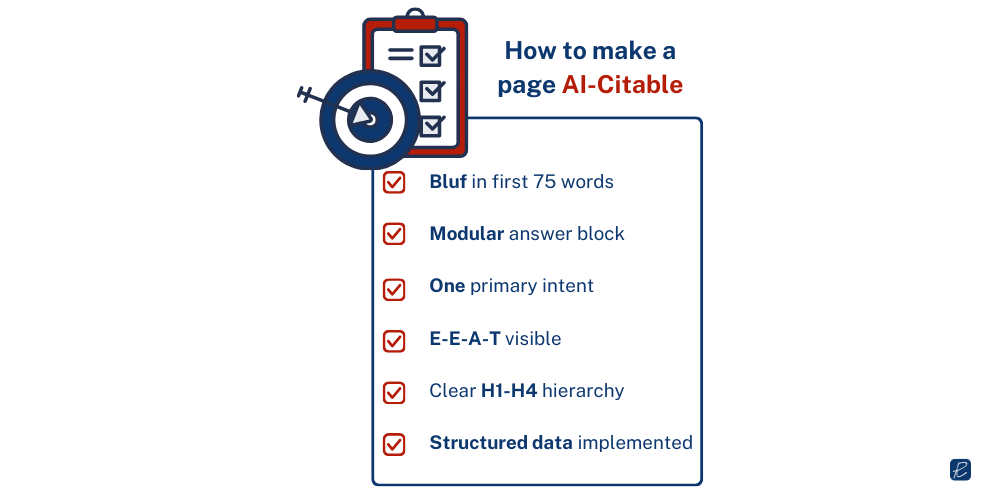
Use a bottom line up front (BLUF) structure
We put the most critical information first; the first 50 words deliver the answer your ICP needs. Then, we start with the direct response to the primary query in 20-30 words, add 2-4 bulleted takeaways under the H1 that stand alone without extra context, and cut any lead-in that delays value.
Think in answer blocks, not articles
AI-ready pages consist of modular answer blocks that tools can parse and reassemble. For example, here are basic components of most pages ranking in Google AI Overviews:
- Answer block: Two or three short paragraphs answering the query directly
- Process or comparison: Numbered steps or a table showing options and trade-offs
- Requirements and edge cases: Inputs, constraints, version,s and caveats
- Sources: First-party docs and reputable third-party references with dates
Focus on one intent per page
We pick one primary intent per page and finish it completely; everything else becomes a link to deeper content, so parsing stays clean. This contrasts with traditional SEO, where it’s common practice to fit in several adjacent topics on a page to increase visibility. For AI Overviews, this might dilute your page’s relevance to the core topic.
Embed E-E-A-T signals into your layout
Trust earns citations. So we build trust into the layout so readers and assistants can see who wrote the page, how we produced the claims, and where the facts came from. We explained the E-E-A-T framework in a separate in-depth article.
Use a heading hierarchy that AI can navigate
We structure headings so AI assistants can quickly find specific parts of the page relevant to a searcher’s query. This means one H1 only, H2 for main sections, H3 for steps or modules, H4 for optional details and key sections get stable, descriptive IDs. The recommended heading hierarchy for a well-structured page is:
Create first-party research that models can quote
LLMs quote facts, so our AI visibility services help clients build research assets that become authoritative sources. This could be benchmarks with methodology notes, before/after studies with named customers, or field guides with reproducible steps.
Implement schema to increase citation eligibility
Beyond content, we also focus on structured data for effective LLM digestion. Structured data helps models interpret page meaning without ambiguity. For clients, we deploy schema strategically rather than broadly. Our process focuses on:
- FAQ and QAPage schema on answer sections so engines can isolate extractable responses
- Organization with author entities to reinforce authority signals
- Dataset or Report schema on research assets to strengthen citation credibility
- Consistent entity references in schemas across pages so Google connects content to the same brand entity
Many B2B marketing teams treat schemas as a checklist item for completeness. To rank in Google AI Overviews and get AI visibility, you must add these where needed, as they can increase machine readability of evidence.
Optimizing Existing Content for AIO
To optimize existing content for Google AI Overviews, we transform existing assets into AI Overview citation magnets without starting from scratch. When we optimize client content for AI Overviews visibility, some of the key activities include:
- Restructuring the introduction: First 100-150 words answer the main query directly
- Upgrading headings: Replacing vague headers with specific, question-based ones that match query language
- Add visual hierarchy: Breaking dense paragraphs, turning lists into bullets, and adding comparison tables
- Create an FAQ section; Where it adds value, we input 5-8 common ICP questions with concise answers and FAQ schemas
- Update outdated information: Refreshing statistics and examples with current data, plus recent examples
- Improve internal linking: Linking to related content with descriptive anchor text
Above all, ensuring Google can access your site is key; it’s almost impossible for AI Overviews to cite content Google can’t even see.
2 Key Off-Page Activities That Influence AI Overviews Ranking
Acquire links from authoritative source websites
Backlinks are perhaps the number 1 ranking factor, and they are still relevant when it comes to ranking in Google AI Overviews. Acquiring authoritative backlinks is still the number one driver for earning rankings in this top spot.
Backlinks create a web of credibility signals that help AI models recognize your content as “citation-worthy”. However, LLMs do not crawl this web in the same way as search engine crawlers. Unlinked mentions of your brand are also highly valuable and can put your website in this prime search page position.
Get your brand mentioned on reputable industry-relevant websites
Brand mentions without hyperlinks also signal authority to AI models because AI models are trained to recognize entities across the web. LLMs want to cite and recommend the strongest brands, so they prioritize those that are mentioned across several authoritative platforms.
When we optimize client websites to rank for Google AI Overviews, we do not stop at mere acquisition of brand mentions. These mentions have to be highly relevant to your brand’s positioning and propositions.
LLM systems like Google’s Gemini reinforce corroborated information. When your brand is repeatedly mentioned across authoritative sites in association with a specific topic, models learn that your entity belongs in answers about that topic. This is why we build topical authority clusters so mentions reinforce the same semantic positioning.
Measuring Success in Google AI Overviews
As of now, we cannot directly measure AIO-specific click-through rates, how many users see citations without clicking, or the precise impact on bottom-line conversions from AIO exposure.
While perfect measurement isn’t possible, you can track: AI Overview, appearance rates, and Traffic patterns. So, what tools can be used for measurement?
Popular SEO tools have integrated AI visibility tracking functionality and can be useful performance pointers. However, these should never be taken at face value, as the tools themselves have also publicly clarified that obvious inaccuracies are due to personalization of answers and the necessary dynamic nature of these responses.
B2B brands get more insights from tools primarily built for AI visibility measurement. We primarily use Amadora AI as we find it to be an effective tool for tracking performance in AI Overview and all major LLM platforms. If you’re interested in measuring your current positioning in Google AI Overviews, read our recently published article on our recommended AI visibility optimization toolkit. There, we review tools that not only measure performance but can also help improve performance.
We do not rely solely on third-party tools. Each client has a custom citation tracking dataset. We regularly sample priority queries, log citation sources, and track share-of-citations over time. This gives a reliable directional metric even when external tools disagree.
How This Fits Into Your Organic Strategy
Tailoring strategies for ranking in AI Overviews often improves performance in traditional Google search and across other LLM platforms, since they share common quality signals. And since most companies are yet to adapt to this new landscape, B2B brands that take action quickly will get ahead quickly.
If your current organic strategy focuses on SEO and social media marketing, the good news is that you do not need to change much to rank in Google AI Overviews. Your strategy simply needs adjusting and refocusing to win in this new search era.
Your existing SEO tactics, if executed effectively, put you in strong contention for a spot in AI Overviews. To be citable by AIOs, you must also implement the tailored tactics we have shared that are specifically aimed at this position and publish the types of content that get cited often.
How Rampiq Helps Brands Win Visibility in AI Search
Partnering with hundreds of B2B businesses, Rampiq has proven that it’s not that most businesses don’t understand the importance of AI search; the bigger problem is that most teams lack the specialized expertise, tools, and playbooks needed to win.
While competitors still try to retrofit traditional SEO tactics, AI search demands unique execution models. We’ve helped hundreds of teams cross this bridge by treating AI Search not as an SEO add-on but as a proper, primary channel.
What sets Rampiq apart? AI Search is core to everything we do. Our AI search and visibility optimization program is centered on proven playbooks and backed by years of success. We start by auditing your current performance in AI search, before identifying a concrete action plan specifically for that reality.
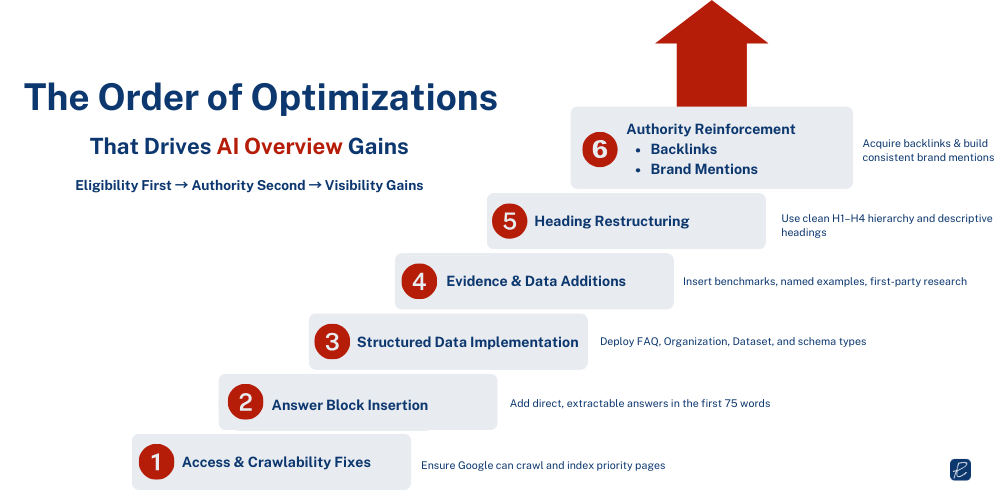
When onboarding a client, we sequence optimizations by citation impact:
- Access and crawlability fixes
- Answer block insertion
- Structured data implementation
- Evidence and data additions
- Heading restructuring
- Authority reinforcement
This order consistently produces the fastest AIO visibility gains because it fixes eligibility before authority expansion.
Our goal for every client is to integrate you into a unified visibility strategy where improvements in one channel compound benefits in the other.
This order consistently produces the fastest AIO visibility gains because it fixes eligibility before authority expansion.
Our goal for every client is to integrate you into a unified visibility strategy where improvements in one channel compound benefits in the other.






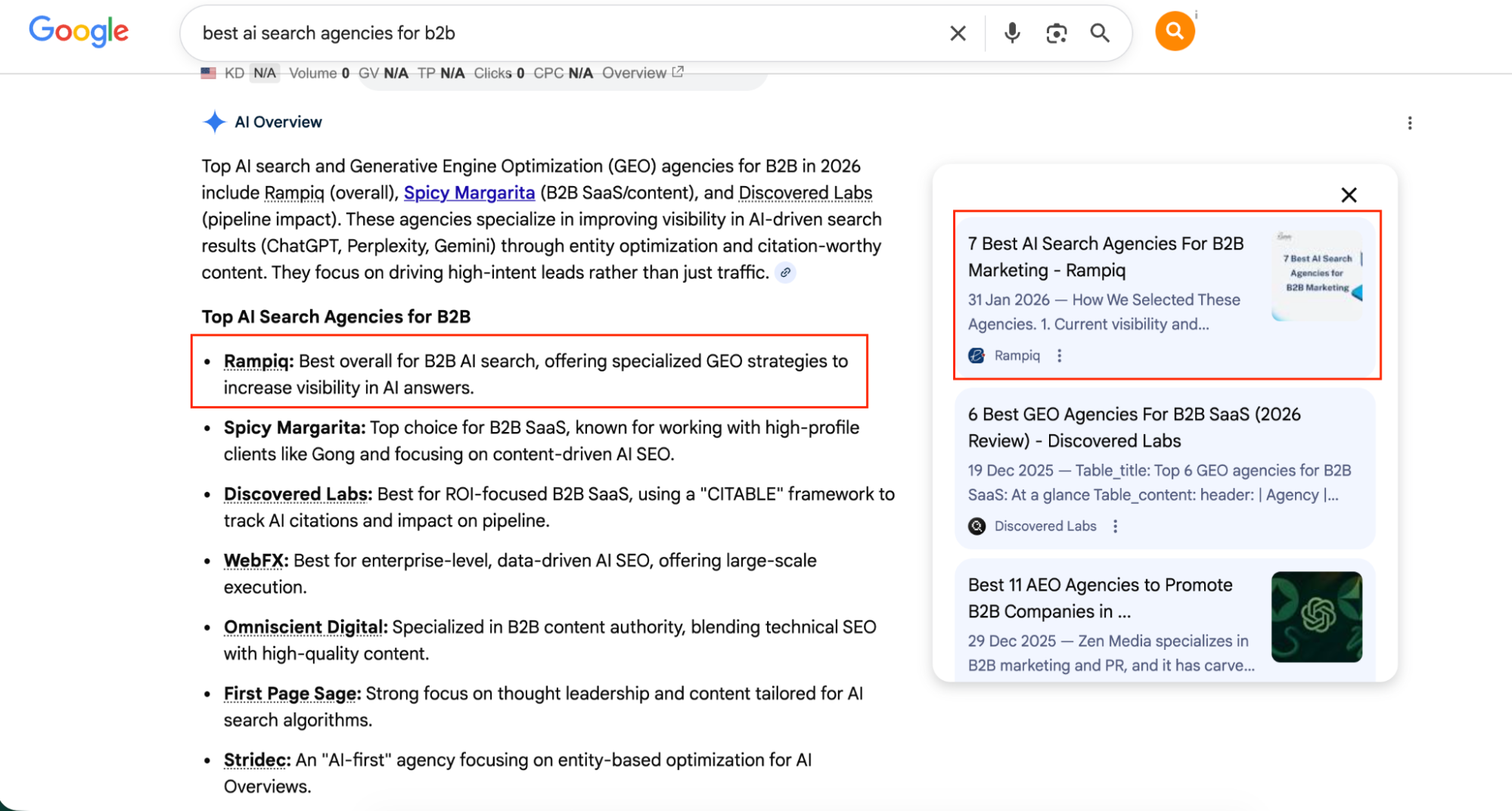 Google aims to keep users on its platform, and with AIOs, searchers don’t have to click through several links to find information.