What are ‘brand mentions’ in AI search?
A brand mention in AI search is any reference to your company in a generated AI response named, implied, or contextually associated, regardless of whether a link or citation is included.
When a potential buyer asks ChatGPT for product recommendations, the response might name three vendors, describe their positioning, and recommend one for a specific use case. Every reference in that response is a brand mention. Some will include source links; most won’t. All of them carry weight. Here’s a distinction between brand mentions and other appearances inside AI responses
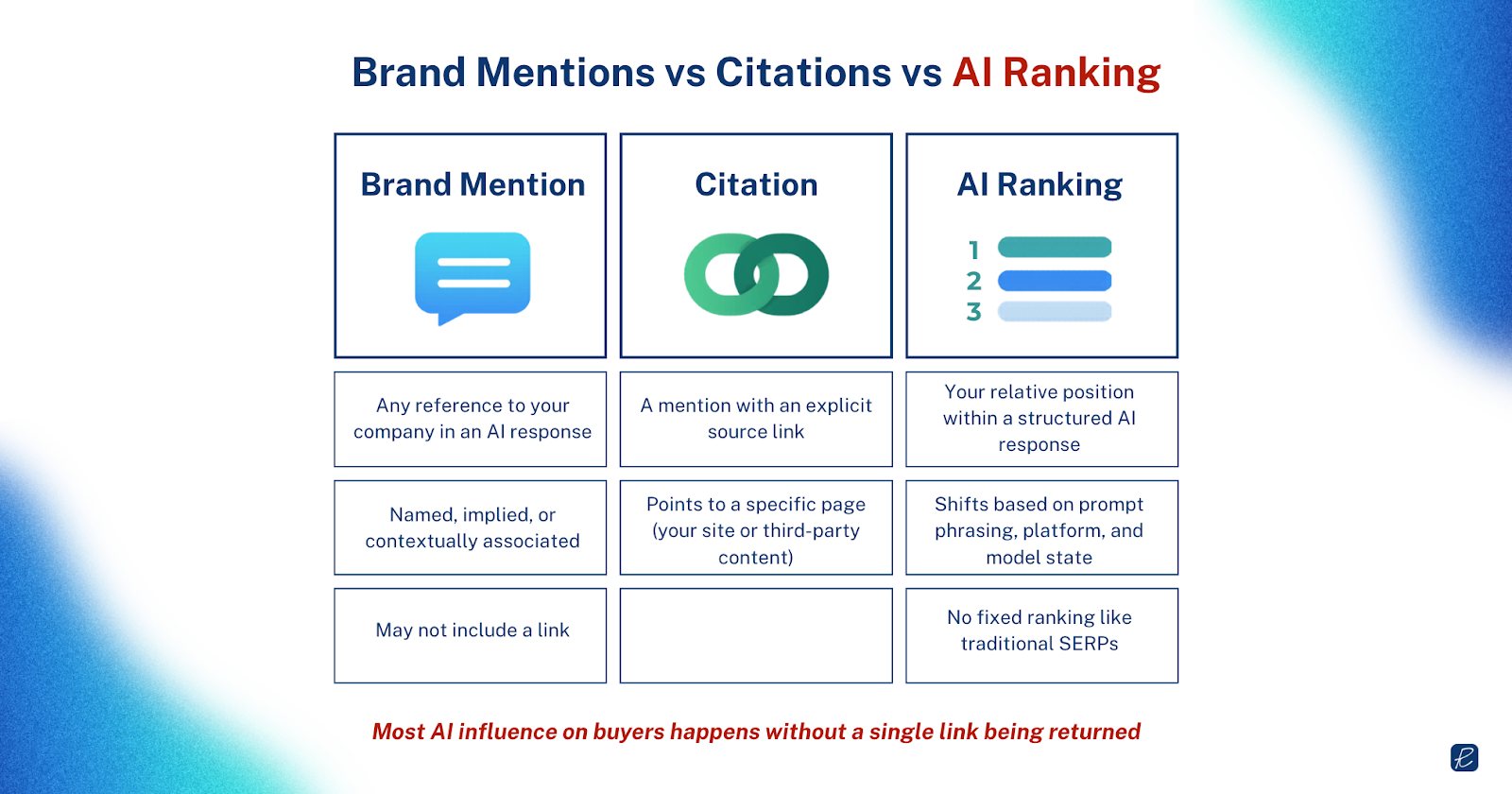
Brand mention: any linked or unlinked reference to your company in an AI response, whether named explicitly, implied, or contextually associated with your category.
Citation: a mention that includes an explicit source link back to a specific page: your website, a piece of content, or a third-party article that references you.
AI ranking: your relative position within a structured AI response. Unlike traditional SERP positions, there’s no fixed rank data to query. Position shifts with prompt phrasing, platform, and the model’s current training state.
Monitoring brand mentions is harder and more important than tracking citations alone, because most AI influence on buyers happens without a single link being returned. If you’re not tracking mentions, you’re missing the majority of how AI systems influence vendor selection.
Read our GEO glossary to understand common terminology associated with AI visibility optimization.
Why you should monitor brand mentions in AI search results
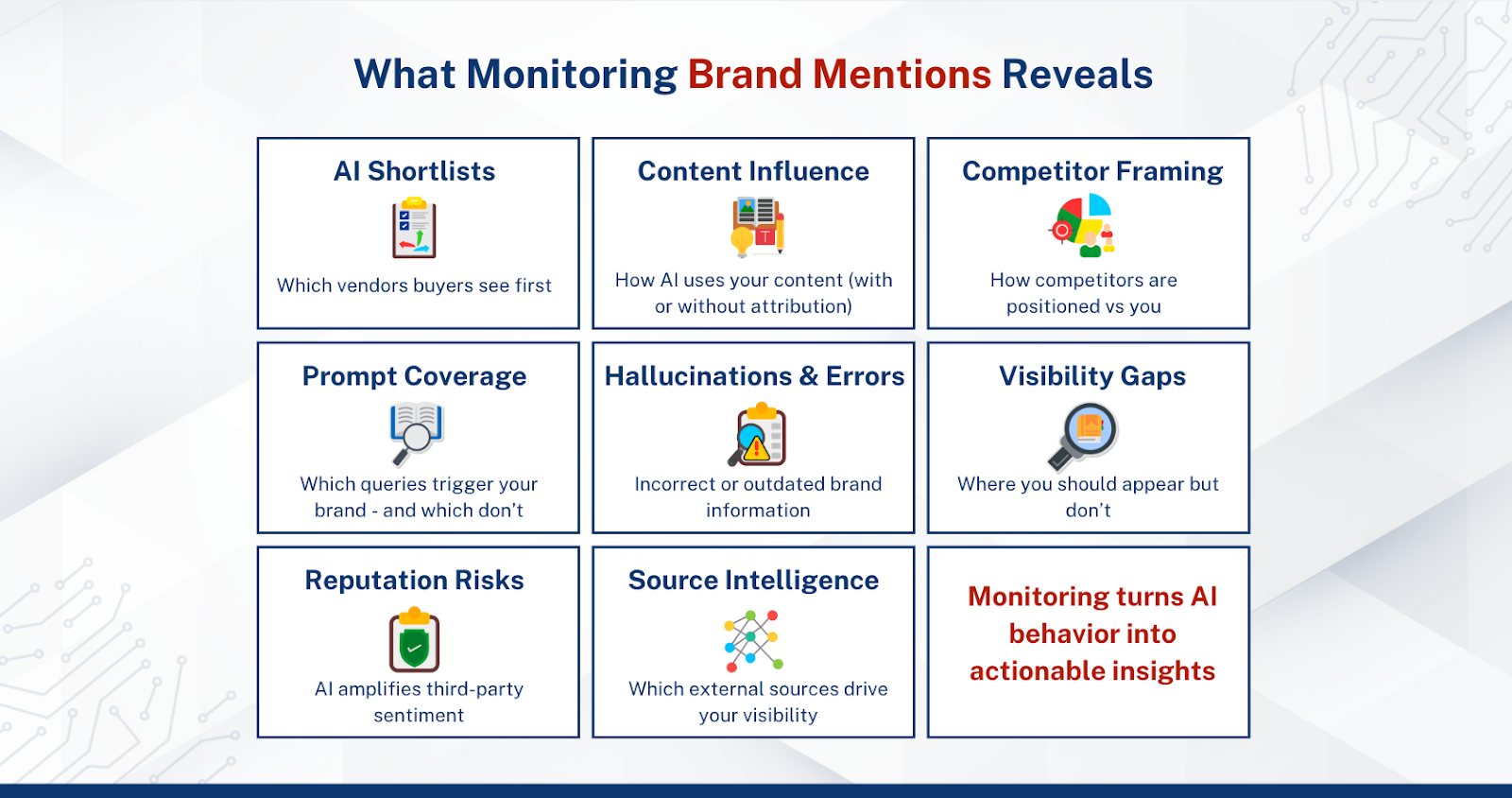
Monitoring brand mentions in AI search gives you direct intelligence on how AI systems are influencing your pipeline before, during, and after buyer research. Here’s what it surfaces specifically.
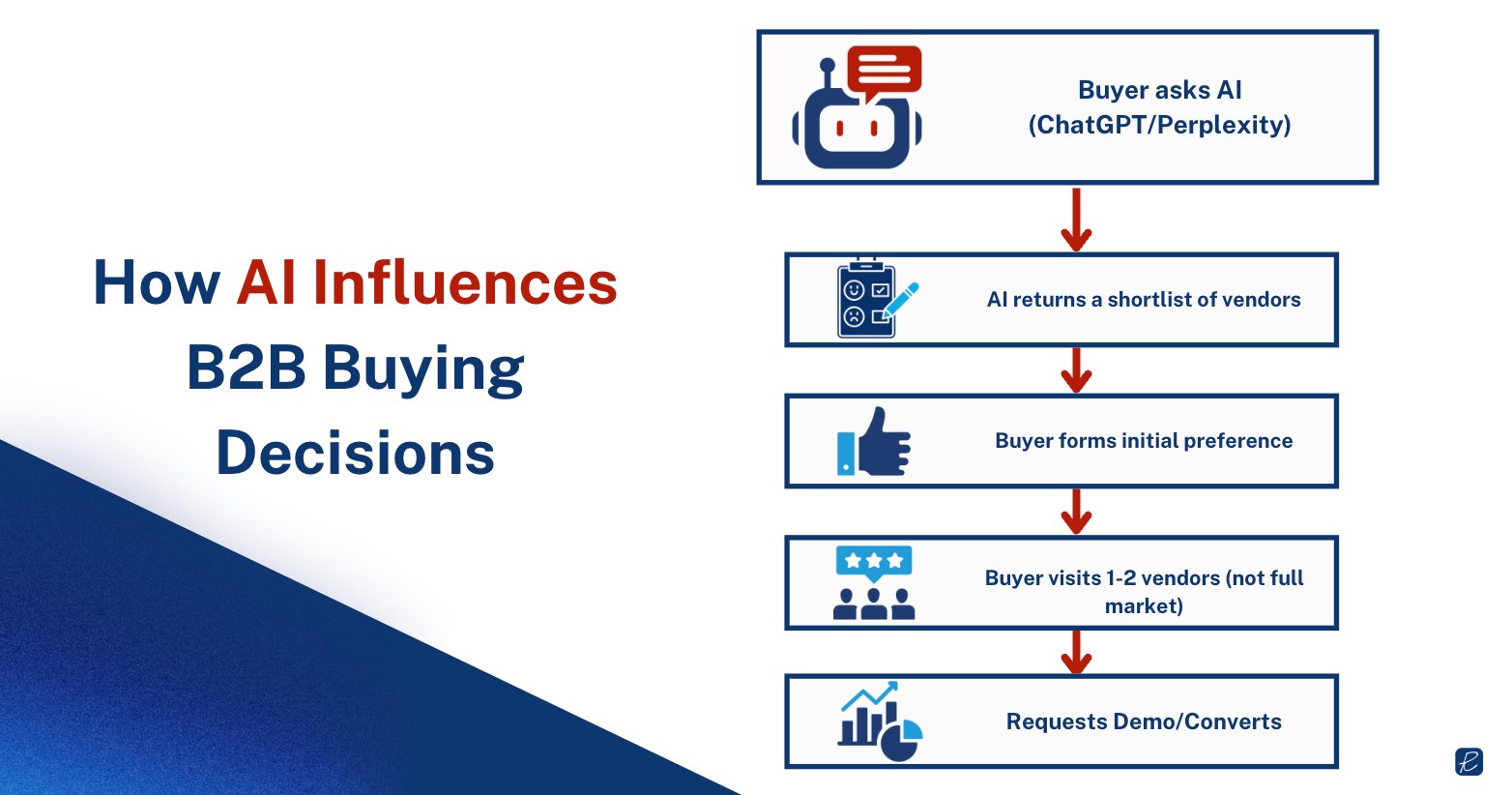
Understand how AI shortlists buyers see before reaching your website
B2B buyers are running vendor research queries in ChatGPT and Perplexity before they hit your website, and the shortlist AI returns are shaping their consideration set. By the time a prospect fills out a form or requests a demo, they may already have a preferred vendor, most likely the one their AI platform recommended in a response you’ve never seen.
Understand how your content influences decisions when AI answers don’t
Most AI responses don’t link back to sources, but the responses are still built on content – yours, your competitors’, and third parties’. Monitoring lets you identify sources where AI systems are drawing on your positioning and whether the output accurately reflects what you actually do.
This is where content structure and clarity directly influence how your brand is represented in AI-generated answers.
Identify competitors AI systems favor and how they’re framed in buying contexts
AI shows buyers a competitive frame you didn’t set. Knowing which competitors appear alongside particular use cases, and how they’re framed relative to you, is competitive intelligence your traditional SEO tools won’t give you. We regularly see cases where a competitor is consistently positioned as the “safe enterprise choice” or “best for SMBs” in AI responses – a framing that shapes how buyers evaluate the entire category.
These patterns are consistently visible across AI visibility audits and directly influence how categories are perceived.
Identify the prompts that trigger your brand versus those that trigger competitors
You don’t know which prompts you own until you start investigating. Some buying-intent queries will surface your brand. Others will surface a competitor who shouldn’t be in that conversation at all. Monitoring tells you which prompt categories you own and which you’re losing. This becomes the foundation of any GEO strategy worth building.
This prompt-level visibility is a core input into how we structure AI visibility program.
Detect missing, weak, incorrect, or hallucinated brand information
AI systems hallucinate. They can misattribute product features, describe your offer in outdated terms, or associate your brand with a market position you abandoned two years ago. We’ve seen AI responses confidently state a vendor’s pricing model that no longer exists, or frame a brand’s specialization around a service they’ve deprioritized. You cannot correct what you cannot see, and the correction window matters because AI-driven perceptions compound fast, as models evolve.
Highlight gaps in content or authority in AI
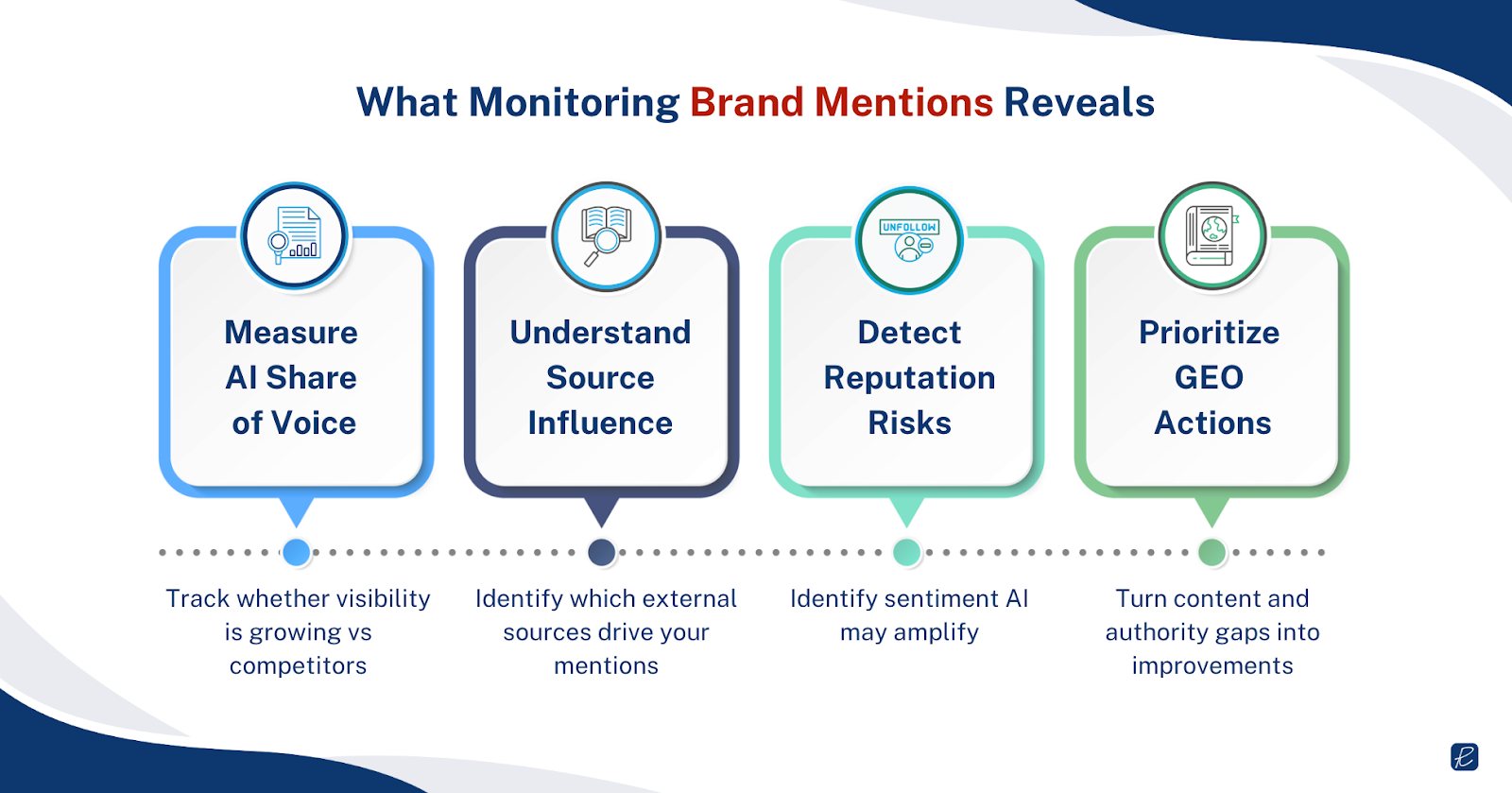
When AI systems ignore your brand in response to queries where you should be the obvious answer, that absence points to something specific: a content gap, an authority deficit, or a structured data problem that GEO can address. Monitoring turns those gaps from vague concerns into prioritized action items.
These gaps are typically identified and prioritized during AI visibility audits.
Identify and mitigate reputational risks since AI can amplify aggregated perceptions
AI aggregates opinions from across the web. If third-party sentiment about your brand skews negative in any of those sources, AI responses will reflect and amplify that perception at scale. Monitoring lets you catch reputation signals early, before they become the default narrative an AI repeats to every buyer who asks about your category.
Enable measuring AI share of voice and visibility changes over time
You can’t optimize what you don’t measure. Tracking brand mentions over time gives you the data to measure whether your GEO efforts are working; whether your AI share of voice is growing relative to competitors, holding steady, or declining.
This is how AI visibility becomes a measurable, optimizable channel rather than an assumption.
Understand which third-party sources are driving your AI visibility
AI models synthesize third-party content. Monitoring gives you insight into which external sources are driving your mentions and which are suppressing them. That intelligence tells you exactly where to concentrate authority-building and PR efforts to move the needle in AI search.
Conclusion
Monitoring is the starting point. It tells you what buyers are seeing, where you’re visible, where you’re absent, and what needs to change, and you can use AI visibility tracking tools like Amadora AI to set up your tracking systems.
At Rampiq, we help clients map exactly what AI platforms say about their brands across both their training memory and live augmented search, so you know what they’re working with before we build a GEO strategy on top of it.
The brands that will win in AI search are the ones that start treating it as a measurable channel now, not after the buying patterns are fully established.