What To Expect From GEO Services
First, to clarify, GEO is not a tactic. This is a framework for influencing how AI systems understand and represent your company.
GEO focuses on improving how AI systems:
- interpret your brand
- explain your product category
- compare your offering with alternatives
- cite your expertise
- recommend your company within answers
The objective changes from only search engine rankings. It now includes how knowledge about your company exists inside AI-generated explanations. This distinction is subtle but important.
Unlike traditional search engines that mostly rank pages, LLMs synthesize information from multiple sources when generating answers. As a result, visibility depends on a network of signals rather than a single page’s ranking strength.
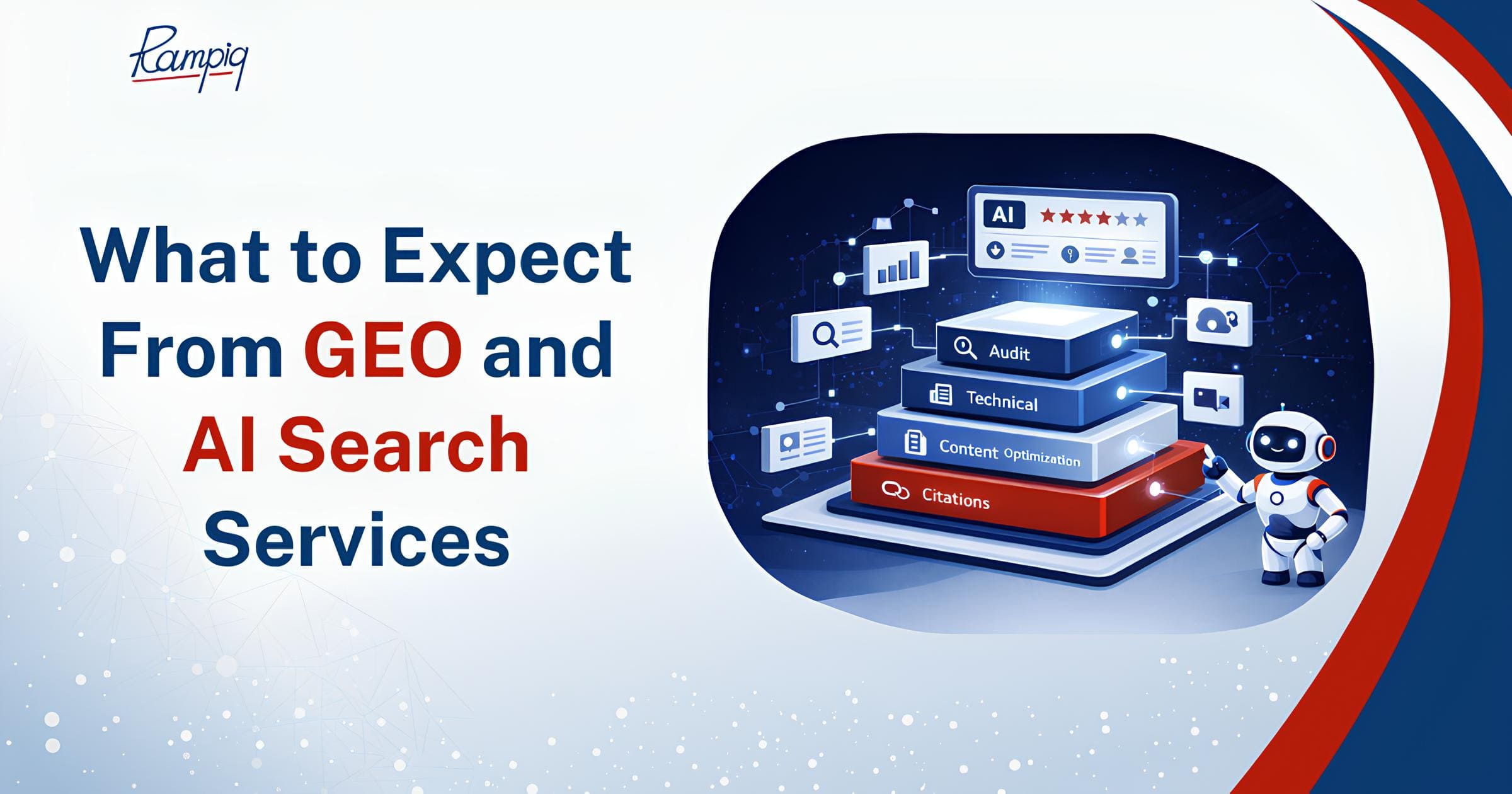
While implementations vary between agencies, mature GEO programs usually revolve around five core pillars. At Rampiq, these pillars form the foundation of the AI Visibility Optimization framework we run with B2B clients. 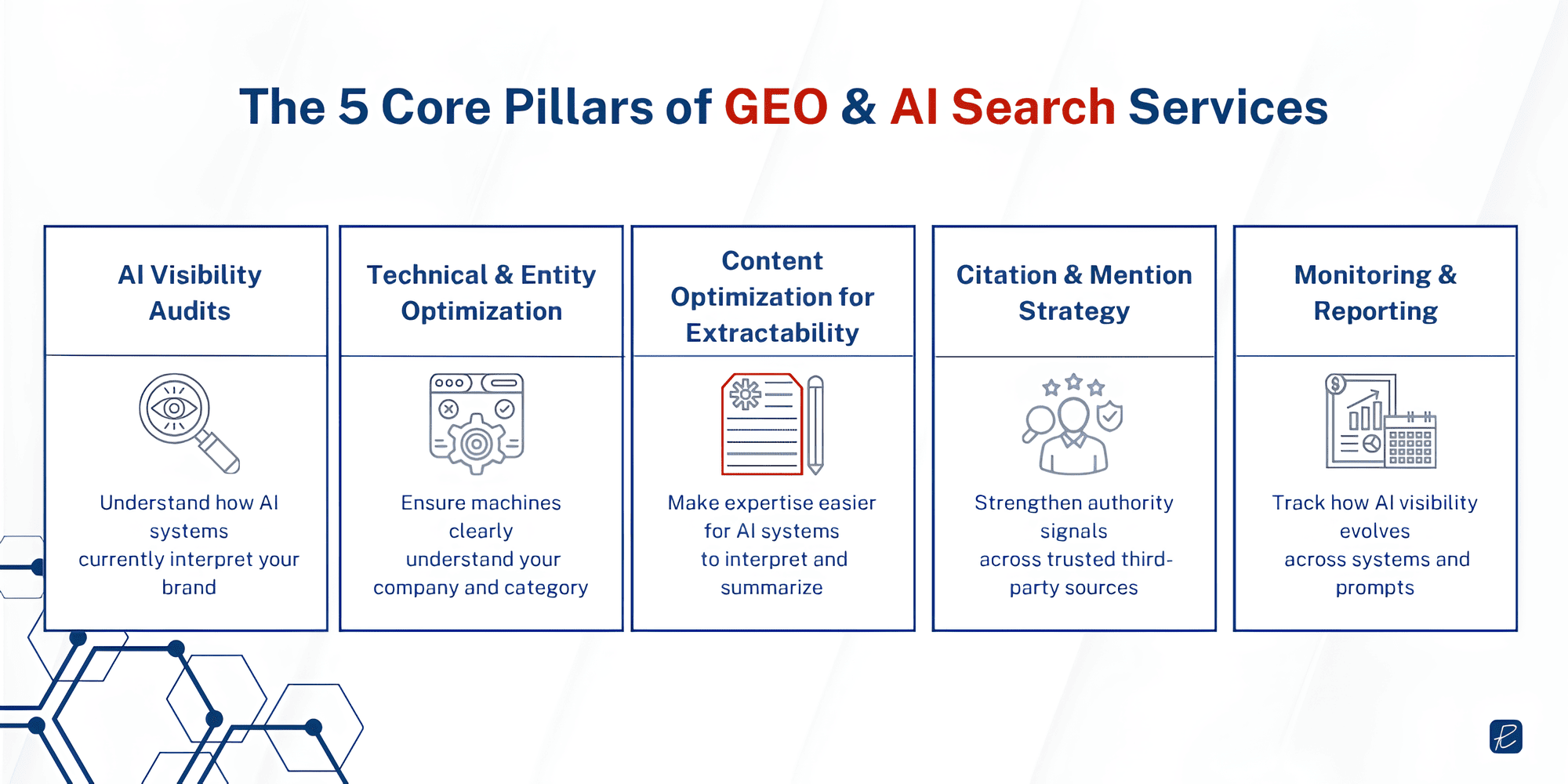
- AI Visibility Audits: Understanding how LLMs currently interpret your brand.
- Technical and Entity Optimization: Ensuring machines clearly understand who you are and what you offer.
- Content Optimization for Extractability: Making expertise easier for AI systems to interpret and summarize.
- Citation and Mention Strategies: Strengthening authority signals across trusted sources.
- Monitoring and Reporting: Tracking how visibility evolves across AI systems with tools like Amadora AI.
These pillars work together to influence how AI systems interpret your category and decide which companies appear in answers.
1. The Audit Phase
Every serious GEO engagement begins with an audit. This stage reveals how AI systems currently interpret your company and how often your brand appears in AI-generated answers. That interpretation is often different from how internal teams believe their brand is positioned.
AI models synthesize information from a wide network of sources:
- your website
- competitor sites
- reviews
- directories
- forums
- press mentions
- industry publications
If those signals are inconsistent or incomplete, AI answers will reflect that confusion. An AI search audit surfaces those inconsistencies and maps the environment your brand exists within.
What a GEO Audit Examines
A thorough audit typically includes several layers of analysis.

AI Prompt Visibility
We test a wide library of prompts across tools like:
- ChatGPT
- Google AI Overviews
- Google AI Mode
- Perplexity
- Gemini
- Claude
These prompts simulate real buyer research questions. Examples might include:
- “Best [category] platform for [use case]”
- “Top tools for [problem your product solves]”
- “[Your product] vs [competitor] comparison”
The goal is to understand when your brand appears, how it is described, where answers are sourced, and which competitors dominate recommendations.
For a deeper look at how AI systems interpret brand information, see our guide “What ChatGPT Knows About Your Brand”.
Citation Source Analysis
AI systems often pull information from recurring authority sources. Audits examine which platforms influence answers most heavily within your category. These might include:
- review platforms
- industry publications
- technical documentation hubs
- comparison sites
Understanding this ecosystem helps identify where competitors are building authority signals that influence AI answers.
Positioning Accuracy
One of the most revealing parts of an audit is evaluating how AI systems describe your company. Common issues include:
- outdated product information
- simplified or incorrect category definitions
- missing differentiators
- competitor confusion
These issues can significantly affect how prospects perceive your company before they ever visit your website.
Content Extractability
AI systems tend to favor content that clearly explains ideas. Audits evaluate whether your site provides:
- structured explanations
- clear definitions
- concise summaries of complex ideas
- well-organized topical coverage
Even excellent content can be difficult for AI systems to interpret if its structure isn’t clear.
We explore this topic further in our guide on optimizing content for AI Overviews and AI answers.
Authority Signal Evaluation
The audit also examines how widely your brand appears across credible sources.
If competitors dominate industry publications, review platforms, and directories, AI systems often reflect that dominance.
A strong GEO audit produces clear findings and defined priorities for improving AI visibility. Without that roadmap, GEO efforts risk becoming scattered experiments.
2. Technical & Entity Optimization
Once the audit reveals how AI systems interpret your brand, we move into technical and semantic optimization. This work focuses on strengthening the signals that help machines understand your company.
Search engines increasingly operate on entity understanding rather than simple keyword matching. An entity represents a distinct concept such as:
- a company
- a product
- a technology
- a category
When AI systems understand how these entities relate to each other, they produce more accurate explanations. When those relationships are unclear, AI answers become vague or misleading.
From our experience auditing AI visibility across B2B brands, entity clarity is one of the most common issues we identify. Inconsistent descriptions across websites, directories, and external sources often prevent AI systems from correctly interpreting products or including brands in relevant answers.
What Entity Optimization Involves
Entity optimization typically includes several technical and semantic activities.
Schema and Structured Data Improvements
Schema markup helps machines understand the structure of information on a page. For example:
- product entities
- organization details
- FAQs
- knowledge relationships
While schema alone does not guarantee visibility, it strengthens the clarity of machine-readable signals. Structured data provides explicit signals that help search engines and AI systems interpret relationships between entities such as companies, products, and categories.
Terminology Alignment
Many companies use inconsistent language across their site. A product may be described differently on product pages, documentation, blog articles, and partner listings.
These inconsistencies confuse both search engines and AI systems. Entity optimization aligns terminology across these sources.
In many AI visibility audits we run, inconsistent terminology is one of the main reasons AI systems struggle to accurately describe a product category or position a company within it.
Conceptual Relationship Mapping
Complex products often involve multiple related concepts. For example product features, use cases, integrations, and industry applications. Optimization clarifies how these ideas relate to each other so machines can interpret the bigger picture.
External Signal Consistency
Entity clarity doesn’t exist only on your website. External platforms must also reflect consistent information. This includes company descriptions, product summaries, and even industry classifications.
Inconsistent listings across platforms often cause AI systems to misinterpret your positioning. External sources frequently act as reference points for AI-generated answers, which makes consistency across these platforms particularly important.
When entity optimization is successful, several outcomes become noticeable:
- AI systems describe your product category accurately
- comparisons between competitors become clearer
- your brand appears in more relevant AI answers
These improvements rarely happen instantly, but they tend to compound over time. This workstream directly influences whether your brand is accurately interpreted and included in AI-generated answers.
3. Content Optimization for AI Visibility
If technical and entity optimization ensures machines understand what your company is, content optimization ensures they understand what you know.
Many companies assume that because they have a large content library, AI systems will automatically treat them as authoritative sources. From our experience running the AI Visibility Optimization program for 30+ B2B companies, this assumption often proves incorrect.
Large content libraries can still be difficult for AI systems to interpret if the information inside them is scattered, unlinked, inconsistent, or overly written for human narrative rather than structured understanding.
Content optimization for AI visibility, therefore, focuses on making knowledge easier for machines to extract, synthesize, and reuse. In practice, the issue is rarely content volume. Expertise usually already exists, but it is structured in ways that AI systems struggle to interpret and reference.
LLMs prefer content that has certain characteristics:
- clear conceptual explanations
- authoritative tone
- structured information
- consistent terminology
- concise summaries of complex topics
When content has these qualities, it becomes easier for AI systems to identify relevant passages and incorporate them into generated responses. Across the AI visibility programs we run, improving structure and clarity consistently has a greater impact on AI visibility than increasing content volume.
Why Traditional Blog Content Often Underperforms in AI Systems
Many marketing blogs were originally designed around search ranking patterns rather than knowledge clarity.
That often results in articles that:
- prioritize keyword placement
- include long introductions before delivering information
- bury definitions deep within paragraphs
- mix multiple ideas in the same section
These patterns are not inherently bad for SEO, but they can make it harder for AI systems to extract authoritative statements.
For example, an article might contain excellent expertise, but the information is distributed across paragraphs instead of presented as clear conceptual explanations.
When this happens, AI systems may rely on other sources that provide clearer structures.
What AI Search Agencies Typically Change in Content
Content optimization for AI visibility rarely means rewriting everything from scratch. Instead, agencies focus on improving how expertise is presented. Common improvements include:
Stronger Concept Definitions
Many AI answers rely on clear definitions. We optimize pages to explain what a concept is, why it exists, how it works, and when it should be used. These explanations help position your site as a reliable reference point.
Structured Knowledge Blocks
Information is often reorganized into structured sections such as conceptual explanations, comparisons, use case breakdowns, expert commentary, etc. This structure makes it easier for AI systems to isolate and reuse specific pieces of information.
Clear Terminology and Consistency
Companies sometimes use multiple phrases to describe the same concept. For example, a product might be described as:
- a platform
- a solution
- a framework
- a system
While this variety may sound natural to human readers, it can confuse AI systems attempting to categorize your offering. Optimization aligns terminology so machines consistently interpret your positioning.
Concise Summaries of Complex Ideas
Many B2B products solve complicated problems. While long explanations remain valuable, LLMs often prefer concise summaries that clearly describe key ideas.
A huge part of AI search optimization is adding short explanatory sections that distill complex topics into understandable statements.
If you want to see how this works in practice, we break it down further in our guide on optimizing content for AI Overviews and AI answers.
4. Citation & Mention Strategy
One of the most misunderstood aspects of GEO is the role of third-party mentions. Many teams assume AI systems simply pull answers from the highest-ranking websites.
In reality, generative systems often synthesize information from a network of trusted sources. That network may include industry publications, comparison platforms, knowledge bases, community discussions, review sites, and everywhere your ICP hangs out.
If your competitors appear more frequently across these sources, AI systems may rely on them more heavily when generating answers.
A citation strategy focuses on strengthening your presence within the knowledge ecosystem that AI systems rely on when explaining your category.
This means identifying which sources AI systems reference most often, where competitors are cited more frequently, and which platforms shape how your category is described. From there, we develop a plan to increase credible mentions across those sources. In practice, this means prioritizing the sources that influence AI-generated answers, rather than treating all mentions as equally valuable.
A mature strategy focuses on credibility rather than volume. Instead of pursuing large numbers of mentions, agencies prioritize placements in sources that shape category knowledge. These placements help ensure that when AI systems assemble information about your category, your brand appears within the trusted sources they draw from.
5. Tracking and Reporting
Measurement is one of the most challenging aspects of AI visibility. Unlike traditional SEO, where rankings and traffic provide clear metrics, AI discovery often occurs before a user ever visits your website.
A prospect may ask ChatGPT to compare vendors, receive a recommendation, and only later search for a brand name. This makes attribution more complex. However, meaningful indicators still exist.
Use tools like Amadora AI to track visibility score, mentions, and citations used in AI answers about your brand and offers.
What Can Be Tracked?
Several metrics can reveal how AI visibility is evolving.
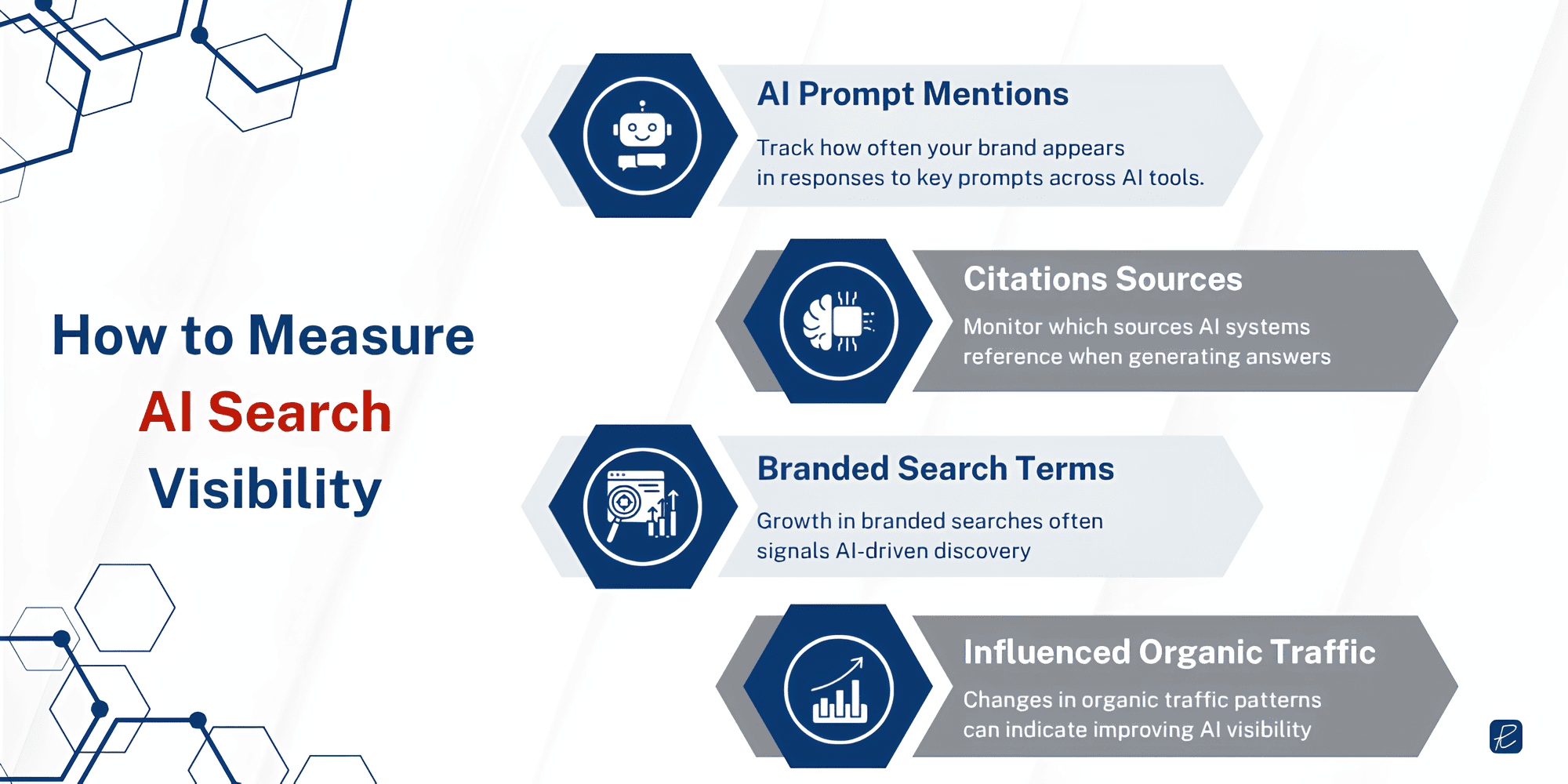
- AI Prompt Mentions: We track how often your brand appears in responses to key prompts across different AI tools. Over time, this helps reveal whether visibility is improving.
- Citation Sources: Monitoring which sources AI systems reference provides insight into where authority signals are strengthening.
- Branded Search Trends: When AI tools recommend a company, users often follow up with a branded search. Increases in branded search demand can therefore signal growing AI-driven discovery.
- Influenced Organic Traffic: Changes in organic traffic patterns, especially for MOFU queries, may reflect improvements in AI visibility.
What Cannot Be Measured Precisely?
Despite these indicators, some aspects of AI discovery remain difficult to quantify. For example:
- how many buyers researched your company inside AI tools
- how AI explanations shaped their perception
- the exact influence AI had on vendor selection
However, when multiple signals move together, they often provide strong evidence that visibility is improving.
What a Good Report Should Include
A strong GEO report combines technical observations with strategic interpretation. This means you should get:
- prompt-level visibility trends
- competitor comparisons
- citation source analysis
- traffic correlations
- recommendations for next optimization steps
Rather than presenting isolated metrics, reporting should show how visibility is shifting across prompts, competitors, and sources, and how those changes relate to pipeline influence.
How GEO Differs From Other Marketing Disciplines
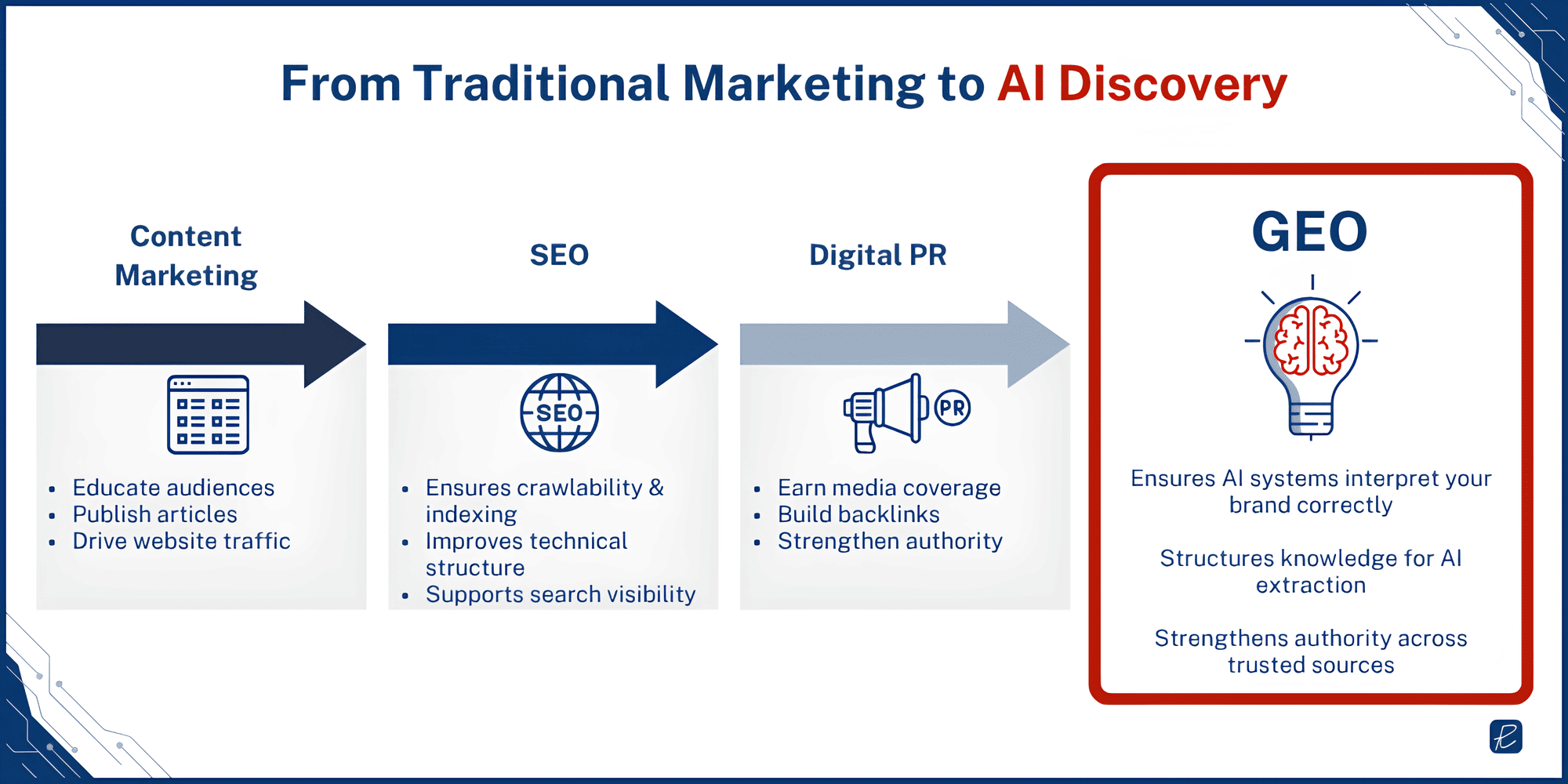
Because GEO touches multiple areas of marketing, teams often struggle to understand where it fits. The easiest way to think about it is as an alignment layer across existing disciplines.
GEO vs Content Marketing
Content marketing focuses on educating audiences and driving traffic. GEO focuses on ensuring that AI systems interpret and extract knowledge from that content correctly.
A company may publish excellent articles, yet still fail to appear in AI-generated explanations because the information structure isn’t machine-friendly.
GEO vs Technical SEO
Technical SEO ensures search engines can crawl and index a site efficiently. GEO goes further by ensuring AI systems understand entities and relationships within that content. This includes:
- product definitions
- use cases
- category positioning
- conceptual relationships
Without those signals, AI models may misinterpret or oversimplify your offering.
GEO vs Digital PR and Link Building
Digital PR and link building focus on earning coverage and dofollow backlinks. GEO focuses on building authoritative signals across the sources AI systems rely on when generating answers. That includes:
- trusted publications
- industry directories
- review platforms
- knowledge bases
One might argue that these are one and the same. But the difference is the objective. For GEO, it’s not about link equity alone, but credible presence within the knowledge ecosystem of your category.