Top AI visibility tools for optimization: At A Glance
Use this stack in three lanes, then connect them in reporting:
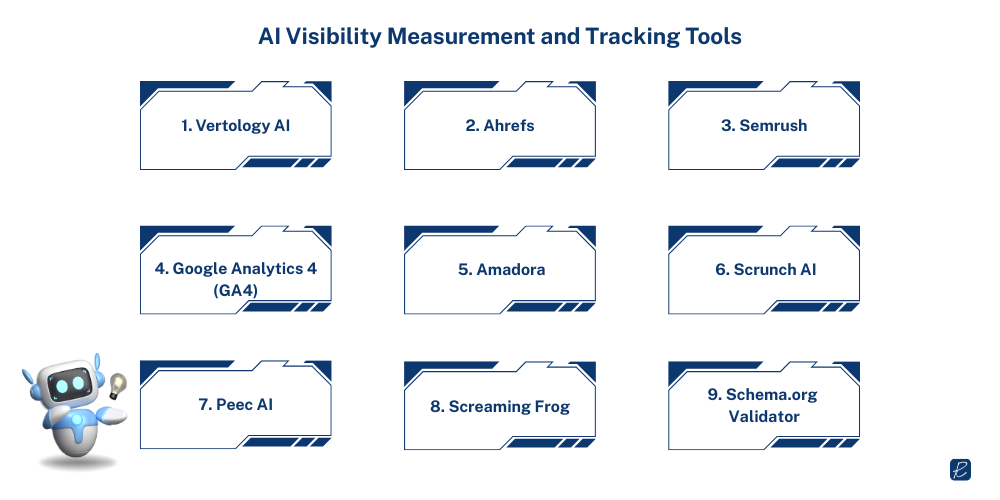
- AI visibility audits: Vertology for “what ChatGPT knows” diffs; Ahrefs for new AI mentions and competitor gaps; Semrush for prompt research and AI traffic trends.
- AI citation trackers & measurement: GA4 to quantify AI referrals and conversions; Scrunch to track prompt-level visibility and trusted sources; Amadora AI to trend share of voice and cited sources in responses.
- On-page AI visibility tools: Screaming Frog to find thin/duplicate templates, weak linking, and missing schema; Schema.org Validator to confirm your structured data is clean and parseable.
Next, we’ll proceed to show when each AI visibility tool is important, what we look for in the data, and the specific actions we take after each pass.
AI Visibility Audit Tools
 These are the best AI search visibility tools to get insights on how large language models perceive and present your business in their search results. Some AI visibility tools for measurement also provide suggestions on how to optimize for performance in AI search features and chatbots.
1. Vertology AI
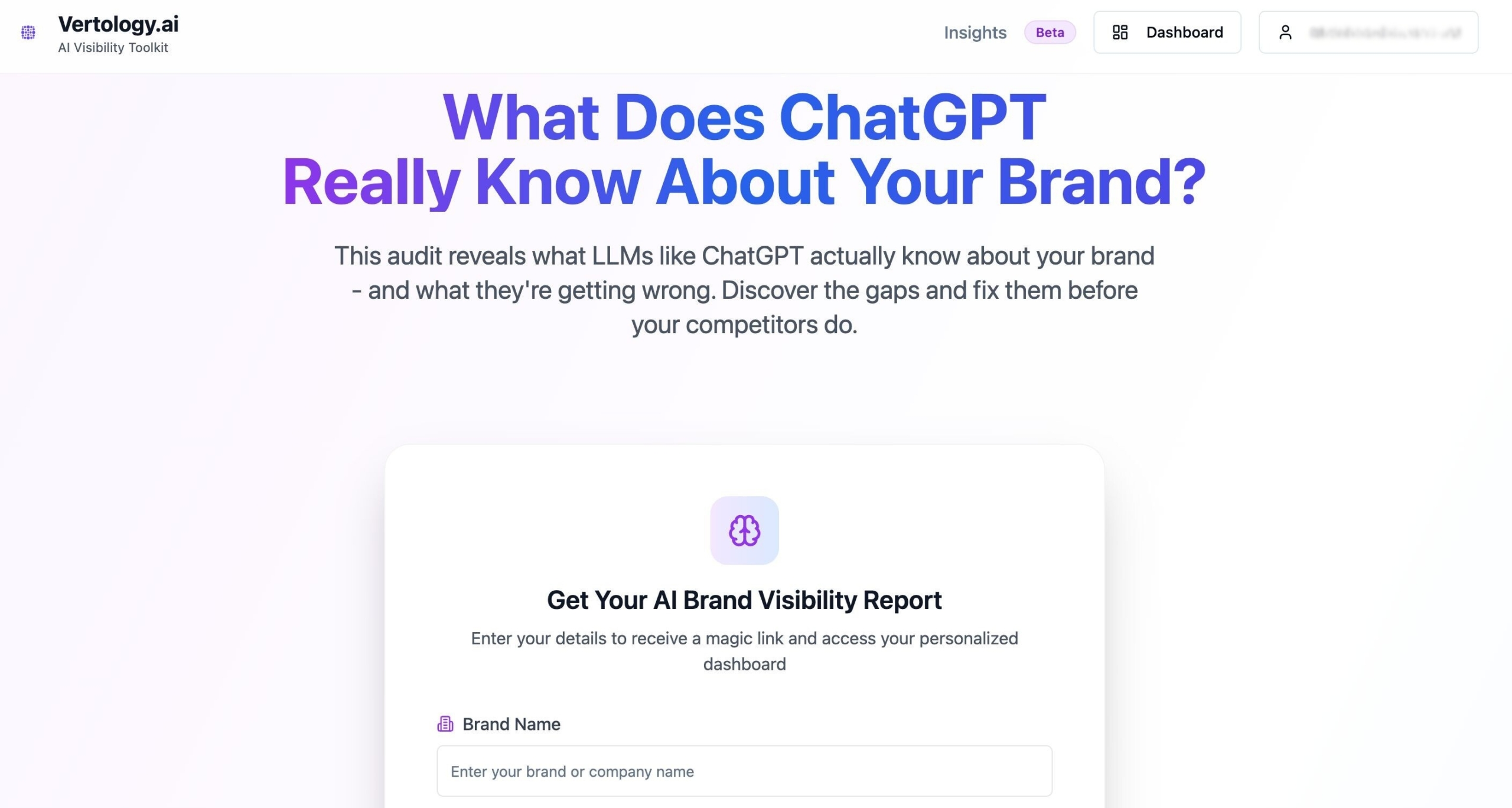 Vertology lets you see what ChatGPT actually knows about your company. Simply type in your website’s domain name, and voila! it displays both ChatGPT’s stored training data and its live data pulled directly from the web.
This is crucial because ChatGPT may only recognize part of your services. For example, you may have five offerings, but ChatGPT only lists three of them. Similarly, your product may not be recommended to users simply because ChatGPT does not have the information about some of your product’s features. With Vertology, you get to see those gaps clearly.
Searches today are very specific. A user might look for “an agency that built X using Y.” If ChatGPT doesn’t connect your expertise to that specific query, you’re left out of citations on its generated results.
Vertology is an LLM visibility tool that reports come with clear-cut next steps to help fix these gaps: rewrite some pages, include missing keywords, or construct citations. Its insights are designed to enable marketing and content teams to act immediately.
It also monitors your visibility against your competition so you can see how visible your brand is to LLMs. For a practical preview, watch our recent webinar, where we conducted live audits for various attending companies and immediately found high-impact actionable next steps.
To get the most out of Vertology, start with one product line. Run the “what ChatGPT knows” diff, fix gaps on 3 to 5 core pages, then re-run in two weeks to confirm changes took. If your team wants a walkthrough, book a short working session and we’ll map gaps to pages live.
To see how to audit what ChatGPT actually “knows” about your brand before fixing gaps, read our guide on this topic.
2. Ahrefs
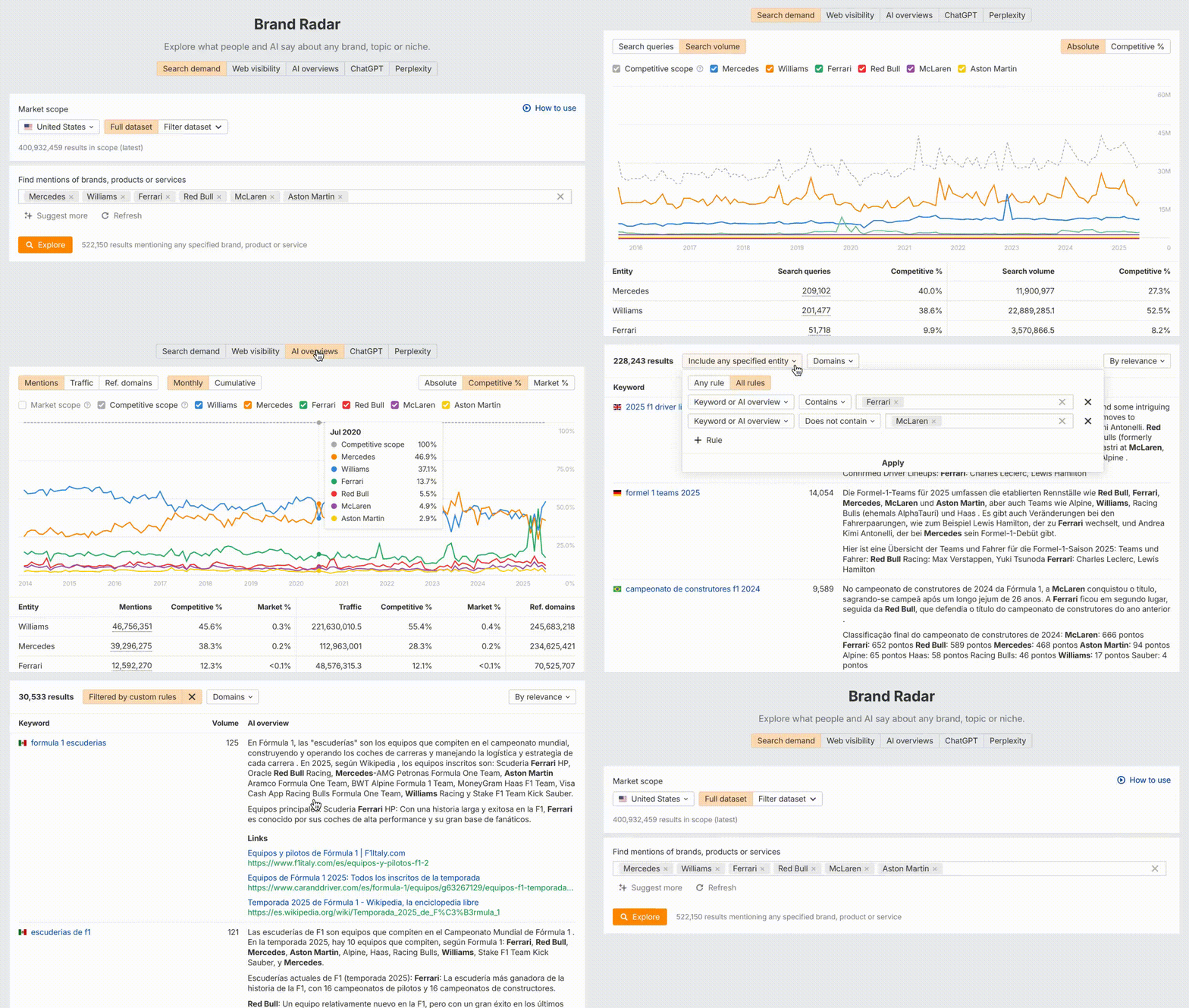 Ahrefs, the well-known SEO platform is also one of the best ai search visibility tools today. You may have noticed the Brand Radar feature recently popped up on your Ahrefs dashboard. This feature is an update on Ahrefs which helps with AI visibility measurements for your website.
Ahrefs Brand Radar is one of our audit tools for quickly spotting where LLMs are already mentioning you, and where competitors are winning instead. Brand Radar provides key AI visibility metrics like: brand mentions, impressions, competitive share, amongst others and has a huge prompt set, which makes competitive benchmarking and prompt-level monitoring possible without a custom crawl.
It features the typical advanced filters that let you focus on the exact metrics of interest. Our team uses Ahrefs’ Brand Radar to identify content gaps and for competitive analysis in AI search and platforms.
Note that you must upgrade your existing subscription to access the Brand Radar. This might be an issue for brands who simply want to try their feature to know if it is something they may want to include in their AI visibility toolkit.
To use Ahrefs as an AI visibility tool, filter for New AI mentions in the last 14-30 days, export the prompts/topics, and cross-check against your content inventory. Pages without a crisp answer block or source list go first in the queue.
3. Semrush
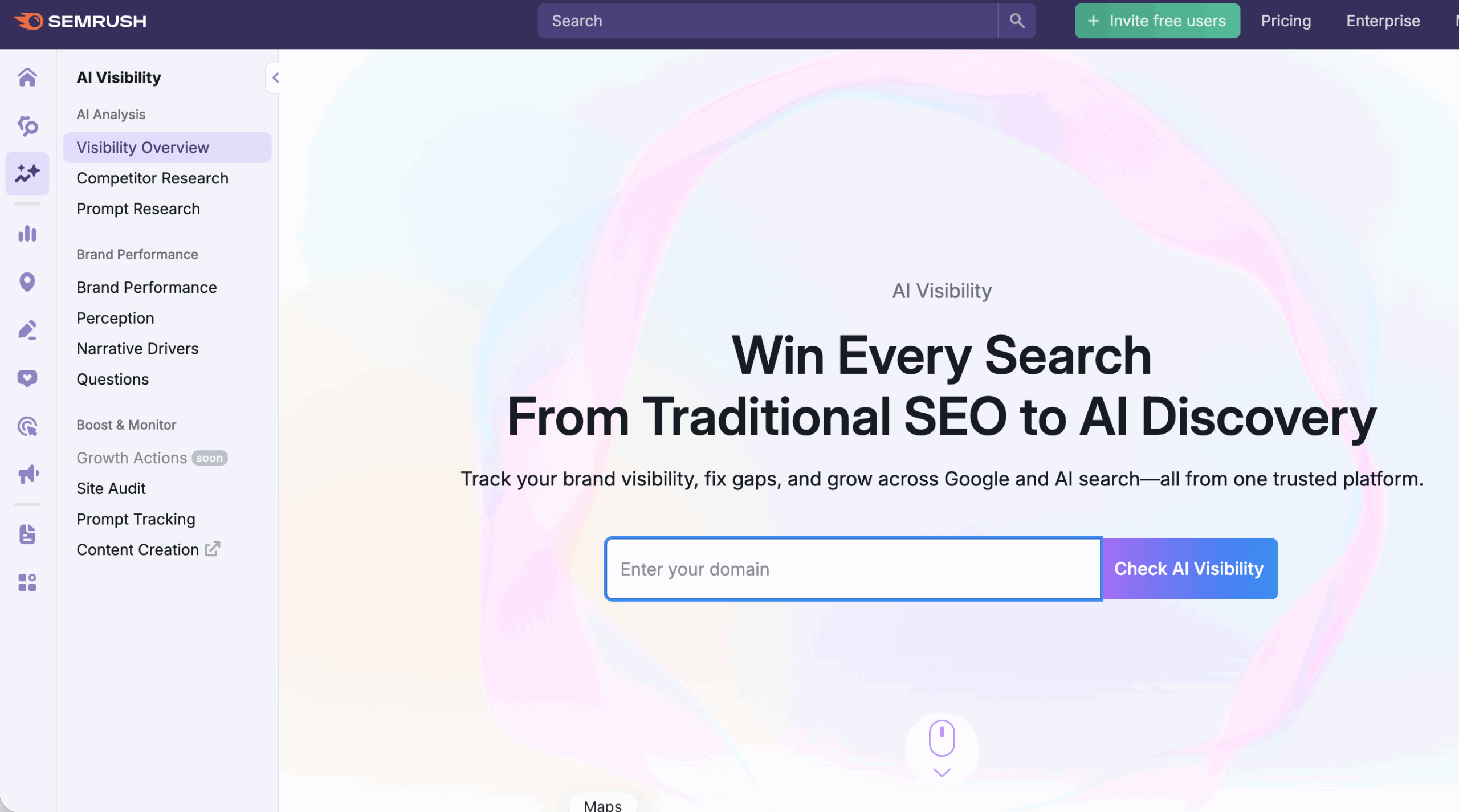 Semrush has been our most used SEO tool for years, and now the addition of AI visibility optimization tools make Semrush even more special. Semrush AI Traffic tool tracks visits from major AI sources, shows trend lines and top pages with AI visits, and benchmarks your AI traffic share against competitors.
Another new AI search visibility optimization tool is the AI SEO Toolkit. Within Semrush’s AI SEO Toolkit, use AI Visibility and Prompt Research to pull mentions, missing prompts, and competitors, then group those prompts into page briefs you can track over time in AI Traffic.
We especially like the Prompt Research feature, which reveals which prompts matter most and gives you ideas to create content that earns more AI mentions.
Another promising feature added to Semrush is the AI PR toolkit, which you can use to monitor your exposure on media frequently cited by LLMs, and locate journalists that you need to reach out to.
For a practical roadmap that turns these findings into page briefs and releases, use our AI visibility playbook for B2B marketers.
Vertology vs. Ahrefs vs. Semrush for LLM Visibility Audits
If you’re starting from zero, start with Vertology to fix perception gaps first, then use Ahrefs/Semrush to expand prompt coverage. Here is how they compare:
| Tool |
Best for |
What it shows you |
When to prioritize |
| Vertology |
Brand understanding audits |
“What ChatGPT knows” vs. your real offerings; missing attributes, services, and associations |
First tool to use when AI visibility is weak or misaligned |
| Ahrefs Brand Radar |
Competitive AI mention audits |
New AI mentions, co-citations, competitive share, prompt-level visibility across a big dataset |
When competitors are being cited more than you |
| Semrush AI SEO Toolkit / AI Traffic |
Prompt gap audits at scale |
Missing prompts, mention coverage, AI traffic trends, top AI-driven pages |
When you need structured prompt expansion and traffic trends |
AI Citation Trackers
These are the best AI brand visibility optimization tools that help us track where you’re cited in AI answers, measure prompt-level visibility, and tie AI exposure to real traffic and conversions.
4. Google Analytics 4 (GA4)
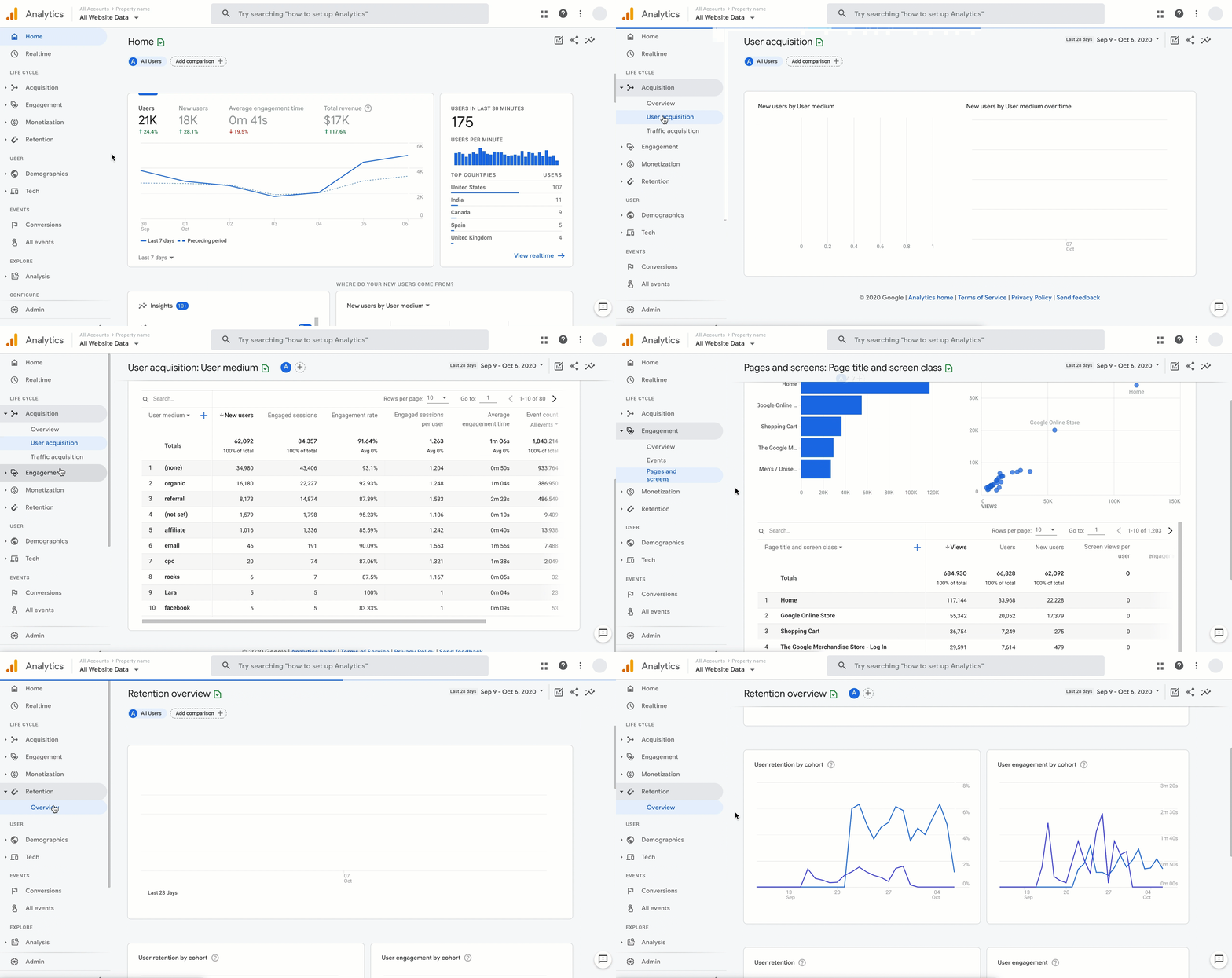 Google Analytics 4 (GA4) makes it easy to understand how visitors from AI tools interact with your site. You can spot AI traffic trends, see where AI referrals are coming from, and compare AI traffic to non-AI traffic.
GA4 will not give you every AI-specific metric, but it is a reliable way to see which pages AI assistants send traffic to, which assistants refer to it, and how those sessions convert. You would need to segment AI traffic, by selecting session sources manually or using a catch-all regex pattern, such as:
(chat\.openai\.com|chatgpt\.com|perplexity\.ai|you\.com|gemini\.google\.com|copilot\.microsoft\.com|phind\.com|search\.brave\.com|arc\.net)
You can also use GA4 as a data source in Looker Studio and create a calculated field that buckets Session source into AI vs Non-AI using the same regex above. We do this and update monthly as new AI referrers appear. Pairing this with conversion rate and assisted conversions keeps it business-relevant.
To verify, we may also build a second exploration filtered to Session medium contains referral and add Referrer as a secondary dimension. You should see rows like chatgpt.com / referral, perplexity.ai / referral, gemini.google.com / referral, or copilot.microsoft.com / referral. If not, review the regex and your site’s actual referral patterns before shipping dashboards.
If you want a step-by-step walkthrough to validate this setup and chart movement, see our AI visibility measurement guide for GA4.
5. Amadora.ai: AI Response Monitoring & Citation Analysis
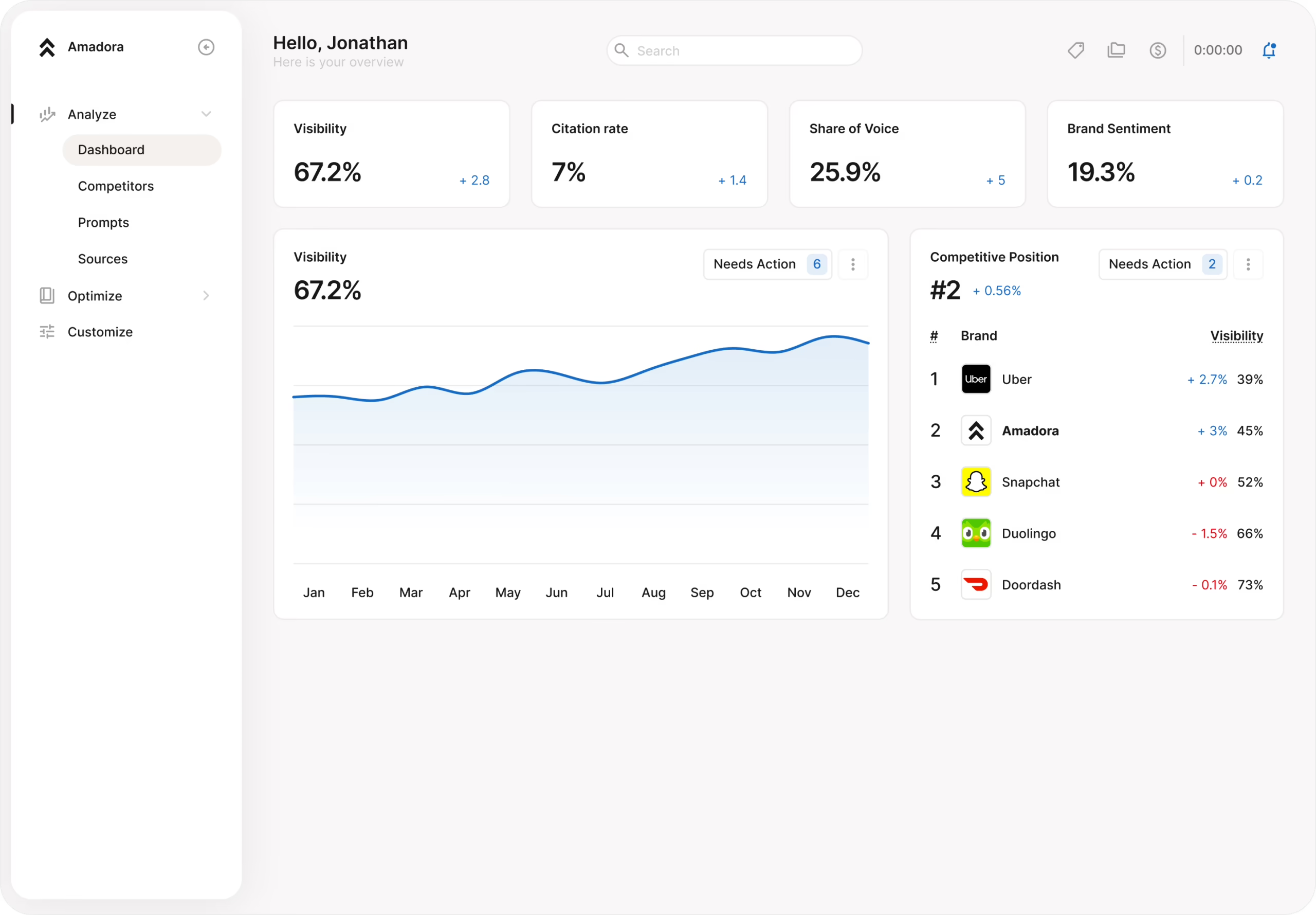
Amadora gives us another layer of context around prompt-level visibility and citation sources. Rather than showing only whether a brand appears in AI responses, Amadora systematically reverse-engineers live AI replies to reveal the actual URLs and domains that models rely on for a given prompt set.
We use Amadora when we need precision around how AI engines actually construct answers in your brand’s categories. Amadora shows us how brands are represented inside AI-generated responses. We run structured prompt sets across multiple AI systems and analyze the responses at scale. This helps us understand mainly:
- Responses where AI tools mention your brand, compared to competitors
- The average position of your brand in list-based AI responses
- Which competitors get visibility and for what prompts
- Which third-party domains are used as sources for responses
One of Amadora’s most valuable features is its ability to surface the source URLs behind AI answers. That allows us to reverse-engineer influence patterns. We identify which types of sources are shaping AI outputs in your niche. From there, we translate the data into strategy:
- Content refinement where AI comprehension is weak
- Authority building where competitor citations dominate
- Targeted PR or link acquisition toward repeatedly cited domains
- Prompt-cluster expansion to capture overlooked high-intent queries
Amadora is excellent for analyzing your current performance, find visibility gaps, and prioritizing the next actions that increase your likelihood to be mentioned or recommended in AI responses and search results.
6. Scrunch AI
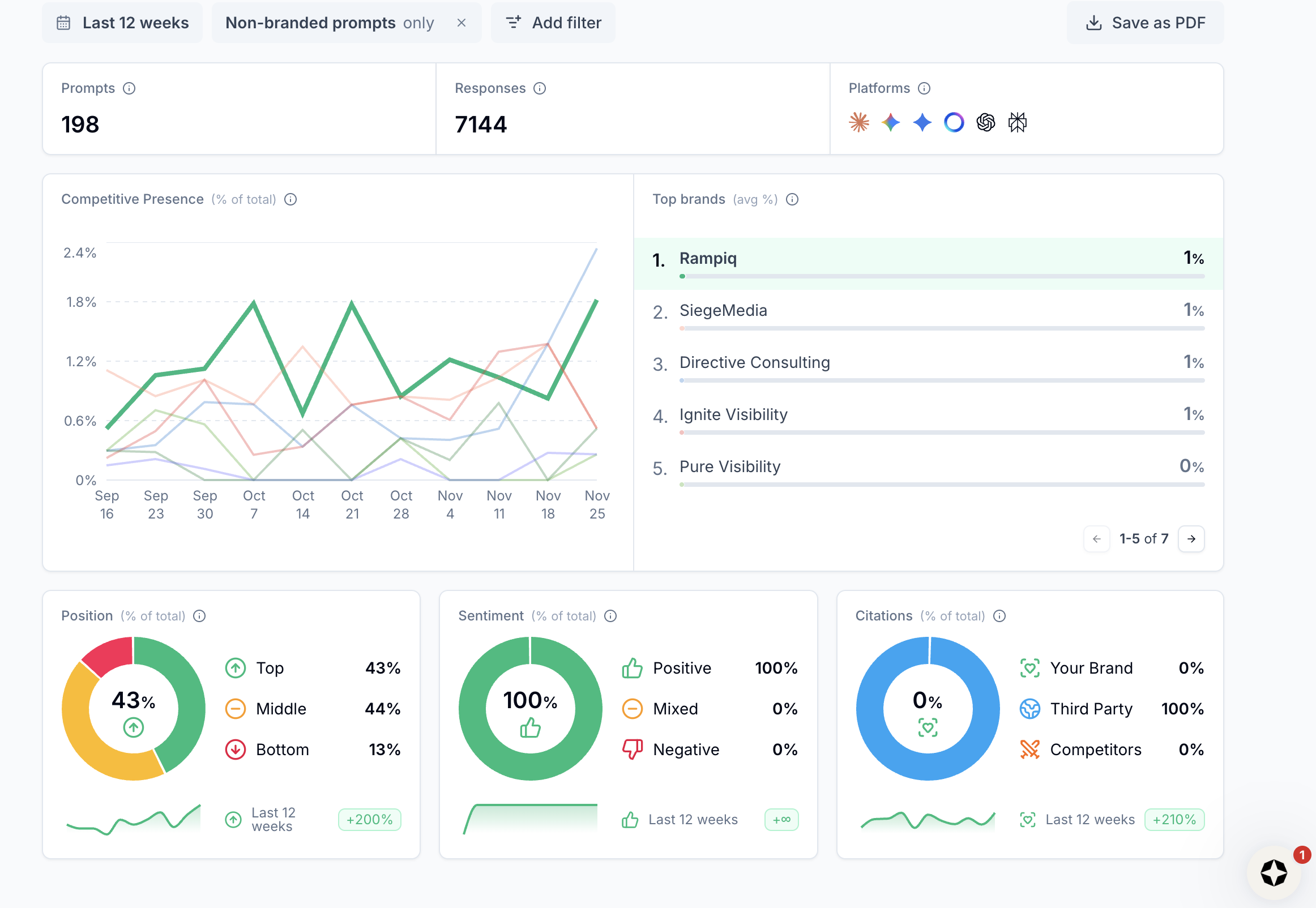 Scrunch is a GEO and AI search monitoring and optimization platform that shows how your brand actually appears across major AI assistants, then helps you close the gaps. It tracks prompts, citations, competitors, and AI bot traffic across ChatGPT, Perplexity, Claude, Meta AI, Gemini, and Google AI Overviews, with modules for Prompt Manager, Insights, Sources, and a reporting dashboard.
Once your domains and brands are connected, Scrunch’s Monitoring & Insights view gives you a prompt-level picture of where you’re visible, where you’re buried, and where you’re missing entirely. You can see brand presence, performance, and position across LLMs and slice it by competitor, persona, topic, or geo, plus trend lines over time.
This is the view you use for monthly “are we winning the right prompts?” reviews like money prompts, comparison prompts, and key use-case queries.
The Insights and Sources tabs are where Scrunch becomes actionable. Insights turns model behavior into plain-language recommendations (ex., which topics to expand, where to strengthen definitions, or which pages need clearer answer blocks), while Sources highlights the third-party sites LLMs lean on most often. Here is a workflow to follow:
- Use Prompt Manager to load core prompts per product/ICP (solution, comparison, “best X for Y,” and pain-point prompts).
- Let Scrunch collect data for a few weeks.
- In Insights, flag low-rank or missing prompts and map them to specific pages and answer blocks.
- In Sources, pull an outreach-ready list of outlets AI already trusts for your topic, then fold those into your digital PR plan.
Scrunch also monitors AI bot traffic, so you can see when and how AI crawlers hit your key pages and spot crawl errors before they turn into visibility issues.
For brands that want to go beyond measurement, the AXP (Agent Experience Platform) module lets you generate a parallel, AI-friendly version of your site so LLMs get a cleaner, structured view of your content without redesigning your public-facing pages.
Pricing at the time of writing starts at 300 USD/month for the Starter plan (3 users, hundreds of custom prompts plus industry prompts), with Growth, Pro, and Enterprise tiers adding more prompts, personas, page audits, and success support such as Slack access and strategy reviews.
For most B2B teams, Scrunch makes sense once you’ve validated that AI is already mentioning you (via GA4 plus an audit pass in Vertology or Ahrefs) and you’re ready for a proper operating rhythm: prompt sets defined, monthly reporting, and a clear backlog of on-page, PR, and AXP tasks tied directly to AI visibility gains.
7. Peec AI
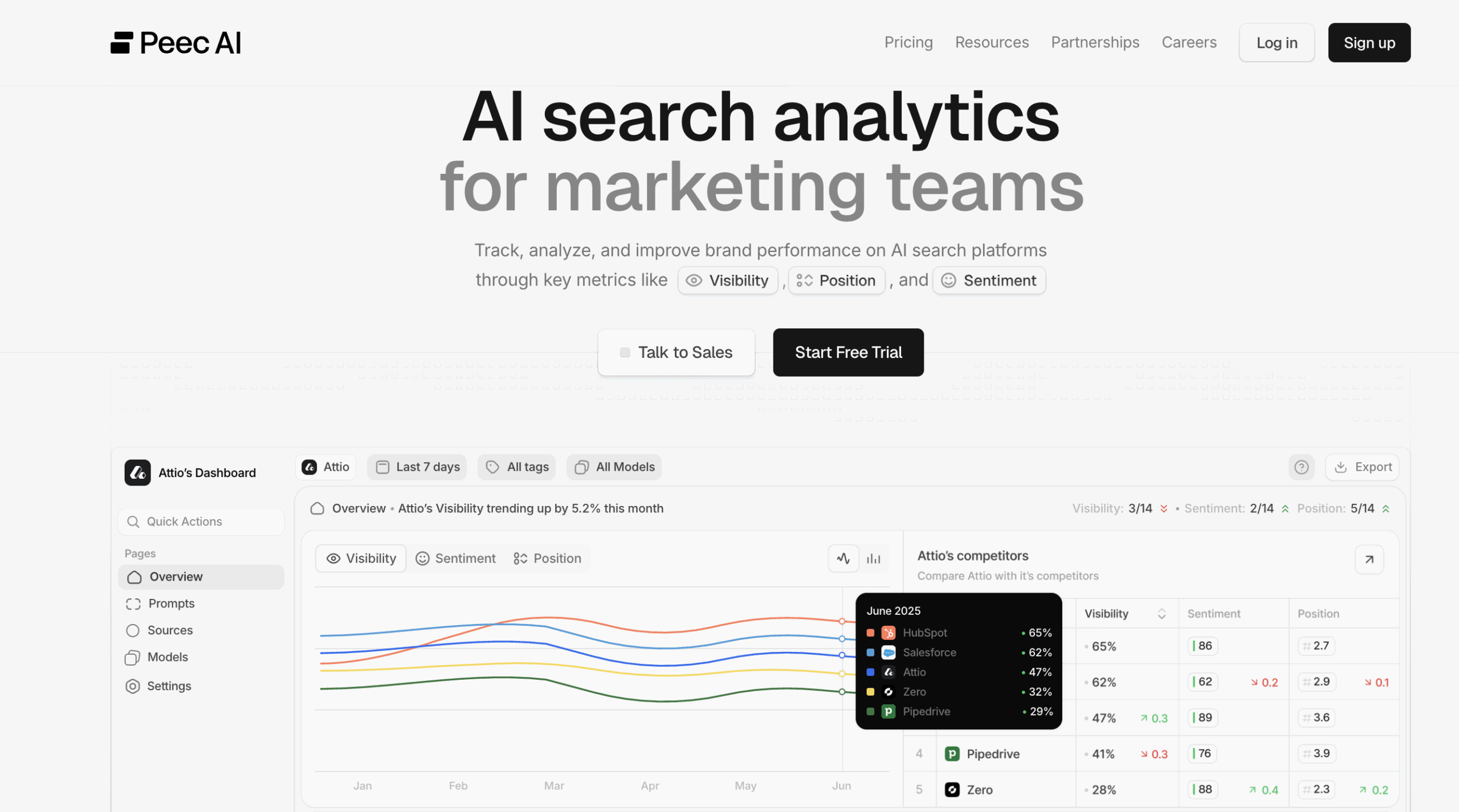 Peec AI promises to show you the prompts important for your goals and how your brand performs in the responses to these prompts. To track your brand’s AI visibility with Peec AI, you’ll first need to enter the information of your brand. Next, enter the keywords you care about, and then the tool will begin tracking your brand’s visibility, position, and sentiment on AI search surfaces.
If you are not sure of what prompt to be researching for AI visibility, Peec AI “Suggested” tab within the Dashboard feature can be used to create suitable prompt ideas based on your site keywords and topics. Yes, it’s that simple and straightforward.
Within the dashboard of Peec AI, you can toggle the tracking period from 7 days to any custom range. But it only begins from the date when you started using the tool and not from a previous date.
Peec AI is a solid tool, but not for every brand. Consider Peec AI if you are an established brand that already sees recurring LLM sightings and needs trendlines, sentiment, and competitive context.
However, if your brand is at a very early stage, then you may not gain much since there is little or no visibility for the tool to track. Start with GA4 AI segmentation and Scrunch, then layer Peec once you see repeat mentions.
Pricing at the time of writing starts at 104 USD per month, with higher tiers for larger prompt sets.
GA4 vs. Scrunch AI vs. Amadora vs. Peec AI for Tracking AI Citations
AI citation tracking turns AI visibility into something measurable. We use GA4 and Scrunch together because each covers a different layer: business impact, prompt-level citations, and long-term trend vs competitors.
| Tool |
Best for |
What it measures |
Where it fits in the workflow |
| GA4 |
Business impact measurement |
AI referral sessions, engagement, direct and assisted conversions |
Proves ROI and feeds dashboards/scorecards |
| Amadora |
Reverse-engineered AI citation source analysis |
URLs & domains that models cite, competitor citation gaps, geo splits |
Source-level diagnostics & tactical prioritization |
| Scrunch |
Prompt-level citation visibility |
Where you show up, rank, or miss across models; sources LLMs trust |
Monthly “are we winning money prompts?” reviews and backlog creation |
| Peec AI |
Trend and sentiment tracking |
Share of voice and sentiment over time vs competitors |
Used after repeat mentions exist to monitor posture long-term |
An important limitation to know is that these tools don’t discover the full universe of what people type into AI assistants. Prompts are long (often 20+ words), personal, and volatile, so demand discovery still relies on your ICP knowledge and manual prompt seeding.
What these tools do excel at is detecting citations, tracking prompt coverage, and measuring visibility across the topics you’ve decided matter.
On-page Tools for AI visibility
On-page optimization is about making pages answerable, citable, and verifiable for LLMs, without sacrificing human clarity. For on-page AI visibility optimization, most of the rules of traditional SEO remain, except that you have to surface and frontload the page’s most important information and details. If your pages are already of high SEO value, below are quick elements to drop into your priority pages:
- A plain-English definition of the problem and solution.
- A scannable process (numbered steps) and/or a comparison table.
- Inputs/requirements and edge cases called out explicitly.
- Timestamps or versioning for anything that changes.
- Source list (first-party docs, reputable third-party references).
- Minimal fluff; headings that mirror how the prompt is phrased.
If your team needs a deeper technical pass while you ship answer blocks, start with our technical SEO for SaaS checklist and tech SEO essentials resource.
That said, the same tools we use for on-page SEO apply to AI visibility optimization. Here are some of the key tools and how you can use them for your brand.
7. Screaming Frog
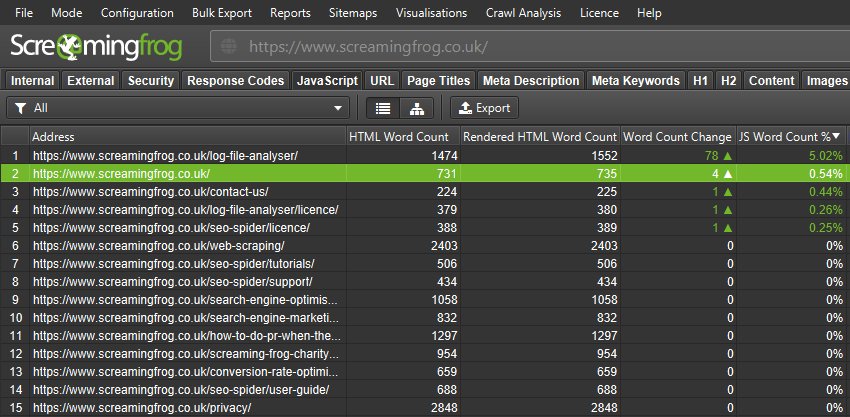 Screaming Frog is our go-to tool for technical SEO checks, but it also deserves a place in our AI visibility toolkit. Plug in GA4/GSC/PageSpeed (and link indexes where applicable) to spot thin/duplicate templates, weak internal linking, and missing schema. Export to CSV, push to Sheets, and visualize in Looker Studio.
Additionally, it’s helpful to tag “AI-target pages” and ensure each one has an answer block, schema, and at least one link from a top-linked hub, one from a related article, and one from a sibling product or use-case page.
8. Schema.org Validator
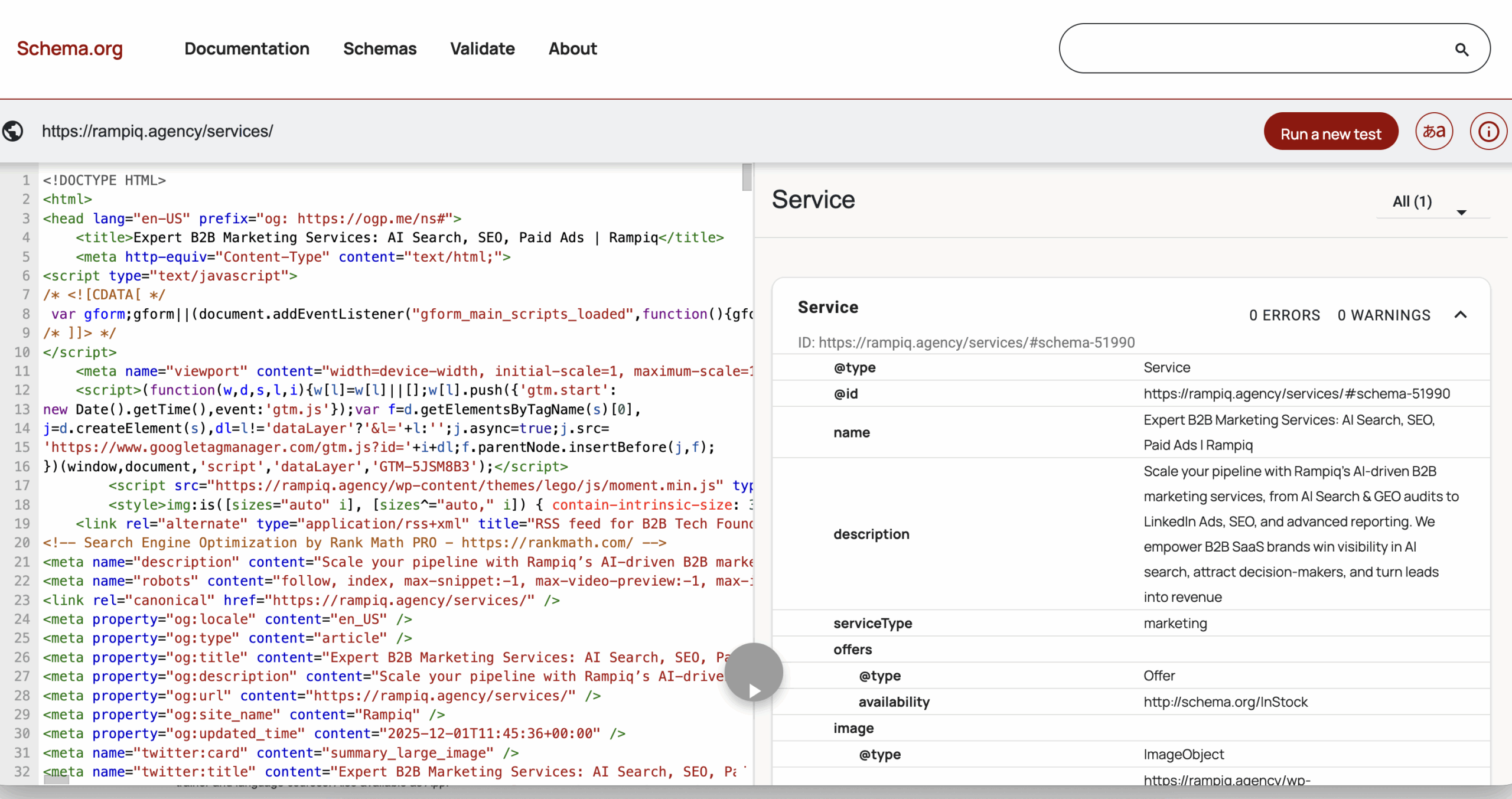 Schema is one of the fastest ways to make your pages more “AI-readable” and safely citable. But it only helps if your structured data is clean, consistent, and actually matches the page intent.
We use the Schema.org Validator to confirm that priority templates (product pages, use-cases, comparisons, guides) are publishing valid schema with the right type and required properties. This helps LLMs interpret your page correctly, connect entities (ex., products, use-cases, FAQs, reviews, etc.), and extract answers without guesswork.
Our workflow:
- Validate the live page’s schema.
- Fix errors/warnings (wrong schema type, missing required fields, broken nesting).
- Re-validate after deployment.
- Re-crawl with Screaming Frog to confirm schema is consistent across the full template.
If your website is already well optimized for search, this step is the “last-mile check” that prevents schema gaps from blocking AI citations.
How to evaluate success in your LLM visibility efforts
AI chatbots show unique, tailored answers to each user based on location, history, or even a single word change in the query. That’s why you must take information from these third-party tools with a pinch of salt.
What we measure and why:
- Leading KPIs: AI referral sessions, prompt coverage (won vs. total targeted), multi-model agreement (how many models cite us), brand search lift (YoY, normalized).
- Quality KPIs: assisted conversions from AI sessions, time to first citation after content release, sentiment on brand mentions.
- Lagging KPIs: net new MQLs/opportunities influenced by AI sources.
Monthly scorecard to tie to your release calendar, so that you can attribute movement to specific on-page or PR changes:
- Coverage ≥ X% of target prompts
- Multi-model agreement ≥ Y models
- Brand search +Z%
- AI-assisted conversions ≥ target
Only count a prompt as “won” when at least two models cite you for two consecutive checks. For conversions, report both direct AI referral conversions and assisted conversions where AI sessions appeared in the path within 28 days.
Key limitations of leading AI visibility tools?
These tools track presence, but even the best software for ai visibility in search may miss context, accuracy, and sentiment. Results can be volatile, so compare patterns over time before taking action. This post cannot be complete without warning you of the main limitations of these tools, so you don’t over-trust dashboards.
- Personalization & volatility: outputs vary by user history, geography, and prompt phrasing; day-to-day swings are common.
- Attribution fuzziness: LLM-driven awareness often shows up as brand search lift and assisted conversions rather than direct clicks.
- Coverage gaps: no tool sees every model or every answer type; triangulate across multiple sources.
- Context loss: many tools track presence, not quality/accuracy of the citation.
That’s why we compare patterns across the top ai visibility tools for optimization and prioritize signals that are consistent across models or sustained over time. For the controllable signals that move you onto AI shortlists, review 12 AI search factors you can control.