What AI Search Visibility Agencies Do
An AI search agency ensures your brand is visible, correctly interpreted, and recommended inside AI-driven discovery environments, and not just search engines.
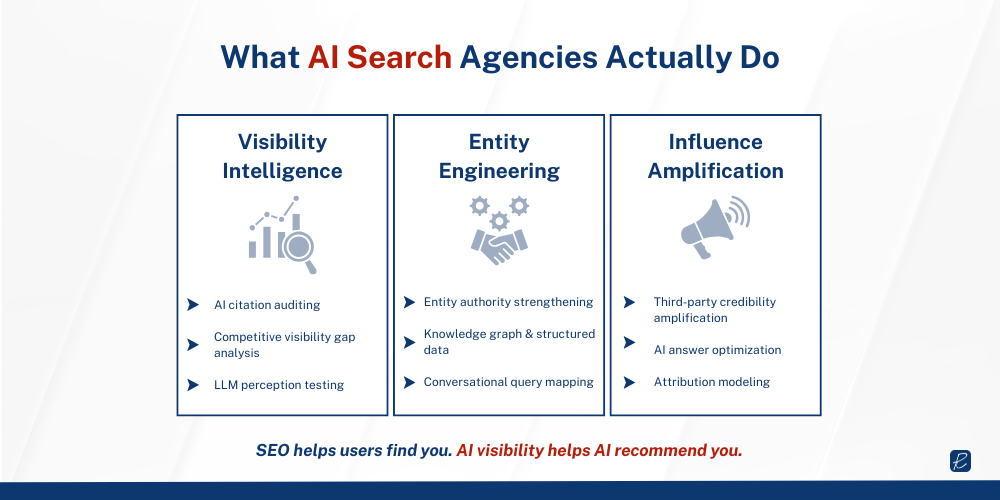
Traditional SEO optimizes pages for rankings. AI search optimization optimizes entities for recommendation. This distinction is important because AI systems don’t rank pages the way search engines do. They synthesize answers from trusted sources and then decide which brands to mention.
Core deliverables typically include:
- AI citation auditing across major models
- entity authority strengthening
- knowledge graph and structured data engineering
- conversational query mapping
- third-party credibility amplification
- AI answer optimization
- LLM perception testing
- attribution modeling for AI-assisted conversions
- competitive visibility gap analysis
In practical terms, SEO helps users find you, but AI visibility positions your brand so that AI recommends you.
Across the B2B AI visibility audits we run, one pattern appears consistently. Companies often assume that ranking equals recommendation. In reality, AI systems weigh credibility signals across sources and determine which companies deserve to be included in the answer.
Most B2B teams don’t notice AI visibility gaps until pipeline impact becomes obvious. By then, competitors may already be structurally embedded in AI recommendations.
If you want to understand how AI systems discover and recommend brands, see our analysis of AI-driven discovery.
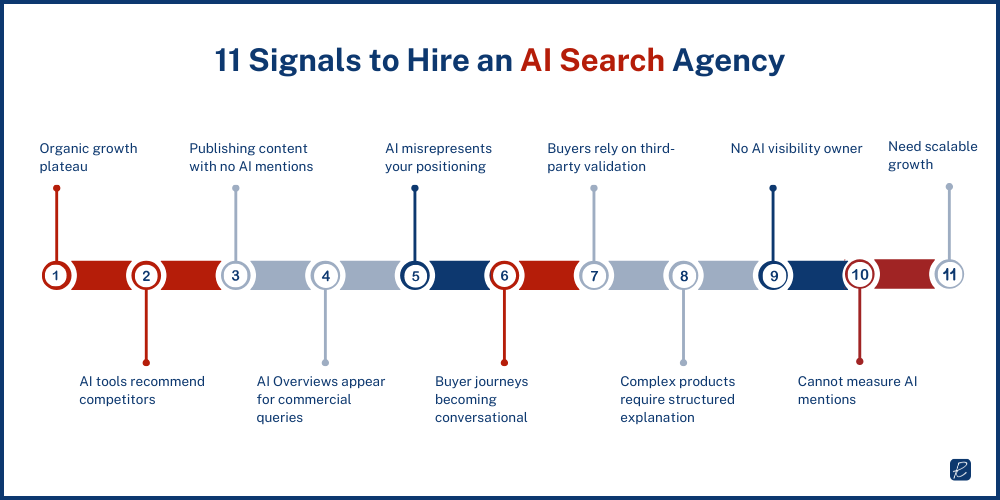
11 Signals It’s Time to Bring in an AI Search Agency
You need an AI search agency when your buyer behavior has shifted, and your current stack can’t measure or influence it. Here are the recurring patterns seen across B2B organizations before they decide to bring in specialized AI visibility support.
1. Your Organic Growth Plateaued Despite Strong SEO
You’ve optimized content, built links, improved technical performance… and growth has flattened. This often means:
- You’ve saturated traditional search demand
- SERP real estate is shrinking due to AI summaries
- Informational queries are being answered before clicks happen
At this point, incremental SEO tweaks won’t unlock new demand. AI visibility does. That visibility gap doesn’t just affect traffic. It also changes which vendors buyers consider before they ever reach your site.
Across the B2B visibility environments we have analyzed, this plateau often appears shortly before competitors begin showing up consistently inside AI answers and AI Overviews.
To understand why traditional SEO alone no longer guarantees visibility in AI environments, see our guide on how ChatGPT and similar systems surface sources.
2. AI Tools Recommend Competitors, Not You
If competitors are cited and you’re absent, this is a visibility gap. Your buyers ask tools like ChatGPT:
“What are the best platforms for X?”
And your competitors appear consistently, while your brand is absent. This is one of the strongest hiring signals because it indicates:
- Your entity authority is weak in the AI training corpora
- Your brand lacks structured credibility signals
- Third-party validation coverage is insufficient
In AI visibility audits, this is often one of the first signals leadership teams notice when evaluating how their brand appears in AI answers.
If you want to understand how AI systems interpret brand signals and build recommendations, see our analysis of how ChatGPT forms brand knowledge.
3. You Publish a Lot of Content But Get No AI Mentions
Many companies discover that content volume alone does not automatically translate into AI visibility. Many companies produce content optimized for search engine rankings, word count, or topical breadth. But AI systems prioritize factors like concise definitions, authoritative phrasing, structured information, and cross-domain consistency.
If you’re producing content at scale but not appearing in AI citations or summaries, the issue might be from your discoverability architecture. It may be time to hire an AI visibility agency.
Across the B2B environments we have analyzed, content volume alone rarely translates into AI visibility if the content structure is not designed for AI extraction and citation.
If your content ranks but rarely appears in AI answers, the issue is often structural. We explain how to structure content so it gets cited in AI summaries in our guide on optimizing content for AI Overviews.
4. AI Overviews Appear for Your Commercial Queries
When Google generates an AI Overview above results, the visibility hierarchy changes instantly. If your brand isn’t referenced inside that generated answer, users may never scroll to your listing, even if you rank #1.
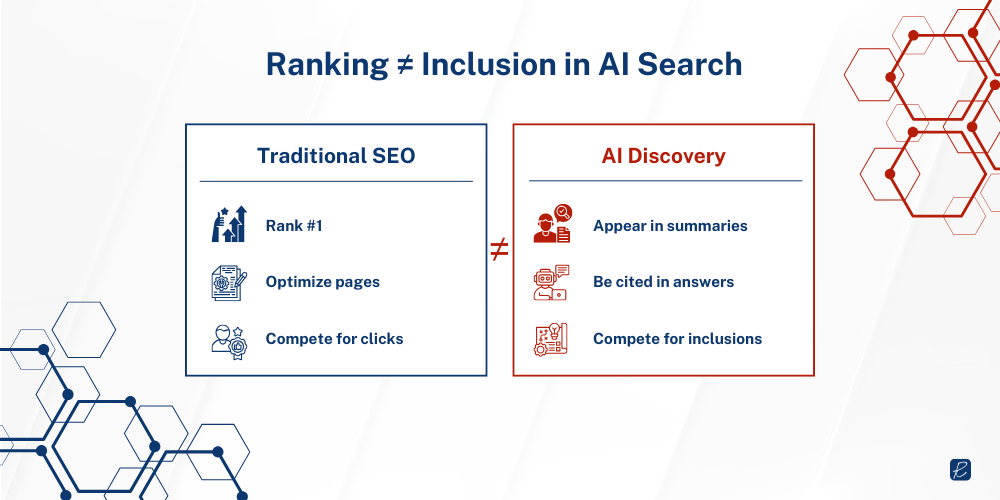
Companies often assume ranking equals visibility. In AI-mediated search, that assumption breaks. Brands that don’t appear inside AI-generated answers lose visibility even when they rank well. At that point, ranking position stops being the deciding factor; inclusion does.
Across the AI Overview environments we have analyzed, brands cited inside the generated summaries often capture disproportionate attention compared to those appearing only in traditional results.
In one B2B engagement, structured generative engine optimization helped a company move from zero presence to appearing in more than 800 AI Overviews and AI-generated answers.
Request an AI search audit
Understand how your AI systems currently represent your brand in responses to your highest-value prompts.
Get Audit
5. AI Gets Your Positioning Wrong
This is one of the clearest signals that your company needs intervention. It is more common than companies realize. Some examples we’ve audited include:
- Inaccurate company positioning category
- Outdated product descriptions and feature claims
- Missing capabilities in comparison or recommendation responses
- Confusing you with competitors
- Incorrect information on your pricing tiers
- Hallucinating your page URLs and sending traffic to non-existent pages
In most cases, these issues happen because your digital signal environment is inconsistent or unclear. AI systems synthesize from everything available. They check your site and external platforms for reviews, directories, press mentions, community discussions, and so on.
If those signals conflict or are missing, AI answers reflect that confusion or gap. Fixing this requires structured AI visibility optimization to standardize signals and reinforce positioning across sources.
In AI perception audits, we frequently see models combine outdated training data with fragmented third-party signals, which leads to incorrect positioning or missing capabilities in AI answers. If this is you, it may be time to hire an AI search agency.
6. Buyer Journeys Are Becoming Conversational
Search queries are evolving from:
“best CRM software”
to
“What CRM is best for a 20-person SaaS team that wants automation but minimal setup?”
…and follow-up queries to the AI.
Sales teams often notice this first. Prospects arrive with:
- pre-formed comparison lists
- specific feature expectations
- narrowed vendor pools
That’s because AI platforms increasingly act as early-stage analysts for buyers.
When discovery shifts from search queries to conversational prompts, brands that optimize only for search queries lose influence over early evaluation. Long-form queries favor brands whose expertise is clearly structured for AI interpretation.
If your traffic data shows rising long-tail conversational queries, it’s a sign that discovery behavior is shifting faster than your optimization strategy.
7. Buyers Depend on Third-Party Validation
If your category is highly trust-sensitive, buyers rarely rely on vendor sites alone. They look for confirmation across reviews, analyst commentaries, LinkedIn posts, case studies, and independent mentions.
AI systems mirror that behavior and prioritize sources that appear credible and cross-verified. So if your competitors dominate third-party authority, AI recommendations often reflect that dominance. In these categories, AI visibility becomes significantly more important.
In categories where understanding equals trust, the company AI explains best often becomes the company buyers’ trust first.
In AI visibility audits we run, brands with stronger third-party signals consistently appear more frequently in recommendation-style AI answers.
You can see how different credibility signals influence AI visibility in our overview of key AI search ranking factors.
8. Your Product is Complex or Technical
Technical offerings benefit more from AI visibility optimization. Why? Because complex solutions require explanation, and explanation is exactly what AI interfaces specialize in. Furthermore, comparisons here are nuanced, and decision cycles are research-heavy.
AI search and chatbots often act as interpreters between technical vendors and non-technical stakeholders. If the model doesn’t understand you, neither would your buyers. If your product requires nuance to understand, shaping how AI explains it can dramatically affect perception, trust, and ultimately, shortlist inclusion.
A practical example of how structured GEO optimization improves how complex solutions appear in AI answers is shown in the Case IQ AI Overviews case study.
9. Your Team Has No AI Visibility Owner
Most marketing teams don’t have AI visibility dashboards, LLM citation monitoring, prompt testing frameworks, or entity coverage tracking. If AI visibility lives nowhere, it improves nowhere.
We see organizations assume that it belongs to either SEO, content, growth, or brand. However, in reality, it spans all of these. Without ownership, AI search visibility becomes a background concern that never receives structured attention or measurement.
When that happens, influence shifts upstream, before traditional marketing analytics can even detect it.
In conversations with marketing leaders, we often find AI visibility sitting between SEO, content, and brand teams without clear ownership.
If you want to see how companies operationalize AI visibility as a structured program, explore our AI Visibility Optimization approach.
10. You Can’t Measure AI Mentions or Citations
Executives want ROI tied to revenue. If your analytics stacks cannot currently answer questions like
How many leads came from AI-assisted discovery?
Which prompts mention us?
Which pages get cited?
Which sources do AI platforms cite in responses to our customers’ prompts?
Then your visibility exists in a blind spot. That doesn’t mean attribution isn’t happening. It might just not be measured. And if you can’t measure it, you can’t optimize it.
AI agencies implement monitoring frameworks that turn invisible influence (or lack of it) into trackable data.
In many early-stage AI visibility diagnostics, lack of measurement is the biggest barrier to understanding how AI discovery influences the pipeline. We explain practical ways to measure AI citations and traffic in our AI traffic measurement playbook.
11. Leadership Wants a Faster Non-Paid Acquisition Channel
Paid channels scale linearly with spend, and they cost more every quarter. AI visibility behaves differently. Similar to early SEO, once authority signals compound, influence grows without proportional cost increases.
Organizations that invest early gain disproportionate visibility advantages. For companies seeking scalable pipeline sources, AI visibility becomes strategically attractive, and hiring an AI agency makes sense.
Most companies that reach out to us recognize at least three of the signals above. That’s usually the tipping point.
If several of these signals sound familiar, the next step is to evaluate how visible your brand currently is across AI platforms.
Are You Already Seeing the Signals?
If you’ve read this far, at least two or three of the signals sound familiar.
Your traffic has stalled.
Your competitors keep showing up in AI answers.
Your sales team mentioned ChatGPT on calls last week.
The reality is simple:
AI-driven discovery is already influencing your pipeline, whether you’re measuring it or not.
The question is whether you want to actively shape that visibility or leave it to chance. The brands that win in AI search are the ones who recognize the shift early enough to shape it.
If these signals reflect what you’re seeing, the next step is to understand how visible your brand actually is across AI search platforms.
You can start by speaking with our team to review your current AI visibility and identify the next growth opportunities.
Why Companies Ultimately Choose Rampiq for AI Visibility Services
Most agencies adapted SEO workflows for AI environments. Rampiq focuses on AI discovery from the start, treating it as a distinct visibility layer rather than an extension of traditional SEO. Organizations typically select Rampiq because they don’t want “AI SEO”. They want focused AI search services.
Rampiq built its methodology specifically for AI discovery environments, based on patterns observed across B2B brands that became visible inside AI answers and AI Overviews.
Organizations choose Rampiq when they want:
- Predictable visibility
- Measurable impact
- Defensible positioning
- Faster market education
- Proven visibility frameworks
- Query monitoring libraries
- Citation analysis models
- Deep integration with B2B buyer journeys
- Revenue-aligned reporting
More importantly, Rampiq’s approach is based on patterns observed across B2B brands that successfully became visible inside AI-driven research flows. That difference shows up not in reports, but in whether AI mentions you or your competitors.