What changed and why it matters
Your rankings may still be fine. They just stopped deciding whether an AI answer cites you.
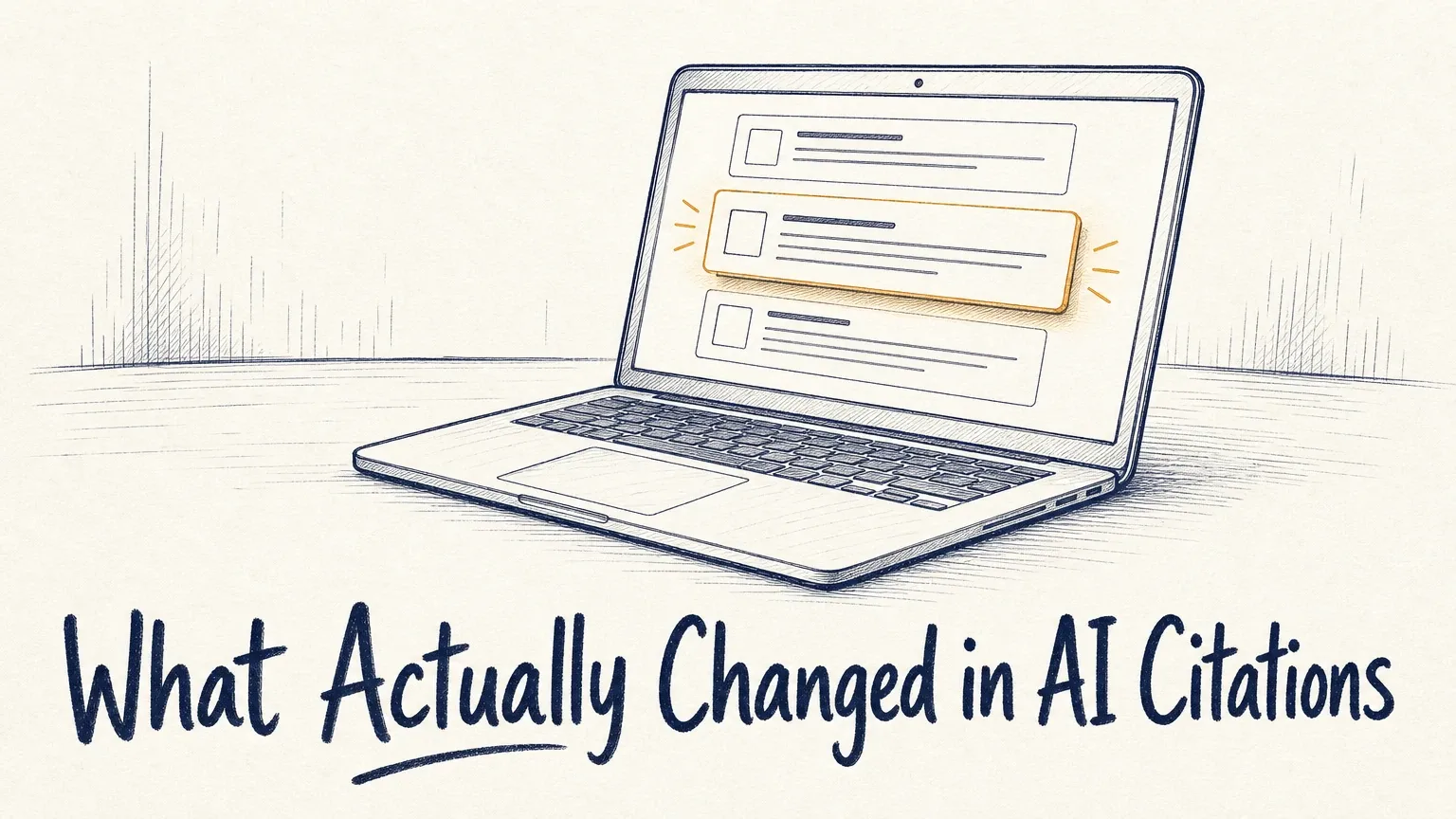
AI Overview inclusion is whether Google surfaces your page as a supporting link inside its AI Overview box for a query. It’s a separate outcome from position. A page can rank well and never get pulled into the answer.

Google’s own documentation on AI features says AI Overviews and AI Mode may use a “query fan-out” technique. That means several related searches across subtopics and data sources, combined into one response.
To be eligible as a supporting link, a page has to be indexed and eligible to show in Google Search with a snippet. There are no additional requirements and no special optimizations necessary. All existing SEO fundamentals continue to be worthwhile (Google Search Central, updated December 2025).
Avassa: from unused content to AI Overview visibility
Avassa’s AI Overview visibility grew 2900% and its AI referral traffic grew 408% (one client account, measured against its own pre-engagement baseline).
Avassa is an edge-computing application-management platform. A website migration had cut the visibility it used to hold. The pages stayed up. The reach went with the migration.
The work ran on four fronts. Keyword strategy was rebuilt around edge-computing and IIoT buying roles, LinkedIn Ads were restructured for the same roles, and technical AI-readiness fixes covered schema markup, LLM.txt and robots.txt. GEO-focused optimization then ran across pages Avassa already owned.
Read the headline figure precisely. It’s growth in AI Overview visibility. It isn’t a share of AI answers.
Classic organic recovered alongside the AI surfaces. Top-20 keyword visibility, organic impressions and organic conversions all moved, and those figures sit in the table below.
Did the AI numbers come from new content?
No. The published mechanism is a content audit and GEO structuring of assets Avassa already owned. Content production wasn’t part of it. The full Avassa case study carries the engagement detail.
Case IQ: recovering and growing AI Overview keywords
Case IQ has 850+ keywords ranking inside AI Overviews and 145% growth in top-3 rankings (one client account, against its own pre-engagement baseline).
Case IQ is investigative case-management and compliance software. A site migration and a rebrand had cut its visibility and its traffic together.
Four things recovered it:
- A technical audit covering crawlability, structured data and AI readability.
- Schema.org, LLM.txt and robots.txt fixes.
- GEO-focused content briefs written against the pages with real ranking potential.
- Real-time dashboards tracking ChatGPT and Perplexity referral traffic through Vertology.ai.
That ran as a monthly cadence with Case IQ’s in-house marketing team, not as a one-off audit handed over and left alone. Classic search recovered too, and that figure is in the table below.
The first two items on that list are checkable on your own site this afternoon. Pull your robots.txt. Look at what your priority pages emit as structured data.
If a page is blocked from indexing or can’t be shown with a snippet, content work alone won’t put it inside an AI answer. The full Case IQ case study has the numbers behind that list.
The pattern across both engagements
Optimize the library you already have before you write anything new.
Structured content optimization is restructuring and re-tagging existing pages, through schema, formatting and clearer sourcing. It replaces publishing net-new content to chase the same queries. It’s the mechanism both engagements share.
A net-new content program is the second call, and it’s the expensive one. Fund it once the pages you have are eligible and structured.
Why the existing library is the cheapest place to start
Read that Google guidance literally and the distance between a page that gets cited and one that doesn’t usually sits inside a page you already published.
Both clients are B2B SaaS, which is where most of our GEO for B2B SaaS companies work sits. New pages ≠ new citations, at least not first.
Side-by-side result comparison
Every published metric from both engagements, on the same dimensions. Both sit in our client case studies index alongside the rest of the work.
| Client |
Metric |
Result |
Surface measured |
Measurement basis |
| Avassa |
AI Overview visibility |
+2900% |
Google AI Overviews |
Vertology.ai and platform analytics, cumulative against the pre-engagement baseline |
| Avassa |
AI referral traffic |
+408% |
AI assistant referrals |
Vertology.ai and platform analytics, cumulative against the pre-engagement baseline |
| Avassa |
Top-20 keyword visibility |
+575% |
Google organic |
Platform analytics, cumulative against the pre-engagement baseline |
| Avassa |
Organic impressions |
+356% |
Google organic |
Year over year |
| Avassa |
Organic conversions |
+89% |
Google organic |
Year over year |
| Case IQ |
Keywords ranking in AI Overviews |
850+ |
Google AI Overviews |
Vertology.ai and platform analytics, count at time of reporting |
| Case IQ |
Top-3 rankings |
+145% |
Google organic |
Cumulative against the pre-engagement baseline |
| Case IQ |
Keywords in positions 1-10 |
3,650+ |
Google organic |
Count at time of reporting |
TTwo things that table can’t hold. Both clients came in from a migration that had already pushed their numbers down. Each percentage is growth off a floor, not off a healthy baseline.
And neither published case study states a start and end date. Read the figures as cumulative program results, not as a fixed-window test.
If your library is sitting in that condition, the AI Visibility Optimization service is where this work runs.
How Rampiq measures and reports AI citation share
AI citation share is the percentage of tracked AI answers, across ChatGPT, Perplexity, Gemini and Google AI Overviews, that name or link a brand for a defined prompt set. It’s the before-and-after metric a GEO engagement should be judged on.
Neither case study above reports one. They report AI Overview visibility, AI referral traffic and keyword position. We won’t backfill a citation-share percentage onto numbers that weren’t collected that way.

The measurement itself isn’t complicated. A defined prompt set is tracked across the engines. Every captured answer is checked for a brand mention or a link. The share carrying one is what lands in the monthly report.
Prompt fan-out is why that share moves in fractions rather than jumps. One tracked prompt spawns a spread of sub-queries. A brand can be cited on some and absent on the rest.
What an AI Overview number in Search Console actually tells you
Less than the phrasing usually suggests. Search Console counts a click on an external link inside an AI Overview as a click, and standard impression rules apply. An AI Overview occupies a single position in search results, and every link inside it is assigned that same position.
So there’s no per-link rank inside an AI Overview to improve. Those appearances sit inside ordinary Web search-type data rather than a bucket of their own, though Search Console’s Generative AI performance report now breaks generative-AI impressions out separately for the sites it has reached.
Ask any agency which of those numbers it’s quoting. A claim about ranking inside an AI Overview has no Search Console figure behind it.