Book a Free Consult
Get Started 🚀

31

Jul

Is your marketing team ready for AI search?

Being ready for AI search means your team has the skills, content, and tools to get your brand accurately represented and cited in ChatGPT, Perplexity, Claude, and Google’s AI answers, and to keep it there as those platforms change. An AI-search ready team can find where the brand is missing or misread, put your brand in sources LLMs trust, structure your website for digestibility, produce content that AI systems will cite, and track how you perform.

Most marketing leaders already feel the pressure. But knowing AI search matters is not the same as being equipped to win it. From working with B2B marketing teams across AI visibility audits and AI Search Training engagements, we see the same pattern repeatedly: teams understand AI search is important, but very few have a repeatable process for improving visibility. So before committing a budget or bringing in help, it is worth running a quick internal check to see where your team actually stands.

This article lays out one way to do that. This is not a formal certification or industry standard. It is the framework we use to evaluate whether marketing teams are ready to execute AI visibility work consistently.

How to evaluate your marketing team’s AI search readiness

Take the five areas below, and give your team a score from 0 to 4 in each. 

Zero means the capability is not there at all. Four means it runs on its own, without anyone having to be told. Add the five numbers for a rough total out of 20.

The total is less useful than the shape. One weak area tends to drag down everything around it, so the point of the exercise is to find that area, not to chase a perfect number. Score your team as it works today. If a capability lives in one person’s head, or showed up once in a workshop and never again, score it low.
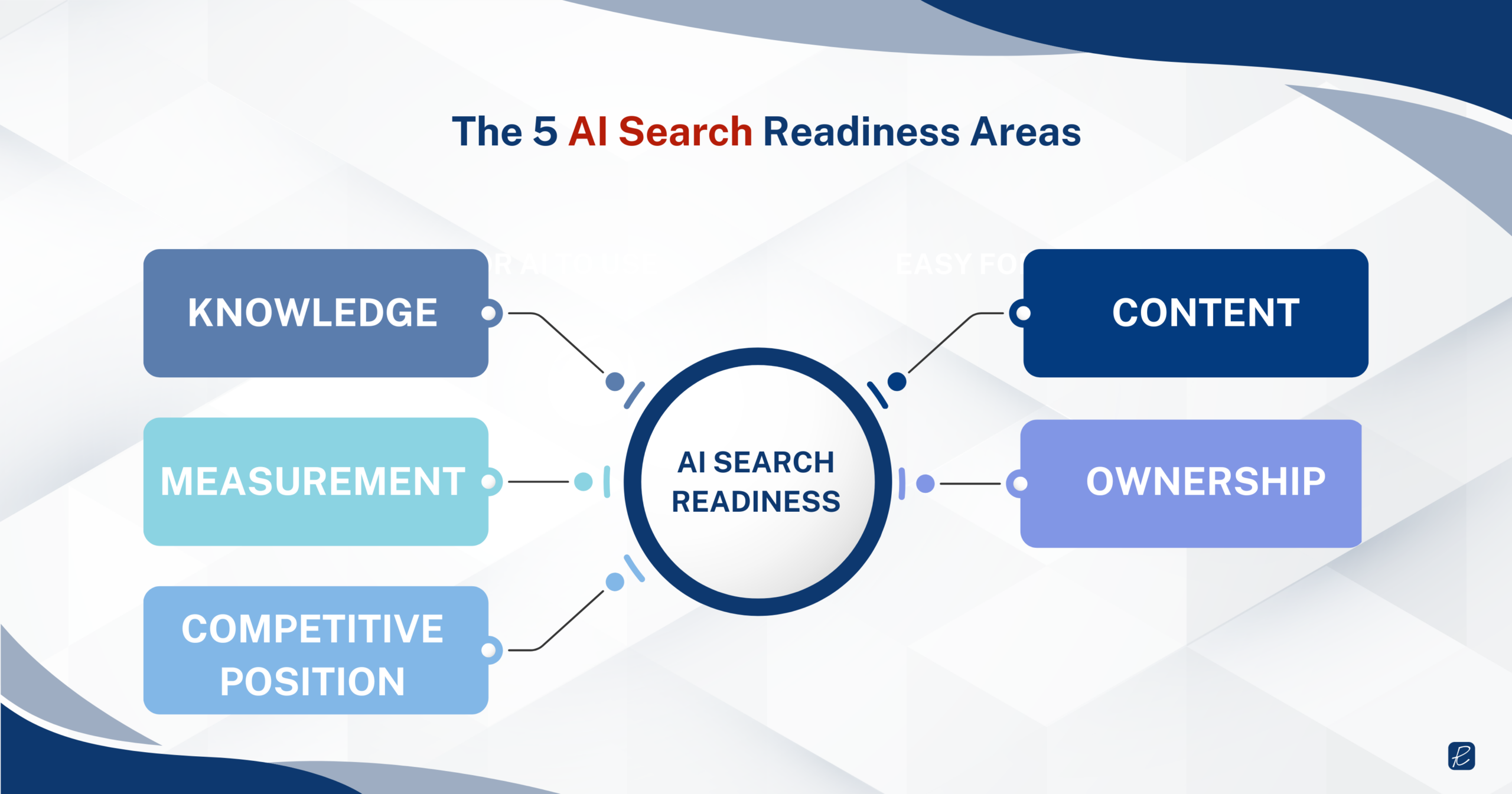
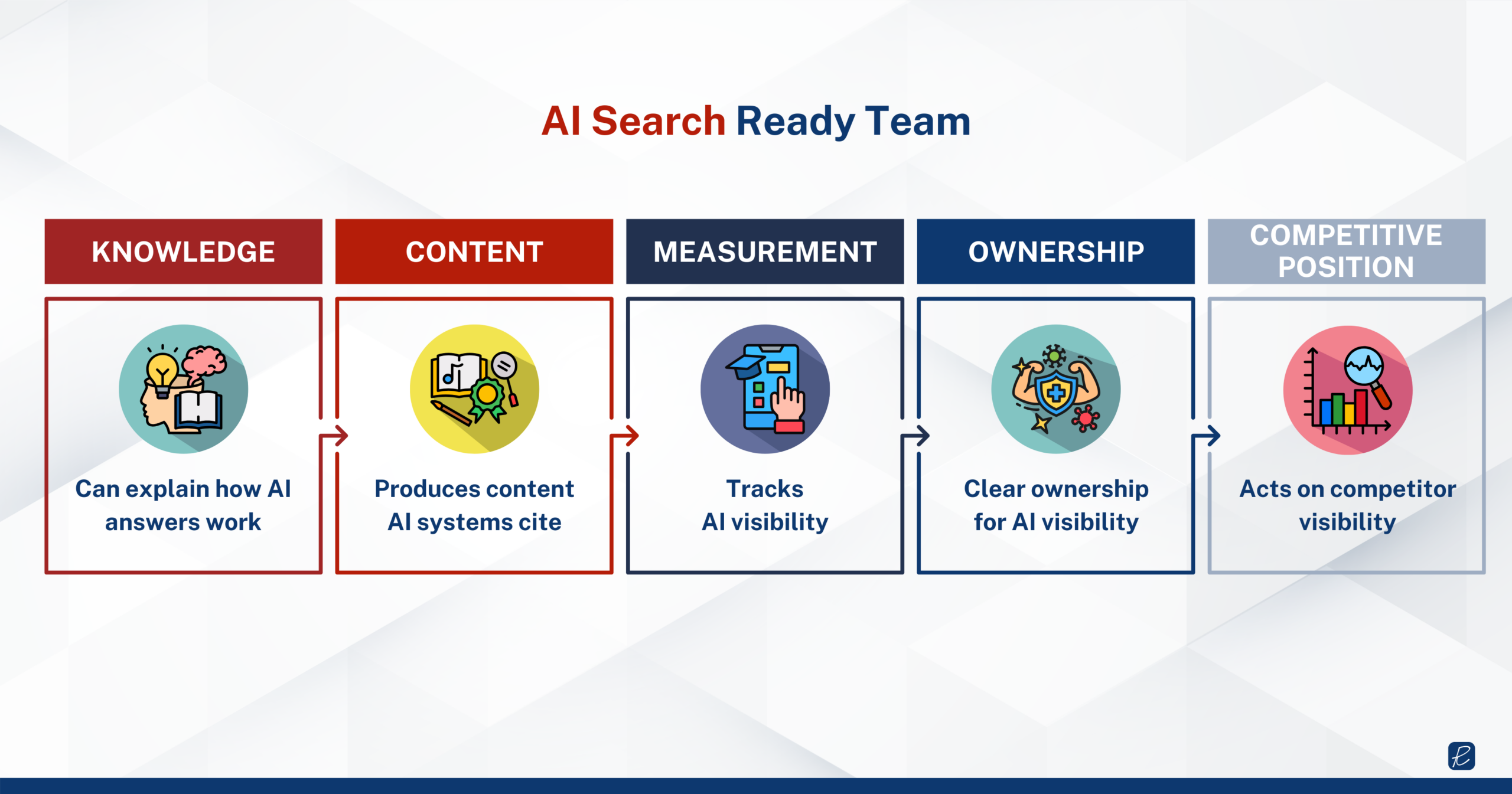
infographic showing the areas of marketing teams ai search readiness

The five areas are:

  1. Knowledge
  2. Content
  3. Measurement
  4. Ownership
  5. Competitive position.

1. Knowledge

Does your team understand how AI search actually assembles an answer, and what it takes to be part of that answer?

This is the foundation the other four areas build on. AI search runs on the same groundwork as SEO, so a strong SEO team starts with an advantage, but the mechanics differ enough that a marketing team treating them as identical will miss things that matter. 

Signs of a ready team:

  • They can explain how a model decides which sources to pull into an answer, and why one brand gets cited over another.
  • They know ChatGPT, Perplexity, Claude, and Google’s AI answers behave differently, and can name at least one way each surface sources differently.
  • Someone understands the difference between a model’s training data and what it retrieves live, because that changes whether you are influencing the next training cycle or the answer a buyer sees today.
  • They can talk about AEO and GEO as things they do, and can point to how they act on them, beyond recognizing the terms.

If your team can rank a page on Google but cannot explain why the brand is absent from the AI answers buyers now read first, that gap sits in knowledge.

2. Content

Can your team produce and restructure content that AI systems cite?

Producing content is rarely the question; if your team already publishes on a schedule, the volume is there. The real question is whether that content is built the way models pull from it, and whether your team can go back and fix the existing library while adding to it. AI systems tend to cite content that answers a question early, defines things clearly, and reads like a primary source. Across our AI visibility work, content volume is rarely the problem. More often, the expertise already exists but is structured in ways AI systems struggle to interpret and cite.

Signs of a ready team:

  • They can take an existing page and rework it for citation without turning it into a months-long project.
  • There is a real editorial process, with named people and a way to tell whether a change worked.
  • Someone owns the back catalogue.

If publishing more is the main lever your team reaches for, that points to a content gap. A single page that answers a question well tends to outperform a stack of thinner pages on the same topic. Our guides on AI-ready content structure and optimizing content for AI Overviews go deeper into what that looks like in practice.

3. Measurement

Can your team see how the brand shows up in AI answers, and connect it to what happens next?

Measurement is often the weak spot, because AI visibility takes a bit more work to see than traditional rankings. GA4 can surface AI-referred traffic, and tools like Semrush and Ahrefs now include AI visibility tracking, alongside purpose-built platforms. Specialist AI visibility tools also exist. The question is whether your team is set up to use any of it.

Signs of a ready team:

  • They understand and track AI visibility metrics which are different from those for traditional SEO and marketing.
  • They can show, on demand, how the brand appears across the major AI platforms for the prompts buyers use.
  • They track performance against named competitors, not in isolation, since visibility is relative.
  • They tie performance results back to traffic and pipeline signals.

If your team cannot answer “Why did this competitor appear instead of us?” you are missing one of the most valuable AI visibility signals. If a single check on one platform is the whole picture, that is a measurement gap. Our AI traffic measurement playbook cover how to close this gap.

4. Ownership

If AI search visibility dropped next month, is there a specific person whose job it is to respond?

A ready team can name that person or role. Without a clear owner, the work tends to slip off the roadmap the moment a campaign deadline lands.

Ownership also runs upward. Because AI search touches positioning, sales, and product beyond content alone, the person doing the hands-on work often needs decisions only leadership can make. Most leaders now treat AI visibility as a priority, so the question is less whether they care and more whether that care is connected to day-to-day work.

Signs of a ready team:

  • AI visibility is treated as a separate channel.
  • This channel has its own budget and owners.
  • Leadership is close enough to the work to unblock it.

This is why our AI Search Training includes both marketing and executive teams. The work moves much faster when the people making strategic decisions are part of the discussion from day one.

5. Competitive position

Do you know how you stand against your closest competitors in AI answers, and are you acting on it?

The first four areas look inward, but this one looks out, because readiness is relative. Being cited consistently compounds. Models build a sense of which brands are authoritative on a topic, and that sense is harder to shift than a search ranking. A competitor who becomes the default answer while you are absent gets more expensive to displace over time.

Signs of a ready team:

  • You know how the brand compares to top competitors in AI answers right now.
  • You can name which competitor is winning the citations you want, and have a sense of why.
  • You are already acting on it.

If you have no read on where you stand, that is the gap to close first here. An AI Visibility Audit is usually the fastest way to establish that baseline before deciding what to improve next.
signs of marketing teams ready for ai search

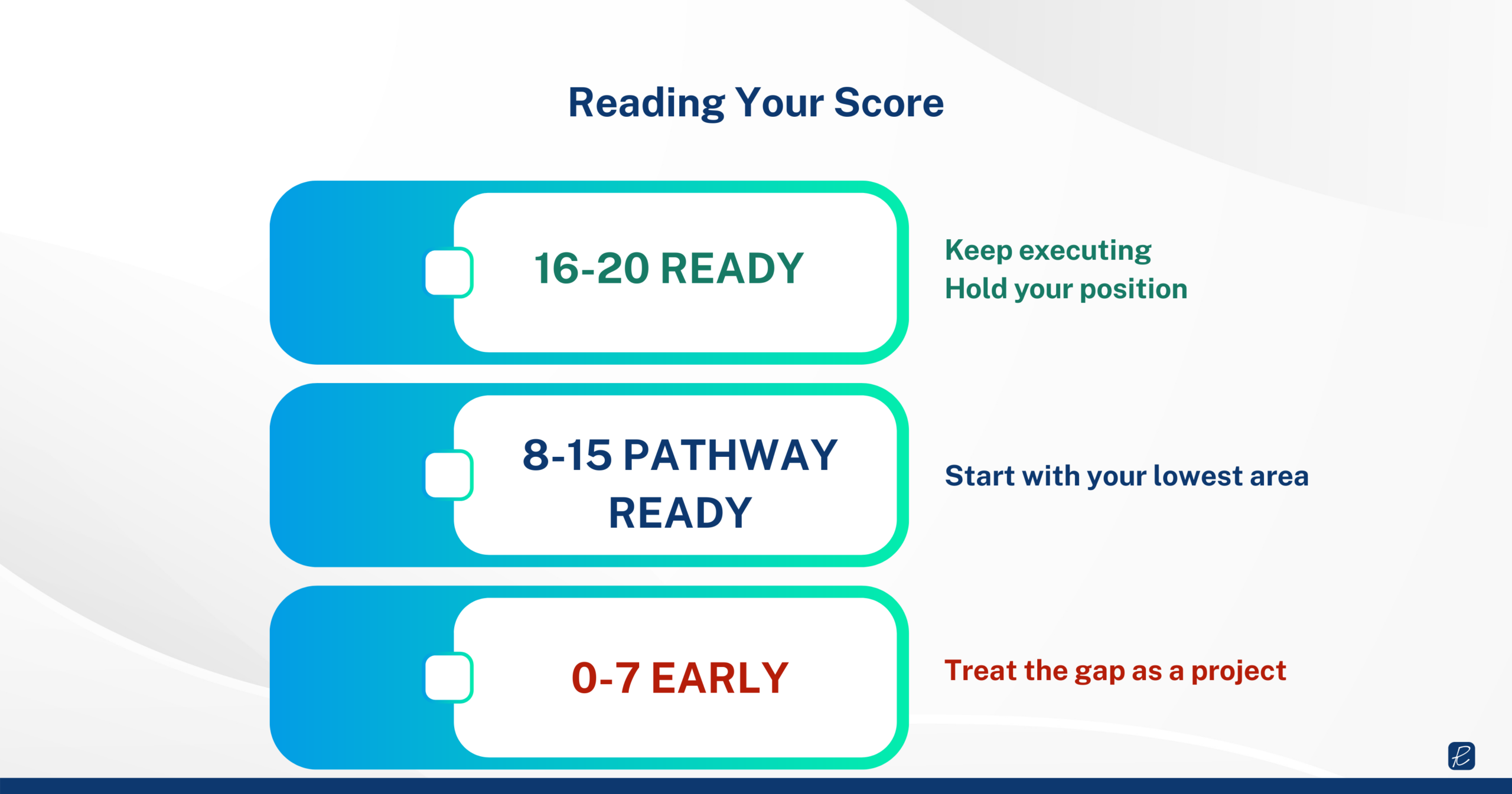
Reading your score

Add the five numbers. Here is a rough guide to what the total suggests. Treat the bands loosely; they exist to point you somewhere.

ai search readiness assessment scoring

  • 16 to 20: ready – Your team has the pieces in place. The work now is to keep executing and hold your position as the space matures, paying attention to whether measurement and ownership stay solid under pressure.
  • 8 to 15: partway there – A common range for established teams, where the total usually hides an uneven spread, for example strong knowledge with no measurement, or a solid content engine with no clear owner. Start with your lowest area. For instance, a marketing team scoring 4 on knowledge and 0 on measurement is not half ready, it is working with a good map it might not be able to read.
  • 0 to 7: early – The capability is not yet in place in any lasting form, which is a more common starting point than the discussions around AI suggest. It is a starting point, and the teams that pull ahead from here treat the gap as a project with an owner and a deadline, then work through it.

Most teams score lower than they expect on their first assessment. That is completely normal. AI search introduces new capabilities that traditional marketing teams were never asked to build.

Generic advice only gets you so far. That is exactly how Rampiq’s AI search training. We run a real AI visibility audit on your site, ICPs, and competitors, then work through the findings with your team so they leave with a start, stop, and continue plan and the monitoring setup to run it themselves.

A marketing team scoring low here does not need a course on what AI search is; it needs to see exactly where the brand is missing and walk out able to fix it.

FAQs

How long does it take a marketing team to become AI-search ready?

The time it takes depends on your starting score in this assessment. For example, a marketing team that is strong on knowledge and content and only missing measurement and a clear owner can close the gap in weeks, because the hard parts are already there. On the other hand, a team starting near zero across all five areas is looking at a quarter or more. What shortens it most is leadership being close to the work, since the delays are usually about decisions more than tasks.

Who should complete the AI search readiness assessment?

Whoever runs marketing can score it, but it is more useful to score twice, once by the marketing lead and once by an executive, then compared. The gaps between the two scores often say more than either total. Where the two of you disagree is usually where the real work is.

Is this the same as a GEO audit?

No, evaluating your marketing team’s readiness for AI search is different from conducting a GEO audit. This exercise gauges your team’s capability to do the work. A GEO audit measures your actual visibility in AI answers right now, which is one of the inputs this exercise assumes you can produce. A marketing team can score well here and still need an audit to know where it stands, and hold a fresh audit but score low because no one owns acting on it. One is about readiness, the other about position, and they answer different questions.

About the author
Liudmila Kiseleva

Liudmila is one of the best-in-class digital marketers and a data-driven, very hands-on agency owner. With top-level education and experience, Liudmila is a true expert when it comes to digital marketing strategies and execution.

Related Posts

Is your marketing team ready for AI search?

A scored self-assessment to find out whether your marketing team is ready for AI search, covering knowledge, content, measurement, and ownership.
07.31.2026
Liudmila Kiseleva
Read more

How to Request AI Visibility Budget From Your Leadership

A practical guide for in-house B2B marketing leaders on how to build the case, frame the ask, and win budget for AI search visibility.
07.06.2026
Liudmila Kiseleva
Read more

Google’s Search Box Is Now an AI Chat Box. Here’s What Changed at I/O 2026

A clear recap of the Google I/O 2026 search announcements, the intelligent search box, AI Mode by default, search agents, generative UI, and what the shift means for B2B brands.
06.24.2026
Liudmila Kiseleva
Read more

ChatGPT vs Google as Your Leads and Traffic Source

Google sends far more traffic, but ChatGPT sends higher-intent B2B visitors and shapes deals your analytics never attributes to it. What the data shows and what to measure instead.
06.22.2026
Liudmila Kiseleva
Read more

Google Says GEO Is Still SEO. Then It Made Search AI Search

Google calls GEO and AEO 'just SEO,' then rebuilt Search around Gemini, AI Mode, and AI Overviews. Here's what the shift to AI search means for B2B visibility.
06.12.2026
Liudmila Kiseleva
Read more

Revenue Attribution Models for B2B Content (and Why They Miss AI Search)

Revenue attribution models that connect content to pipeline, including the AI search blind spot most B2B teams don't know they have. Models compared, with practical fixes.
#
06.09.2026
Liudmila Kiseleva
Read more

Let’s talk!

We would love to hear about your digital marketing challenges and come up with a plan to reach your greatest business goals.

POP-UP