What does a GEO agency do that an SEO agency doesn’t?
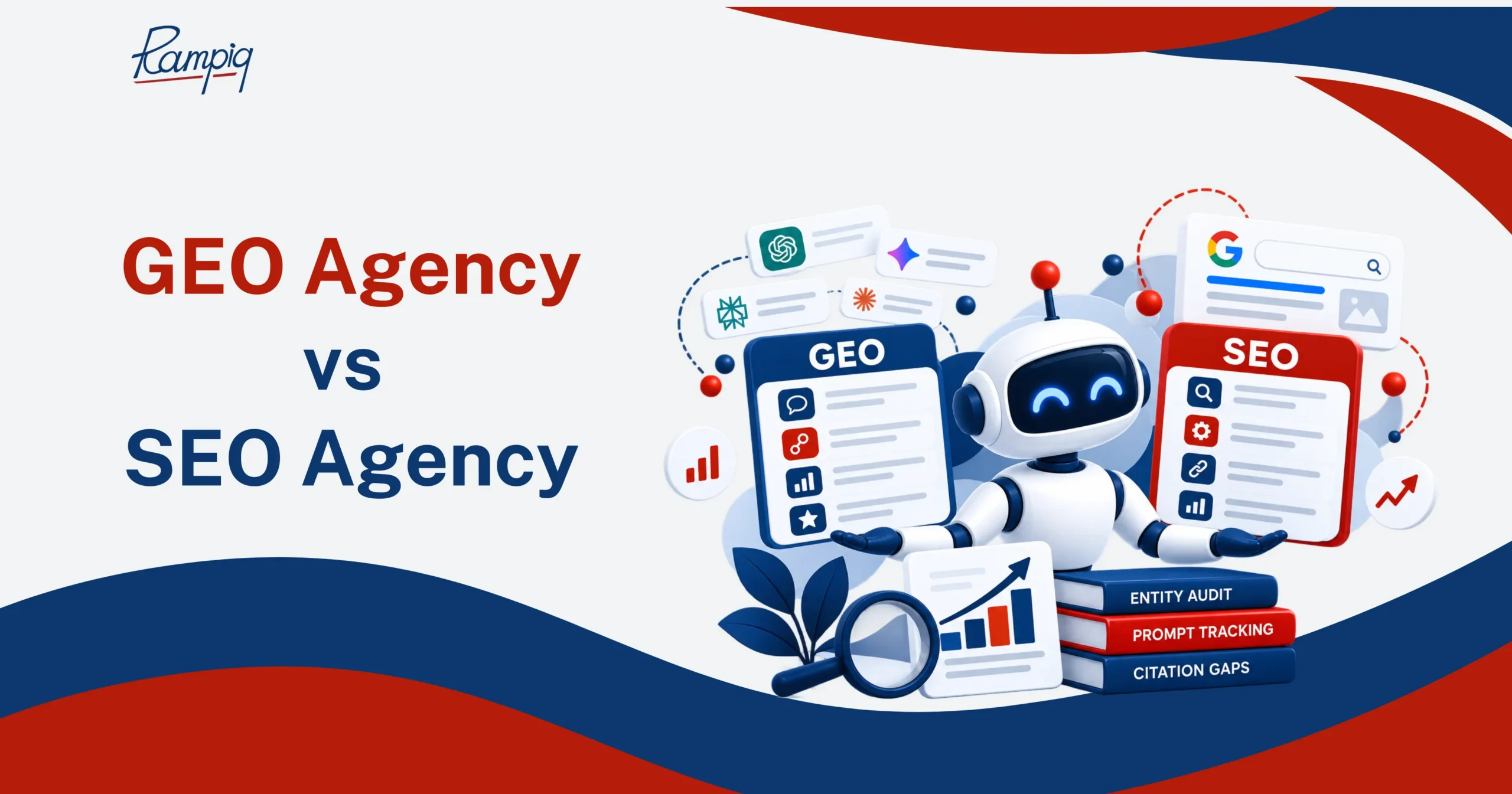
A GEO agency optimizes content and entity signals so AI assistants like ChatGPT, Perplexity, Gemini and Google AI Overviews cite or recommend your brand. An SEO agency optimizes pages to rank in classic search results. The work overlaps at the foundation and splits at measurement.
Four deliverables have no real SEO equivalent:
- Entity audit. A check of how consistently AI models understand who your company is and what it sells, across your site and third-party sources.
- Prompt monitoring (share of voice). Tracking how often and how favorably your brand appears across a defined set of buyer prompts. It’s the GEO version of rank tracking, and rank tracking ≠ citation tracking.
- Citation-gap closure. Finding the prompts where competitors get cited and you are absent, then fixing the pages, sources and entity signals behind that gap.
- AI traffic attribution. Separating visits and conversions from AI assistants in analytics, so the work can be tied to pipeline rather than impressions.
| Deliverable area |
SEO agency retainer |
GEO agency retainer |
| Research |
Keyword research, search volume |
Prompt sets, prompt fan-out, buyer questions |
| Measurement |
Rank tracking, organic traffic |
Share of voice in AI answers, AI referral traffic, AI Overview presence |
| Content |
Pages targeting keywords |
Passages written to be lifted: direct answers, sourced statistics, clear definitions |
| Authority |
Link building |
Entity consistency, third-party mentions AI models pull from |
| Reporting |
Positions and sessions |
Which prompts cite you, which cite competitors, and why |
On the content row, the Princeton-led GEO study found that targeted content changes, such as adding citations and statistics, boosted visibility by up to 40% in generative engine responses on its benchmark (Aggarwal et al., KDD 2024).
Is GEO just SEO with a new name?
GEO is partly SEO with a new name, and the shared part is the part you already pay your SEO agency for.
Google says so directly. Its Search Central guidance on AI features (updated December 2025) states there are no additional requirements to appear in AI Overviews or AI Mode, and that SEO best practices remain relevant. A page still has to be indexed and eligible to show with a snippet. Crawlability, schema, site structure and content quality carry over unchanged.
What Google’s page doesn’t cover is ChatGPT, Perplexity or Claude, or how you’d know whether any of them recommend you, which is where GEO work starts.
A useful rule of thumb comes from Yuval Halevi of Growtika (January 2026, drawn from 50+ B2B campaigns): about 40% of GEO work overlaps with good SEO, and the other 60% is different, covering entity authority, AI-specific content structure, cross-platform consistency and authority signals beyond backlinks. Treat the split as one practitioner’s estimate, not a universal number.
Can your existing SEO agency handle AI search?
Your SEO agency can handle AI search only if it already delivers GEO work. It may be doing excellent SEO either way, so the question is whether that work reaches the places your buyers now ask.

Some SEO agencies have built real GEO capability. Others have added “AI search” to the proposal without changing what they deliver. The difference shows in evidence rather than the pitch deck.
Ask two things before you run the full test below:
- What did they change on a client page because of a prompt result, and what moved afterward?
- Who on the team owns AI search work, and what did that person do before it had a name?
If every answer comes back to rankings, traffic and backlinks, the capability isn’t there yet. If you’re still unsure whether the timing is right, check the signs it’s time to hire a GEO agency.
The rebranded-SEO-agency test
Use this checklist on any proposal, from your incumbent or a new vendor. Each item asks for an artefact you can hold, because a rebranded SEO service can talk about AI search fluently and still have nothing to show.
- Ask for a sample entity audit. A real one shows how specific AI assistants describe a company, where those descriptions conflict and which sources feed them. A keyword gap report with “AI” in the title fails.
- Ask for the prompt list. GEO reporting starts from a defined set of buyer prompts. No prompt list means no baseline, and no baseline means no proof of change.
- Ask which platforms are monitored. “AI search” should name engines: ChatGPT, Perplexity, Gemini, Claude, Google AI Overviews. A vague answer means none are tracked in any structured way.
- Read the retainer line items. Compare them with last year’s SEO contract. If the hours still go to keyword research, link building and rank reports, only the invoice heading changed.
- Ask what the dashboard reports. Look for share of voice across prompts, AI referral traffic and AI Overview presence next to classic rankings.
- Ask for one result in AI terms. Our Case IQ engagement reached 850+ keywords ranking inside AI Overviews and 145% growth in top-3 rankings (one client, after a site migration). Any GEO agency should be able to show a client number of that kind, measured in AI surfaces rather than positions alone.
Two or more failures means the agency is selling SEO under a new label. That may still be useful SEO, but you’d be paying a GEO price for it.
Do you need one agency or two?
You have three realistic setups. The right one depends on how healthy your SEO already is and how much coordination you can absorb.
| Option |
Works when |
Trade-off |
| Incumbent SEO agency with real GEO capability |
It passes the test above |
Lowest switching cost, but GEO risks staying a side project inside an SEO retainer |
| Dedicated GEO agency alongside your SEO agency |
SEO is healthy and you need AI visibility fast |
Two vendors touch the same pages, so someone has to own the handoffs |
| One agency covering both |
SEO and GEO both need work, or you want one owner for pipeline |
Fewer handoffs, but you depend on one team’s depth in both |
If your site still lacks technical basics, fix SEO first. AI features in Google build on the same indexing and snippet eligibility.
If you’re comparing vendors, start with how to choose a GEO agency, then look at a list of the best AI search marketing agencies.
Rampiq runs the third model for B2B SaaS and IT companies. Our AI Search Accelerator (from $3,800/month) includes 8 content briefs per month, schema implementation, a monthly dashboard and strategy calls, with first meaningful signals typically within 60 to 90 days. See the full range of GEO services, or go straight to Rampiq’s AI visibility optimization service to work with us.