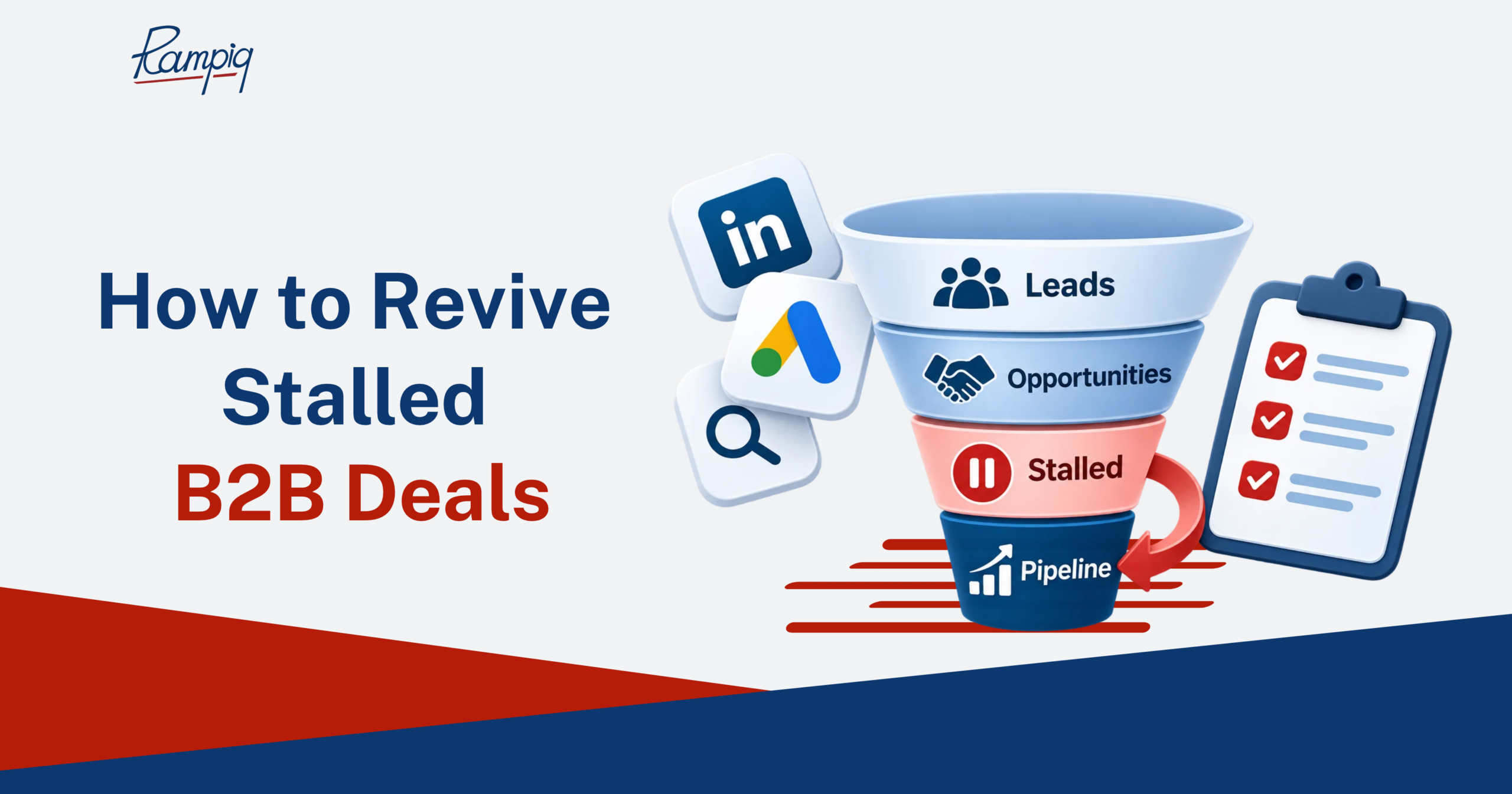
To revive stalled B2B deals, first diagnose why the buying group stopped moving. Then re-enter with something new, reach a second stakeholder, and keep the account warm with ads aimed at the buying group. Reopen the opportunity in your CRM only when a real next step exists.
Quick answer: A stalled deal is an engaged opportunity that stopped advancing. Restart it in four moves: name the stall cause, send a new reason to talk, multithread to another buyer, and surround the account with targeted ads. Measure the result as reopened pipeline, not opens or clicks.
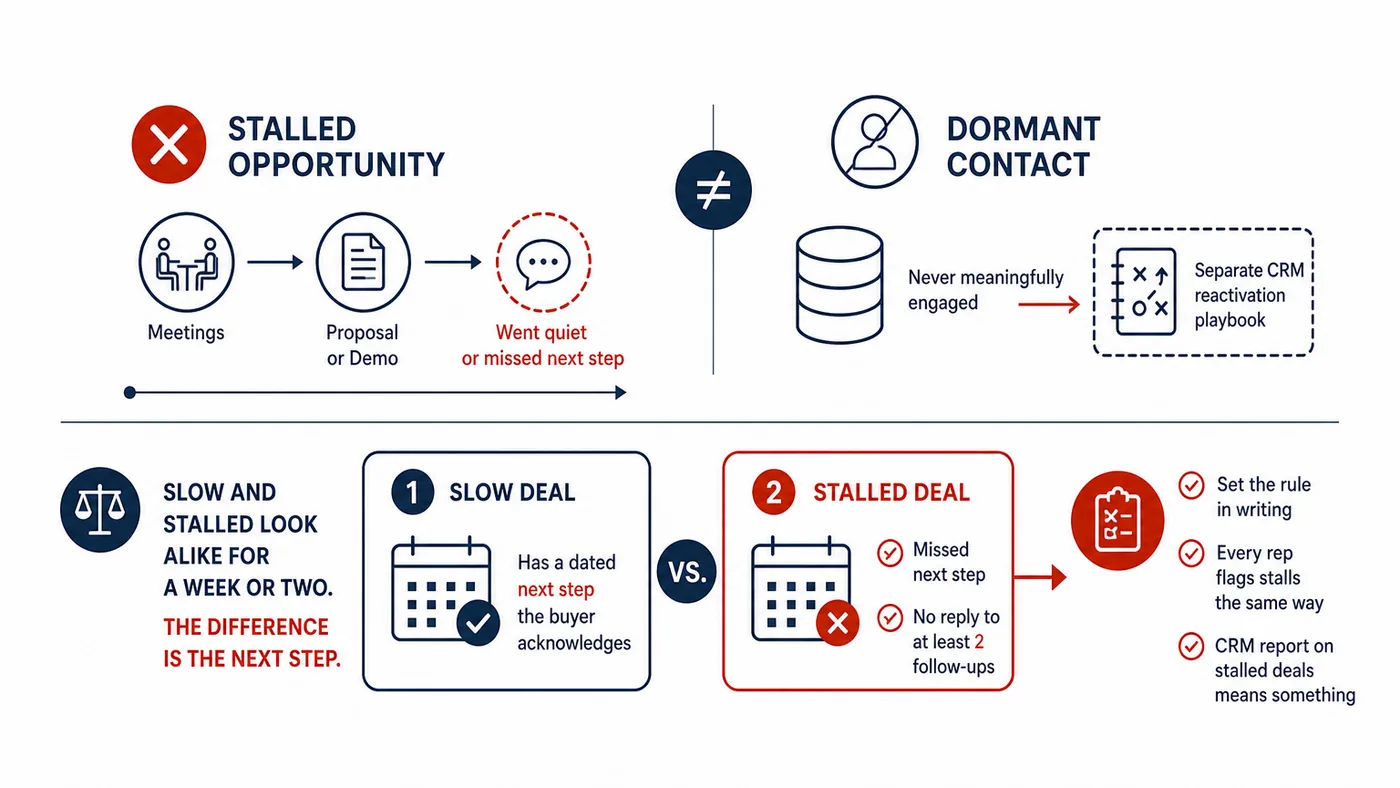
A stalled opportunity is an active, already-engaged CRM deal that stopped advancing. The buyer took meetings and saw a proposal or demo, then went quiet or missed the agreed next step.
A dormant contact is someone who was never meaningfully engaged. That’s a database reactivation problem with different plays, and it belongs in a separate CRM reactivation playbook, not this one.
Slow and stalled look alike for a week or two. The difference is the next step.
A slow deal still has a dated next step that the buyer acknowledges. A stalled deal has a missed next step and no reply to at least two follow-ups. Set that rule in writing. Then every rep flags stalls the same way, and the CRM report on stalled deals means something.
Why B2B deals go dark mid-cycle
Your rep may have done everything right. The deal still stalls, because the cause usually sits inside the buyer’s company.
Forrester’s analysts name shifting priorities, budget constraints, and internal changes as the usual reasons deals detour. They recommend tagging each stalled deal with a standardized reason code, drawn from four detour causes, before choosing a play.
Stall cause
What you’ll usually see
Restart play
Budget
“Let’s revisit next quarter,” procurement goes silent
Rebuild the business case around one number the CFO owns
Authority
Champion stops replying, leaves, or loses the internal argument
Multithread to a new buying-group member
Need
Buyer’s priority list changed, your use case dropped down it
Reconnect the offer to the problem that moved up
Urgency
No deadline on the buyer’s side
Tie the next step to an external date: their launch, renewal, or planning cycle
Log the reason code in a CRM field, not in rep notes. A free-text note can’t be filtered, and you can’t build an audience from it later.
The reactivation playbook: sales and marketing plays
Re-engaging deals that went dark works when every touch gives the buyer a new reason to reply. Repeating the old proposal louder does the opposite.
Re-enter with something new
Open with an asset tied to the stall cause: a revised pricing option for a budget stall, a one-page business case for a need stall, a peer example from the buyer’s segment for an authority stall, a next step pinned to the buyer’s own date for an urgency stall.
Keep it to one idea and one question. Assume the buyer is busy.
Multithread to a second buyer
Multithreading means reconnecting with a new member of the buying committee when the original champion has gone quiet or left the company.
Pick someone who owns the problem. That’s often the operations lead who’d use the product, or the finance partner who needs the business case. Tell the champion you’re doing it, if they still reply. Going around a live champion without a word burns the relationship.
Send a breakup email
A breakup email is the final message in a re-engagement sequence that explicitly offers to close the loop. It often gets the reply the earlier messages didn’t. It lets the buyer say “not now” without awkwardness.
A working structure has four parts:
One line naming the last real step: “We last spoke about rolling out to the EMEA team.”
An honest read of the silence: “I’m guessing priorities moved.”
A choice with an easy out: “Should I close this for now, or is Q1 a better time to pick it back up?”
No new pitch, no attachments.
Send it only after the earlier, value-led touches have gone unanswered. Sent too early, it reads as a threat.
Using LinkedIn Ads to restart a stalled deal
Email reaches one inbox. Ads reach the buying group, including people your rep has never met.
Export the accounts and contacts on stalled opportunities from the CRM. Upload them to LinkedIn Campaign Manager as a Matched Audience. LinkedIn’s help documentation sets a minimum ad set audience size of 300 member accounts, so pool stalled deals by stall cause or segment rather than running one campaign per account.
Match the creative to the reason code. A budget stall sees ROI proof. An authority stall sees content aimed at the roles you haven’t reached yet.
This is how Rampiq’s Pipeline Activator works. It builds warm audiences from the CRM and leadership networks, and from the Scale tier up runs Thought Leader Ads that promote posts from the CEO’s or founder’s own profile. LinkedIn Predictive Audiences come later, built from the profiles that converted. Stale CRM deals are an explicit target.
Judge it on pipeline. One SAP-solutions provider reported that paid campaigns produced 40% of its total sales pipeline after Rampiq restructured its LinkedIn and Google Ads (ACBaltica Brand Manager, Clutch review; one self-reported result, not a stalled-deal figure).
A reply is not a reopened deal. Move a stalled or closed-lost opportunity back into active pipeline only when the buyer agrees to a dated next step.
Reopen rules
Write the rules once and apply them to every rep:
Reopen the original opportunity when the same buying group and use case return, so the history stays attached.
Create a new opportunity when the scope, budget owner, or product changed enough that the old record would mislead the forecast.
Reset the stage to where the buyer actually is, with a new close date, and keep the original reason code.
Remove stalled deals that stay silent after the breakup email from the forecast, instead of letting them age in late stages.
Measure recovered pipeline
Pipeline-based attribution means judging the restart program by reopened opportunities and recovered pipeline value, not by opens, clicks, or impressions.
CRM-native execution means running every play on existing Salesforce or HubSpot records and their history, not a bolt-on list. The audience and the reason code sit on the same record as the reopened stage. Ad spend ≠ recovered pipeline until the record proves it.
Respect opt-outs on old threads
Stalled deals mean contacting people who may have asked to stop. The FTC’s compliance guide says CAN-SPAM makes no exception for business-to-business email, and opt-out requests must be honored within 10 business days. Check suppression lists before any sequence or audience upload.
Got a dark opportunity worth restarting? Book a stalled-deal diagnostic with the Pipeline Activator team. We’ll map which play fits the reason code.
See Where Competitors Beat You in ChatGPT
Are AI tools recommending your competitors instead of you?
Understand how AI platforms describe your brand vs. your competitors and the exact steps to flip those results.
Should sales or marketing own a stalled-deal restart?
Both, with a clear split. Sales owns the reason code, the outreach, and the reopen decision. Marketing owns the audience build and the ad creative mapped to each stall cause. The shared CRM record keeps them working on the same deals.
Can ads restart a deal on their own?
Rarely. Ads keep the account warm and reach buyers your rep can’t email. Someone still has to ask for the next meeting. Treat ads as cover for the sales play, not a replacement for it.
About the author
Liudmila Kiseleva
Liudmila is one of the best-in-class digital marketers and a data-driven, very hands-on agency owner. With top-level education and experience, Liudmila is a true expert when it comes to digital marketing strategies and execution.
Stalled B2B deals aren't always lost opportunities. See how to identify why deals stop moving, re-engage decision-makers through targeted outreach and LinkedIn Ads, and bring qualified opportunities back into your sales pipeline.
Your existing blog archive could be a source of AI citations without adding more content. See how to audit old posts, decide what to merge, retire, or refresh, and restructure pages for AI Search while protecting existing SEO rankings.
More traffic and leads don't always mean more qualified pipeline. See where B2B leads drop off, why marketing and sales qualification often don't align, and how to measure AI Search, SEO, and paid media against the right buyer stages.
Learn how to reach B2B buying committees by combining AI Search, SEO, and paid media. See how to target different decision-makers, coordinate channels across priority accounts, and avoid overlapping spend, with real client examples.
Learn how AI Search, SEO, and paid media work together to generate qualified B2B pipeline. See how to sequence these channels, measure their contribution to sales opportunities, and avoid common mistakes, with real client results.
See how AI assistants build B2B vendor shortlists, which agencies get recommended, and what drives those recommendations. Based on real AI search data, learn why third-party mentions matter and how to improve your brand’s chances of being shortlisted.