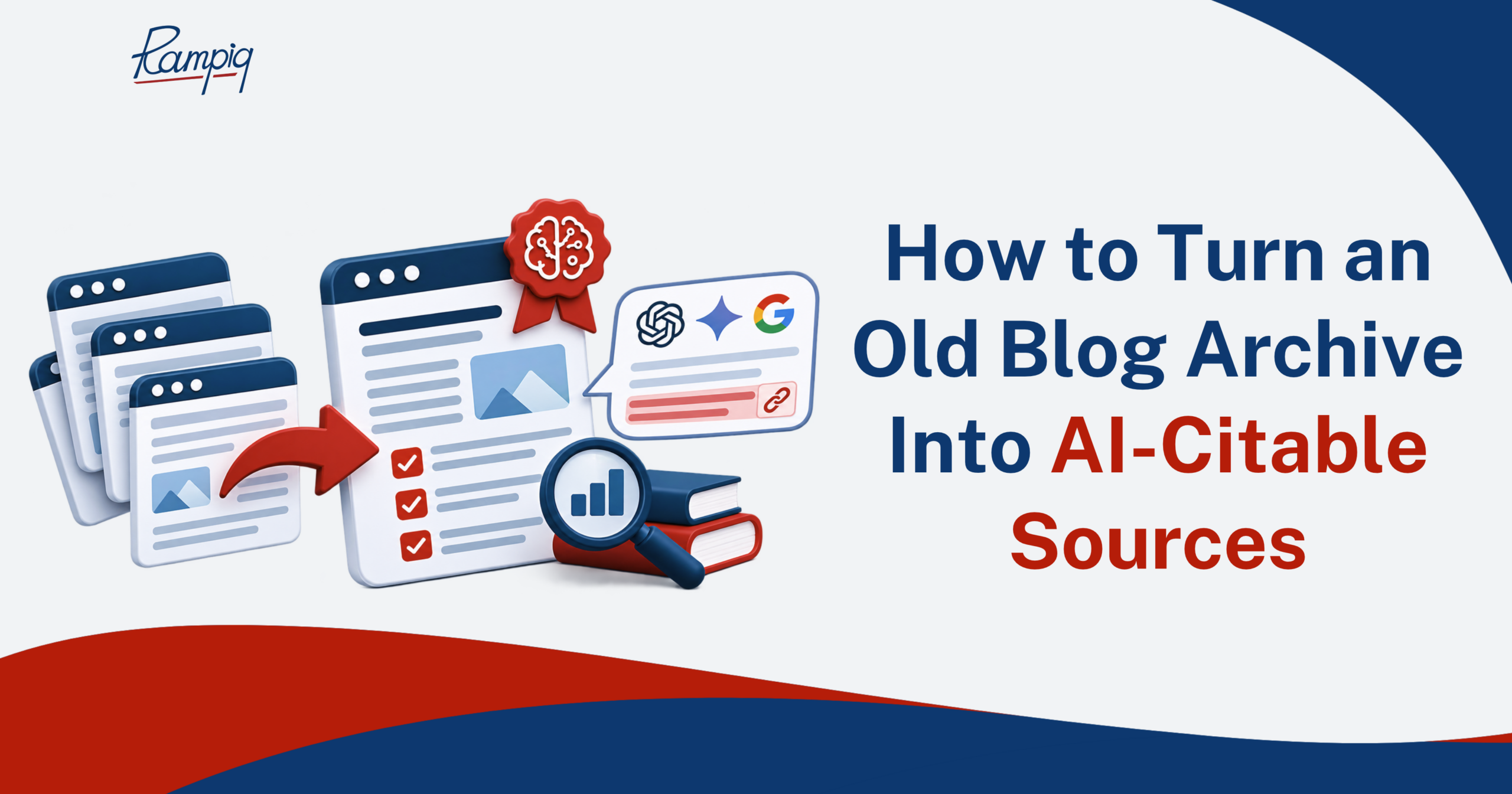
Your blog archive doesn’t need more posts to get cited by AI engines. It needs fewer, stronger ones: one authoritative URL per subtopic with its duplicates redirected into it, rebuilt so a single passage can be lifted on its own.
That’s existing content optimization at archive scale. For Case IQ, the work started from the existing content library instead of new content creation, and the client now has 850+ keywords ranking in AI Overviews (one client, after a site migration). Related results are in our GEO case studies.
Quick answer: Score every post on topical overlap, performance, freshness and pipeline fit. Merge when three or more posts answer the same subtopic, retire posts with no traffic, links or citations, and refresh the rest. Redirect each retired URL to its closest survivor, then rebuild every survivor answer-first.
Why archives get skipped: AI search splits a question into related sub-searches. Google calls this query fan-out and says its AI features issue “multiple related searches across subtopics.” Each sub-search wants one clear page. When five of your posts half-answer it, Google decides which pages are duplicates based on similarity of content, and the one it keeps may be your weakest.
Five posts on one subtopic ≠ five chances to be cited.
Score every post before you decide anything. The scoring sheet is the decision. The rewrites come later.
Check Crawler Access Before You Score Anything
A post that can’t be fetched can’t be cited, so start with access. OpenAI documents two separate crawlers: OAI-SearchBot surfaces sites in ChatGPT search, while GPTBot collects data for model training, and each robots.txt setting is independent. Sites opted out of OAI-SearchBot are not shown in ChatGPT search answers, per OpenAI’s crawler documentation. After a robots.txt change, OpenAI says its systems take about 24 hours to adjust.
Check robots.txt first, then your CDN or firewall bot settings for the same user agents.
On the Google side there is no special markup to add. Google’s guidance on AI features says a page must be indexed and eligible to show with a snippet to appear as a supporting link. A noindexed or blocked post is out before scoring starts.
Score Each Post on Four Signals
Export every blog URL into one sheet, then add four columns:
Signal
What to pull
0
1
2
Topical overlap
Other posts answering the same subtopic
2+ others
1 other
None
Performance
Organic clicks (12 months), referring domains, AI citations from your tracking tool
None of the three
One
Two or more
Freshness
Age of facts, examples, screenshots and product names
Wrong or outdated
Dated but correct
Current
Pipeline fit
Does the subtopic match a buying problem your ICP has?
No
Adjacent
Yes
Content decay is the gradual loss of traffic and accuracy as a post’s facts, examples and screenshots age. The freshness column measures it. A low score there means refresh, not delete.
Decide: Merge, Retire, or Refresh
Every row in the sheet gets exactly one decision. These are the thresholds we use:
Decision
Trigger
What happens to the URL
Merge
3+ posts answer the same subtopic, or 2 posts target the same primary query
Strongest post survives, the others 301 to it
Retire
Performance 0 and pipeline fit 0
301 to the closest relevant page, or remove it if none exists
Refresh
Unique subtopic, pipeline fit 1-2, freshness 0-1
Keep the URL, rewrite the content
Keep
Unique, and no row above applies
Leave it alone
Your weaker posts may still earn a few clicks each. Spread across one subtopic, they compete for the same sub-search and none of them reads as the authority.
This is the same sheet we’re running on our own 128-post archive: every post scored, every row decided, before any copy changes.
How to Merge Without Losing AI Citations
A 301 redirect permanently moves a URL. Google Search Central’s redirect documentation (April 2026) says the indexing pipeline uses a permanent redirect as a signal that the redirect target should be canonical.
A rel=”canonical” tag keeps both URLs live and signals which one should be canonical. Google’s canonicalization guide lists redirects as a strong signal and says to use them only when deprecating a duplicate page.
For a merge, the old post is being deprecated, so use the 301. Reserve canonical tags for duplicates that must stay live, such as a campaign copy of the same article.
The merge itself, in order:
Pick the survivor. Highest performance score wins. On a tie, keep the URL with more referring domains and AI citations.
Build the redirect map. A two-column sheet: retired URL, survivor URL. One row per retired post, each pointing at the closest matching survivor.
Move the substance. Every unique statistic, example, quote and source from the merged posts goes into the survivor once, with its original source and date.
Ship content and redirects together. The survivor goes live with the merged material the same day the redirects do, so every redirect lands on a page that already answers the retired post’s question.
Update the schema. Set dateModified on the survivor’s Article markup to the merge date.
Restructure the Survivor for LLM Retrieval
Build the survivor so each section answers one sub-search from the fan-out on its own:
Answer-first intro. The direct answer in the first two to four sentences, before any context.
One question per heading. Phrase H2s and H3s as the questions buyers ask, and answer in the first sentence below each.
Self-contained passages. No “as mentioned above”. Each section names its subject in full, so it still makes sense when lifted alone.
Sources next to claims. The statistic and its source in the same paragraph.
A short FAQ for leftovers. Only residual questions the body leaves open, marked up with FAQPage schema.
A visible updated date. Show it on the page and keep it in sync with dateModified.
A retired URL should disappear from everything you control: redirects, sitemap and internal links.
Remove retired URLs from your XML sitemap. Google’s canonicalization guide treats sitemap inclusion as a weak canonical signal, so a sitemap listing redirected URLs argues against your own redirects.
Update internal links to point straight at the survivor instead of passing through the redirect. Then check for chains: if an older redirect points at a post you just retired, repoint it to the final survivor.
Use permanent redirects only for retirements you won’t reverse. Once the archive is clean, new briefs go only where the scoring sheet shows a gap, which is how an organic growth engine stays lean.
If you’d rather have the archive scored for you, our AI search & GEO audit includes an AIOs-focused content audit and an attack plan covering 10 priority pages and 50 keywords.
See Where Competitors Beat You in ChatGPT
Are AI tools recommending your competitors instead of you?
Understand how AI platforms describe your brand vs. your competitors and the exact steps to flip those results.
How many blog posts on the same topic is too many?
More than one per distinct question. When three or more posts answer the same subtopic, merge them into one page and redirect the rest. Two posts can coexist when they target different queries or funnel stages.
Does consolidating hurt existing SEO rankings?
Not when each old URL gets a permanent redirect to a closely matching page, which is the documented way to consolidate duplicates. Rankings can move while old URLs are recrawled, so compare a full quarter before and after.
How long before AI engines pick up a consolidated page?
No engine publishes a fixed timeline, because pickup depends on recrawling. In our AI Search & Visibility Program, first meaningful signals typically appear within 60 to 90 days. Treat that as a typical window, not a guarantee.
About the author
Liudmila Kiseleva
Liudmila is one of the best-in-class digital marketers and a data-driven, very hands-on agency owner. With top-level education and experience, Liudmila is a true expert when it comes to digital marketing strategies and execution.
Your existing blog archive could be a source of AI citations without adding more content. See how to audit old posts, decide what to merge, retire, or refresh, and restructure pages for AI Search while protecting existing SEO rankings.
More traffic and leads don't always mean more qualified pipeline. See where B2B leads drop off, why marketing and sales qualification often don't align, and how to measure AI Search, SEO, and paid media against the right buyer stages.
Learn how to reach B2B buying committees by combining AI Search, SEO, and paid media. See how to target different decision-makers, coordinate channels across priority accounts, and avoid overlapping spend, with real client examples.
Learn how AI Search, SEO, and paid media work together to generate qualified B2B pipeline. See how to sequence these channels, measure their contribution to sales opportunities, and avoid common mistakes, with real client results.
See how AI assistants build B2B vendor shortlists, which agencies get recommended, and what drives those recommendations. Based on real AI search data, learn why third-party mentions matter and how to improve your brand’s chances of being shortlisted.
See what AI visibility and GEO programs cost in 2026, what drives pricing, and what’s included at each budget level. Learn how to evaluate agency quotes before you commit.