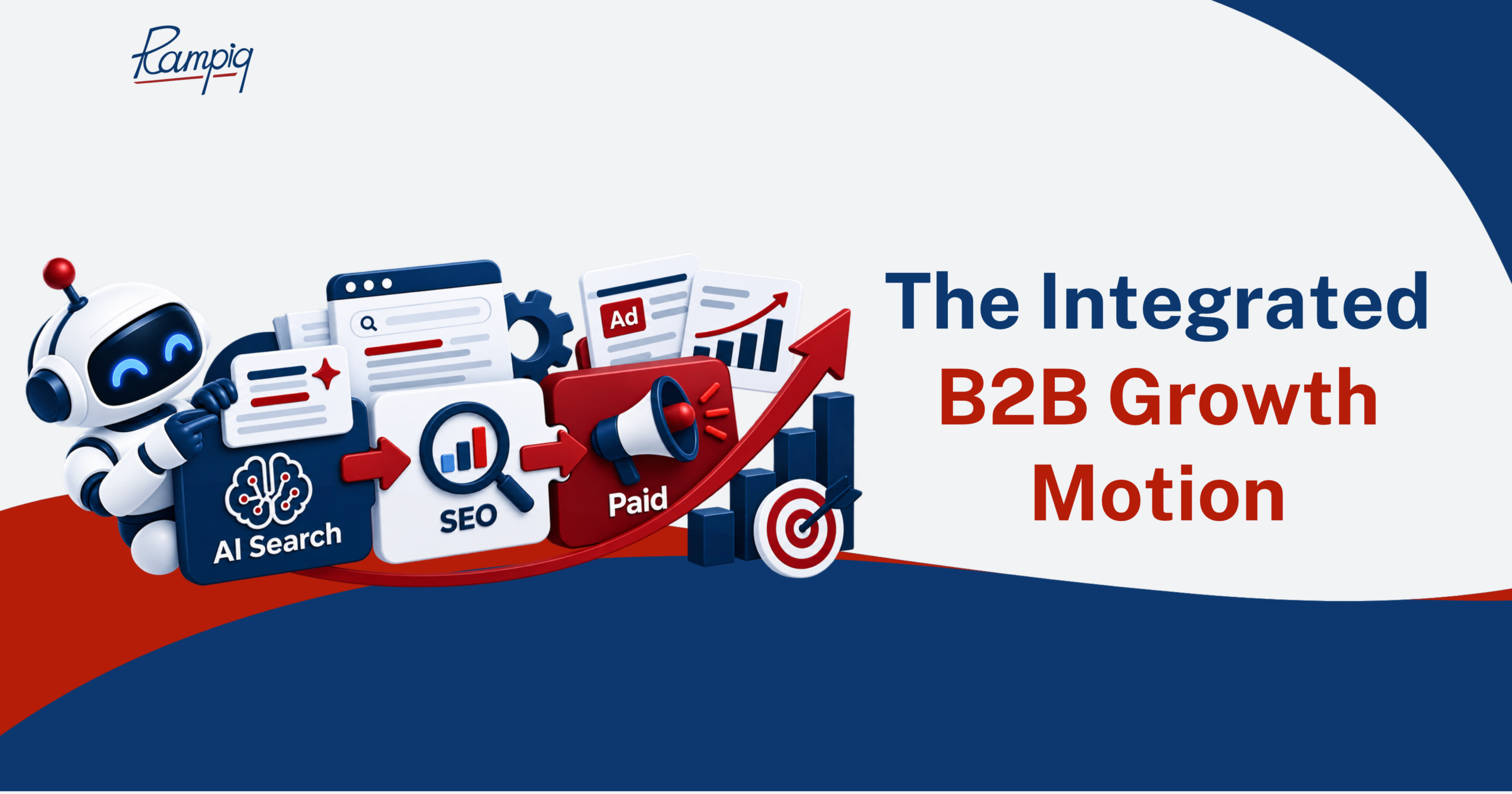
AI Search, SEO and paid media produce more pipeline as one sequenced program than as three separate budgets. If you’re judging a B2B demand generation agency, ask how it connects all three to qualified opportunities, not how it reports each channel on its own.
Quick answer: An integrated B2B growth motion runs AI Search, SEO and paid media in a fixed order. AI Search gets your brand cited while buyers build a shortlist. SEO captures the research-stage searches on the same pages. Paid media then shortens the cycle for accounts that already know you, and all of it is measured in pipeline.
For Avassa, an edge-computing platform, one sequenced program moved AI Overview visibility up 2900% and organic conversions up 89% year over year (one client, after a site migration).
Shortlists form before the first sales conversation. The 6sense 2024 Buyer Experience Report found that 81% of B2B buyers already have a preferred vendor at first contact.
An integrated channel motion treats AI Search, SEO and paid media as one coordinated program with one ICP, one set of buying problems, one content base and one pipeline target.
The default is the opposite: a GEO vendor, an SEO retainer and a LinkedIn Ads budget, each with its own dashboard.
Your siloed setup may still be producing leads. It just can’t show which channel put you on the shortlist.
Generative engine optimization (GEO), also called answer engine optimization (AEO), is structuring content so AI engines such as ChatGPT, Perplexity and Google AI Overviews cite it directly.
Pipeline attribution is tying channel activity to qualified opportunities and pipeline dollars, instead of traffic or impressions.
The silo problem gets worse as buying groups grow. Forrester’s State of Business Buying 2026 reports that a typical decision now includes 13 internal stakeholders and nine external influencers.
Integrated work starts with AI visibility optimization built on the same entity and content decisions as SEO and paid.
How do AI Search, SEO and paid media compound into pipeline?
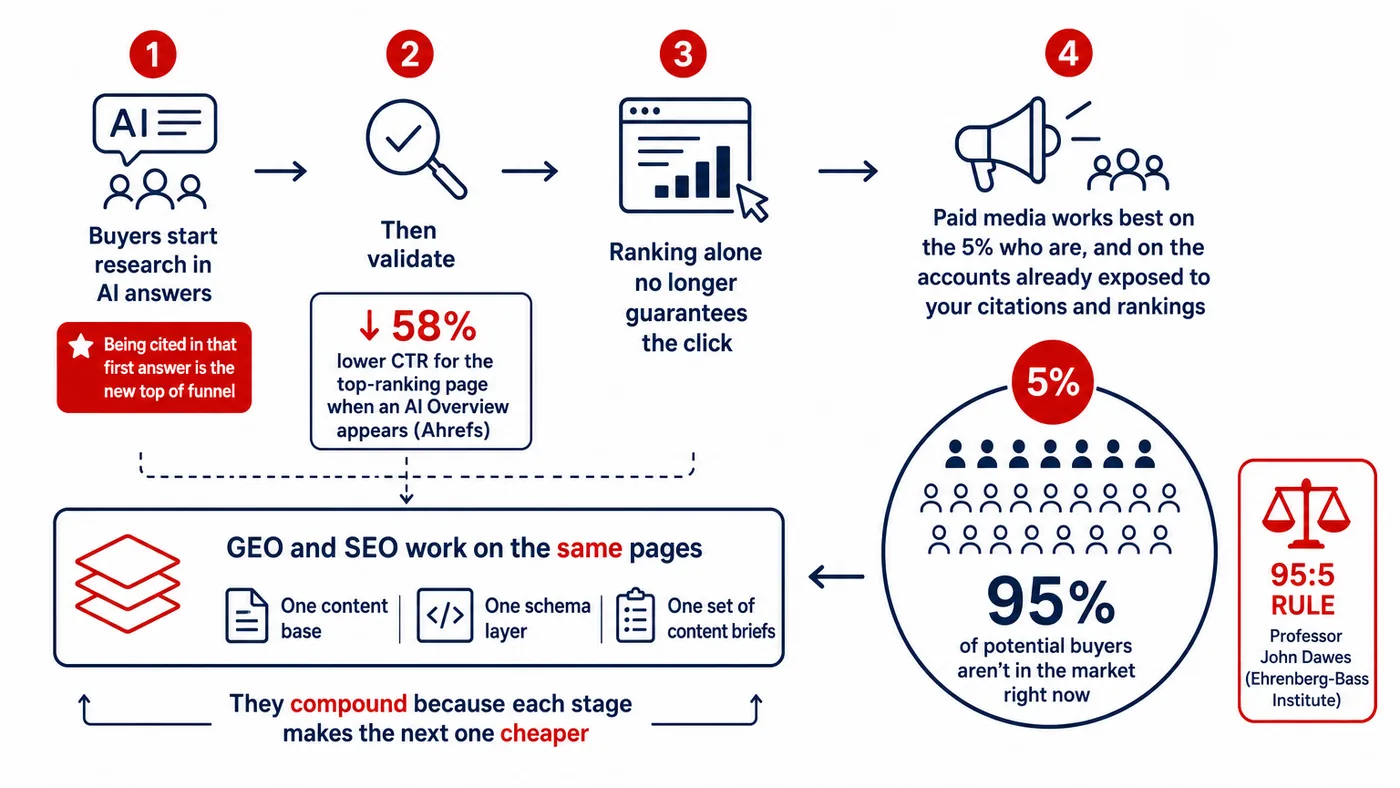
They compound because each stage makes the next one cheaper. Run them in this order.
Stage 1: AI Search earns a place on the shortlist
Buyers start research in AI answers, then validate. Forrester’s 2026 research describes genAI search as where buyers begin, and notes that answer engines often deliver incomplete or unreliable information, so buyers check trusted sources next.
Being cited in that first answer is the new top of funnel.
Stage 2: SEO captures research-stage demand on the same pages
GEO and SEO work on the same pages, so they share one content base, one schema layer and one set of content briefs.
For Case IQ, Rampiq upgraded existing pages instead of producing net-new content. The result: 850+ keywords ranking in AI Overviews, 145% growth in Top-3 rankings and 3,650+ keywords on page one (one client, after a migration and rebrand).
That is what an organic growth engine does inside the motion: it turns citation-level trust into owned rankings.
Stage 3: Paid media compresses the remaining cycle
Most of your market isn’t buying today. Professor John Dawes of the Ehrenberg-Bass Institute summarizes this as the 95:5 rule: 95% of potential buyers aren’t in the market right now.
Paid media works best on the 5% who are, and on the accounts already exposed to your citations and rankings. LinkedIn Ads targeted at buying roles, with remarketing to engaged visitors, reach a committee that has already seen your name.
random visibility ≠ revenue. Sequenced visibility is how visibility becomes pipeline.
Proof: what compounding looks like in a real program
Avassa ran all three stages together. Rampiq audited and reoptimized existing content around edge-computing topics, structured it for ChatGPT, Perplexity and Gemini, and rebuilt LinkedIn Ads around key buying roles with remarketing layers.
Organic and AI results (one client, after a website migration):
Top-20 keyword visibility up 575%
Organic impressions up 356% year over year
AI referral traffic up 408%
The case study publishes no LinkedIn-specific numbers, so the paid contribution is not broken out.
More client results show the individual stages at work, starting from existing content.
How do you measure an integrated program in pipeline?
Measure every stage against one pipeline number, with a leading indicator per stage:
AI Search: share of tracked buyer prompts where you’re cited, plus AI referral traffic.
SEO: Top-3 rankings on ICP-matched pages and organic conversions.
Paid: sales-accepted leads and pipeline sourced or influenced.
Program: total qualified pipeline and the share each stage touched.
Hold paid media to pipeline share, not cost per lead. One SAP-solutions provider reports that PPC generated 40% of its total sales pipeline, with a 23% conversion rate from PPC leads to sales-accepted leads (one self-reported Clutch review, after a LinkedIn and Google Ads restructure and a service-page redesign).
Treat your first month of AI visibility data as a baseline snapshot, since trend claims need several months of data.
Where integrated programs break
Most failures come from order and ownership, not from any single channel:
Paid before proof. Ads send committees to pages AI engines don’t cite and Google doesn’t rank, so buyers validate elsewhere.
Net-new content first. Upgrading pages that already rank is faster than building a new library from zero.
Separate briefs per channel. When GEO, SEO and ad copy describe the product differently, AI engines get mixed entity signals.
Channel-level reporting. Three dashboards hide the hand-offs between stages, which is where compounding happens.
Fix the order before adding budget.
Who this model fits
The integrated motion pays off most where sales cycles are long and buying committees are large.
Company situation
Sales cycle
Fit
Where to start
Established B2B SaaS or IT company, $10M+ revenue, in-house marketing team, active content and paid budgets
Long, multi-stakeholder
Strong
Audit AI visibility and existing pages, then sequence paid
Company recovering from a site migration or rebrand
Any
Strong
Recover rankings and AI citations before scaling paid
Early-stage company without an in-house team or content base
Variable
Partial
Build the content base and ICP first
Short, transactional purchase
Short
Weak
Paid search and conversion work carry most of the load
The first row matches Rampiq’s segment fit. Where a company sits lower in the table, one channel done well beats three done thinly.
See Where Competitors Beat You in ChatGPT
Are AI tools recommending your competitors instead of you?
Understand how AI platforms describe your brand vs. your competitors and the exact steps to flip those results.
What’s the difference between AEO and traditional SEO for B2B?
Traditional SEO earns a ranked link that buyers may click. AEO, or GEO, earns a citation inside the AI answer itself. In practice they share pages, schema and content briefs, so B2B teams get the most from running them as one program rather than two.
How long before an integrated program shows pipeline results?
In our AI Search programs, first meaningful signals typically appear within 60 to 90 days, and revenue-attributable traffic typically compounds between months 4 and 9. These are typical windows, not promised results. Paid media can produce sales-accepted leads sooner once the pages it points to are ready.
What should I ask an agency that claims to combine AI Search, SEO and paid media?
Ask for one client result that shows AI citations, rankings and pipeline from the same program. Then ask how they report pipeline across channels. If each channel has its own dashboard and no shared pipeline number, the work is coordinated in name only.
If you want AI Search, SEO and paid media running as one motion against your pipeline target, see our integrated service model.
About the author
Liudmila Kiseleva
Liudmila is one of the best-in-class digital marketers and a data-driven, very hands-on agency owner. With top-level education and experience, Liudmila is a true expert when it comes to digital marketing strategies and execution.
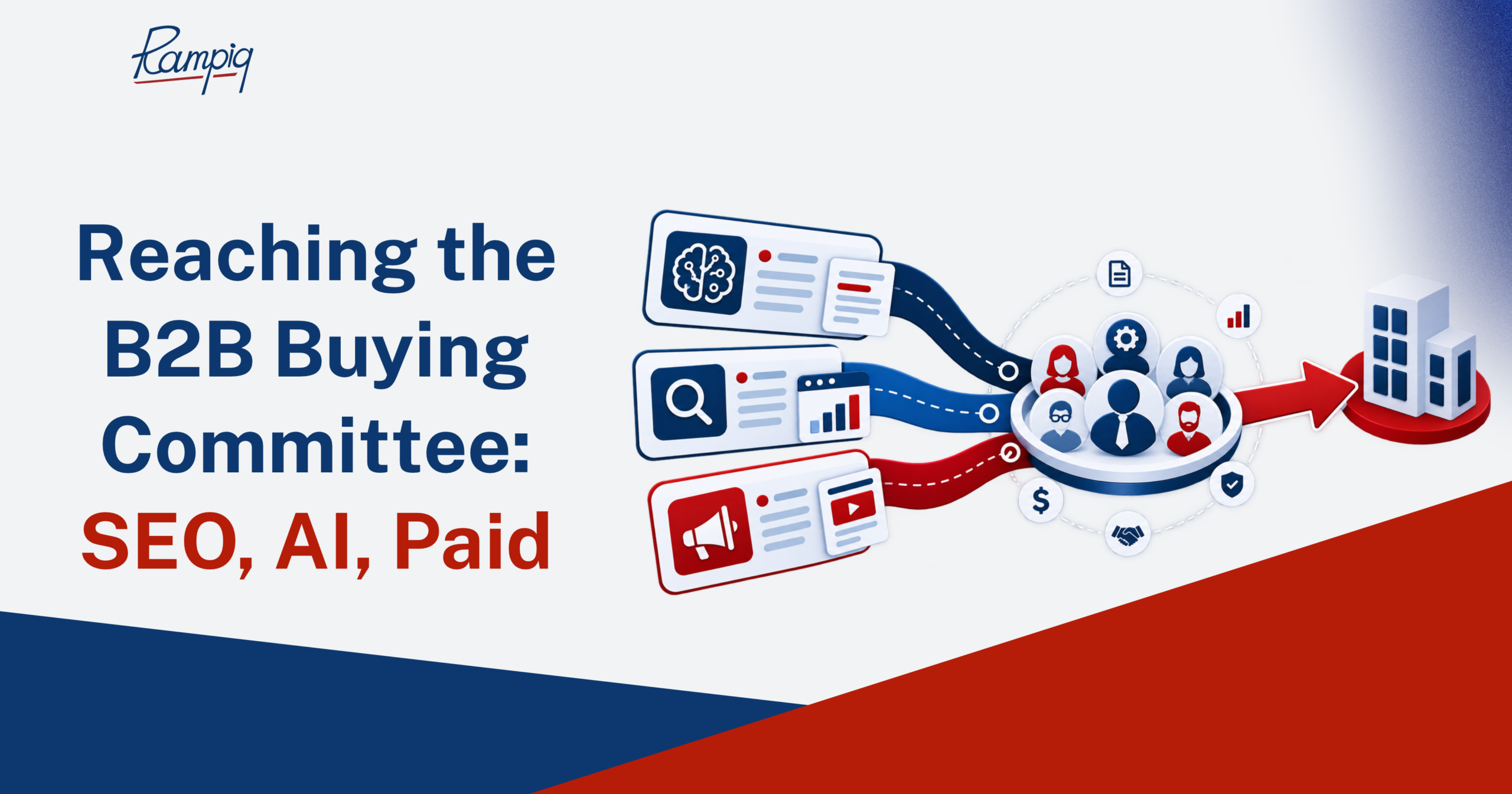
Learn how to reach B2B buying committees by combining AI Search, SEO, and paid media. See how to target different decision-makers, coordinate channels across priority accounts, and avoid overlapping spend, with real client examples.
Learn how AI Search, SEO, and paid media work together to generate qualified B2B pipeline. See how to sequence these channels, measure their contribution to sales opportunities, and avoid common mistakes, with real client results.
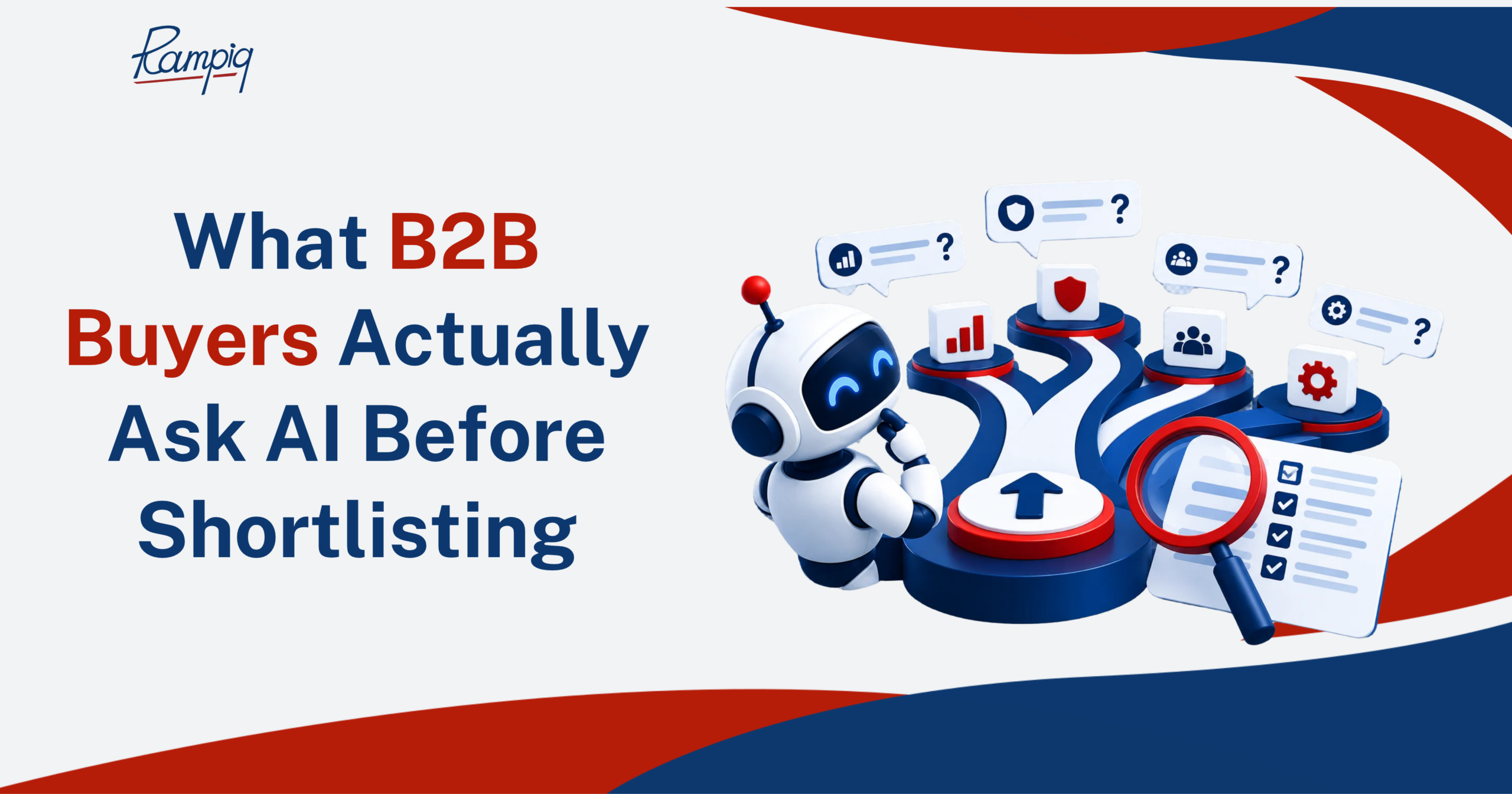
See how AI assistants build B2B vendor shortlists, which agencies get recommended, and what drives those recommendations. Based on real AI search data, learn why third-party mentions matter and how to improve your brand’s chances of being shortlisted.
See what AI visibility and GEO programs cost in 2026, what drives pricing, and what’s included at each budget level. Learn how to evaluate agency quotes before you commit.