Cybersecurity and compliance SaaS vendors get recommended by AI assistants when independent sources confirm what their own pages claim. Your site still has to state each security claim in a form an engine can check. That means the standard, the scope, the date, and the place to verify it.
This works in compliance software. Case IQ, an investigative case-management and compliance platform, reached 850+ keywords ranking inside AI Overviews and 145% growth in Top-3 rankings after Rampiq’s technical and GEO content work (one client, after a site migration, per the Case IQ case study).
Quick answer: AI assistants recommend security and compliance vendors whose claims are dated and repeated by sources the vendor doesn’t control: an audit report with a named type and period, a certificate with a scope, a current review profile, an analyst report cited by title. Vague assurance copy gives an engine nothing to cite. What changes is sentence-level work: rewrite every security claim so a third party could verify it.
How do AI assistants evaluate security and compliance vendors?
An AI assistant evaluates a security vendor by the evidence it can retrieve about that vendor, and most of that evidence sits off the vendor’s site.
Assistants with web retrieval answer a shortlist prompt by pulling pages and composing an answer from them. That includes ChatGPT search, Perplexity, Gemini, and Google AI Overviews.
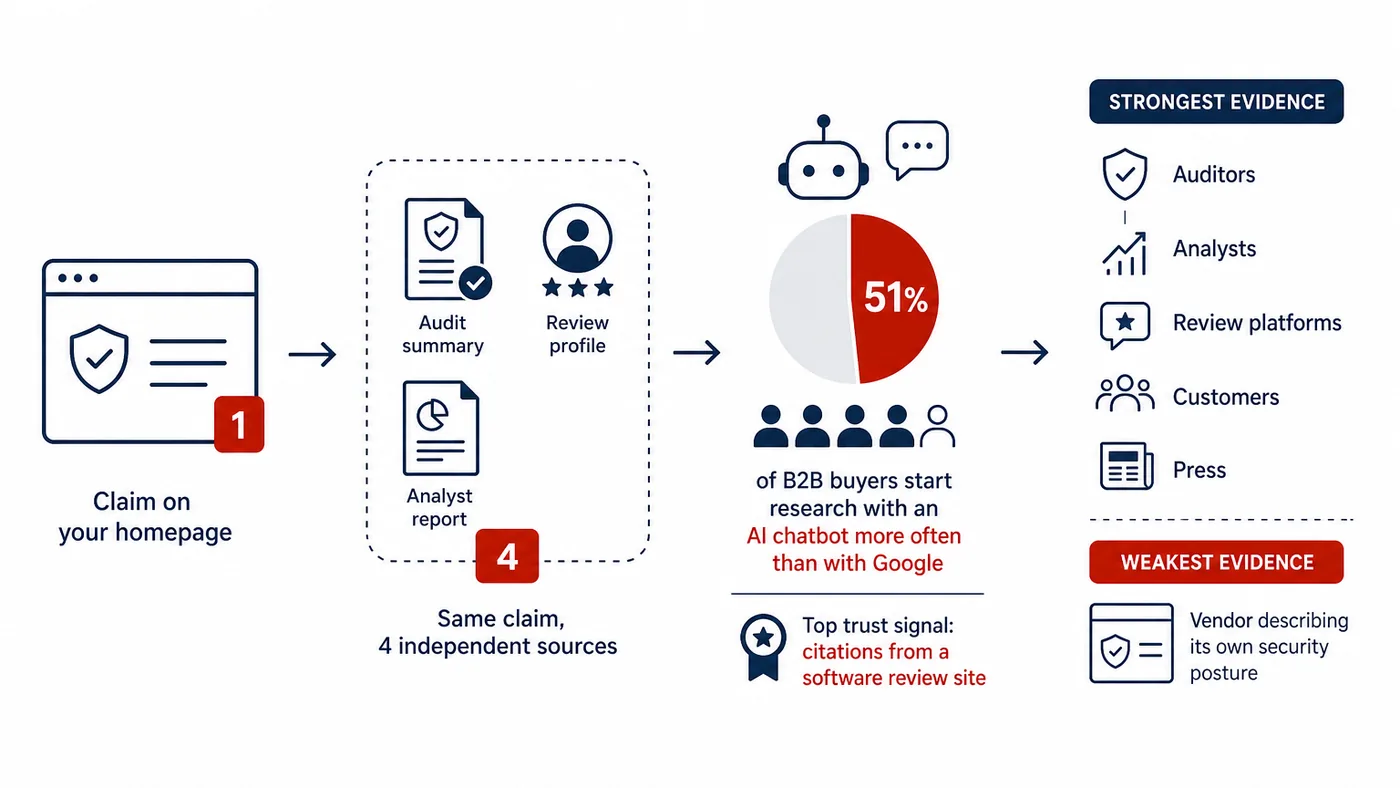
A claim that appears only on your homepage is one source. The same claim in an audit summary, a review profile, and an analyst report is four. That’s our working model from audit work, since engines don’t publish ranking formulas.
Buyers already shop this way, and in G2’s Answer Economy research (April 2026), 51% of B2B software buyers said they now start research with an AI chatbot more often than with Google (survey of 1,076 buyers and decision-makers, March 2026). The same buyers named citations from a software review site as their top trust signal.
Third-party corroboration is the repetition of a vendor’s claim by sources the vendor doesn’t control: auditors, analysts, review platforms, customers, and press. For security buyers it is the dominant trust signal. A vendor describing its own security posture is the weakest evidence of it.
Your security page may already be accurate. It just isn’t written for a reader that checks every sentence against other sources.
What changes for compliance software?
Compliance software raises the bar further, because buyer prompts name frameworks directly (“SOC 2 Type II GRC tool for a fintech”). The framework, report type, and scope have to exist on your pages as text an engine can match.
Which trust signals do AI engines actually pull from?
AI engines pull trust signals from the places where a third party has already checked the vendor. Each signal below has a home, and the home is what gets cited.
SOC 2 is an attestation report issued by an independent CPA firm, covering controls relevant to security, availability, processing integrity, confidentiality, or privacy (AICPA & CIMA). A Type I report assesses control design at a point in time. A Type II report tests whether controls operated over a review period.
ISO/IEC 27001 is the international standard for an information security management system. Certification comes from an accredited certification body against a defined scope (ISO/IEC 27001:2022). In security buying, both are baseline proof points. They qualify you for the shortlist without setting you apart on it.
A trust center is a public, crawlable page where a vendor lists its certifications, audit reports, subprocessors, and security policies in one place. Other pages should link to it rather than restate it, so every claim has one source of truth.
An analyst citation is a reference to a named, dated report from a firm such as Gartner or Forrester. “Recognized by leading analysts” gives an engine nothing to retrieve. The report title and year do.
Review ratings are the scores and written reviews on platforms such as G2 and Gartner Peer Insights. An engine can quote the score, the review count, and recent customer language directly.
Customer references count as corroboration only when they name the customer and a measurable result over a stated period.
Signal
Where it lives
What makes it citable
SOC 2 report
Trust center, full report on request or under NDA
Report type, period end date, issuing audit firm
ISO/IEC 27001 certificate
Trust center, certification body’s register
Scope, standard edition, expiry date
Analyst reports
Analyst firm’s site, licensed excerpt on vendor site
Disclosure history is a trust signal too. For US public companies, the SEC’s July 2023 rules require a Form 8-K disclosure of a material cybersecurity incident, generally within four business days of determining it is material. That record is public.
Your advisories page should state the same facts with the same dates. An engine that finds two versions of an incident trusts neither.
How do you rewrite sensitive claims so AI can safely cite them?
Handle a sensitive claim by making it verifiable on its own: name the standard, the scope, the date, and the place a reader can confirm it, then cut anything you can’t back with a document.
The pairs below are templates with bracketed fields to fill from your own audit reports and records. Nothing here describes a real vendor.
Claim type
Before
After
Compliance status
“We take compliance seriously and meet the highest industry standards.”
“[Product] holds a SOC 2 Type II report covering security and availability for the period ending [month year], issued by [audit firm]. Request it from our trust center.”
Analyst recognition
“Industry analysts recognize us as a leader.”
“[Product] is included in [exact report title] ([analyst firm], [year]) in the [category] category.”
Data protection
“Your data is completely safe with us.”
“[Product] encrypts customer data at rest with [algorithm] and in transit with [protocol and version]. Every disclosed vulnerability is listed on our advisories page with its fix date.”
Each “after” version does the same job. It gives the engine a fact it can match against another source.
The trust center confirms the SOC 2 period. The analyst site confirms the report title. Your advisories page and public CVE records confirm the fix dates.
Vague claim ≠ citable claim.
Which security claims should never ship?
Some claims fail verification by design, so cut them before an engine or a security reviewer finds them:
Inherited certifications. “Hosted on SOC 2 compliant infrastructure” implies your product is audited. Your cloud provider’s report covers the provider’s controls and leaves yours unaudited.
Absolute claims. Nobody can verify “unhackable” or “100% secure”, and one public incident contradicts both.
Expired or out-of-scope certificates. A certificate whose scope excludes the product you sell, or whose expiry date has passed, is a contradiction waiting to be retrieved.
Implied audits. “SOC 2 ready” or “aligned with ISO 27001” reads like a certification. If an audit is in progress, say so and give the expected report date.
What changes in your content plan
Your current security content can still be accurate. The work now moves from publishing more pages to making existing claims checkable. That applies to every page an engine can retrieve. For most security vendors it’s an editing project before it’s a writing project.
Inventory every claim. Pull each security and compliance statement from the site, product docs, and review profiles into one list.
Rewrite to the pattern above. Make the trust center the single source of truth and match its dates and scopes everywhere else.
Close the gaps off-site. Keep review profiles current and reference analyst coverage by report title, so independent sources say what your pages say.
Mark up and test. Add structured data, then run the prompts your buyers type, such as “SOC 2 Type II [category] tools”, and record which sources each assistant cites.
With that work, first meaningful signals typically arrive within 60 to 90 days, though that window isn’t promised.
Do your trust center and marketing pages disagree? Start there. Book an AI visibility audit and we’ll map every claim an engine can’t verify yet.
See Where Competitors Beat You in ChatGPT
Are AI tools recommending your competitors instead of you?
Understand how AI platforms describe your brand vs. your competitors and the exact steps to flip those results.
No. A badge image carries no text an engine can match, and buyers treat SOC 2 as a baseline. State the report type, scope, and period in text, and link to the trust center where the report is requested.
Do analyst reports outweigh customer reviews for AI trust signals?
Neither wins outright, because they answer different prompts. Analyst reports matter most when a prompt asks for category leaders. Review profiles supply current ratings and customer language for comparison prompts. Keep both current, since an outdated rating is one more inconsistency an engine can find.
What happens if a compliance claim can’t be independently verified?
Remove it or rewrite it until it can be. An unverifiable claim gives an assistant nothing to cite, and a buyer’s security reviewer will ask for the document anyway.
About the author
Liudmila Kiseleva
Liudmila is one of the best-in-class digital marketers and a data-driven, very hands-on agency owner. With top-level education and experience, Liudmila is a true expert when it comes to digital marketing strategies and execution.
Most citations point to third-party pages, led by review and analyst sites. For your own site, that makes review-profile coverage a lever worth checking alongside your homepage.
A step-by-step playbook to score, segment and re-engage dormant CRM contacts with a combined email and LinkedIn sequence, plus realistic reply-rate benchmarks.