1. Definition and Answer-First Pages
LLMs are fundamentally answer-retrieval systems. When a user asks “what is X” or “how does X work,” the model surfaces the clearest, most direct explanation available. Pages that answer the question in the first 40 to 60 words get disproportionately cited.
Ai visibility trackers consistently show that structured, definition-style content earns citation because the page does exactly what the LLM needs: produces a clean, extractable answer block.
For B2B brands, this means glossary pages, concept explainers, and lead paragraphs on service pages should be treated as a distinct citation asset class.
Structural characteristics that increase citation likelihood:
- A definitional sentence within the first paragraph
- A clear H1 aligned with user question patterns
- Short, self-contained sections of 50-150 words
This structure directly increases the likelihood of your content being extracted into AI-generated answers.

2. Product Pages
Product pages earn a larger share of LLM citations than many content strategists expect.
Branded query research shows product pages account for 12% of citations. When users ask about features, integrations, or use cases, LLMs rely on product pages as the authoritative source.
However, citation depends on specificity. Generic, promotional messaging is not extractable. Concrete, structured information is.
Pages that include:
- integrations
- pricing logic
- use cases by segment
- technical requirements
are consistently cited. Pages that rely on vague positioning are ignored.
For B2B SaaS specifically, buyer intent research shows that LLMs cite product pages most heavily at the Solution Aware stage, when the buyer already knows your category and is evaluating specific capabilities.
3. Homepages
Homepages appear in LLM citations more often for entity recognition than for information delivery. When a model is describing your brand in response to a comparative or navigational query, it often cites the homepage as the authoritative reference point for what the brand is and does.
This makes homepage content more strategically important than many B2B marketers treat it. Most B2B homepages are written only for conversion. LLMs rely on explicit statements about:
- what the company does
- who it serves
- how it is positioned
If your homepage conflicts with third-party descriptions, AI systems receive inconsistent signals and reduce citation confidence.
4. Comparison Pages
Comparison content is one of the highest-performing formats for LLM citation.
When users ask comparative questions, LLMs require structured differences across vendors. Pages that map products across dimensions provide directly extractable information.
High-performing comparison pages include:
- feature-level comparisons
- use case differentiation
- pricing and implementation differences
- clear trade-offs
Citation data shows that comparison content and editorial roundups drive a significant share of citations for B2B SaaS brands, particularly in Gemini and Perplexity, which lean toward affiliate-style and listicle content. Reddit’s “versus” discussion threads are the highest-cited comparison format of all, precisely because they contain multi-perspective, experience-grounded feature debates that LLMs treat as validated evidence.
For brand-owned comparison pages, the structural requirements are strict. The page must actually make claims rather than present a generic table where your product wins every category.
Balanced comparison content is treated as more credible and is cited more frequently.
5. Marketplace Listings and Directory Profiles
Third-party directories consistently rank among the most cited sources.
G2, Capterra, TechRadar, Gartner Peer Insights, and similar platforms appear across all major LLMs.
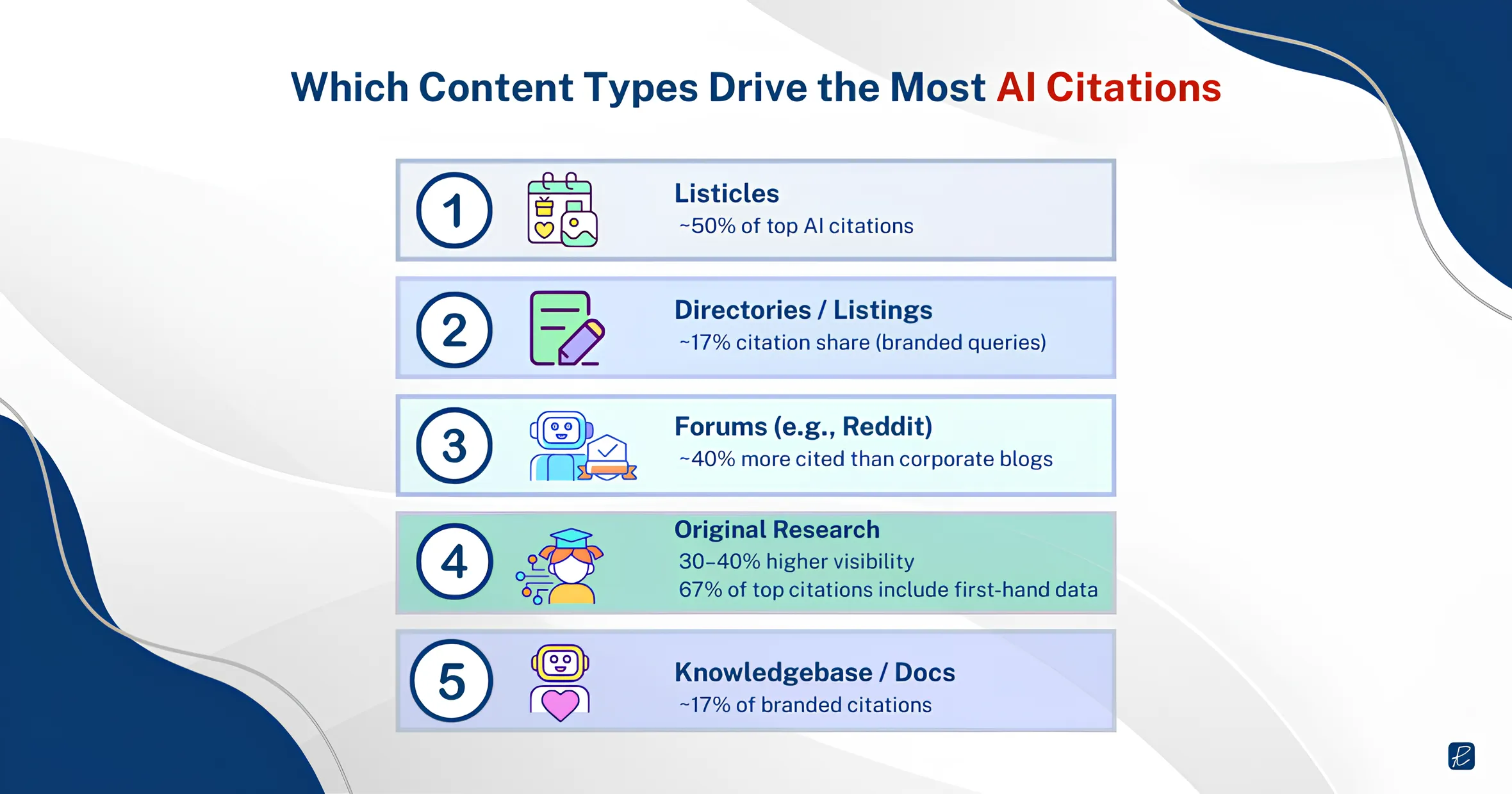
Across the research, directory sites and reference pages are found to have a 17% citation share for branded queries, making it the second-largest citation category after social proof.
For B2B brands, directory presence is a primary driver of AI visibility, not a secondary SEO tactic.
Optimization here includes:
- profile completeness
- consistent positioning
- active review generation
- presence on high-impact platforms.
6. High-Authority Listicles
Listicles are the most cited format in AI responses, accounting for roughly 50% of top citations.
Numbered and bulleted lists create clear extraction boundaries. When a model is generating a list-based answer like “top tools for X” or “key factors to consider for Y,” listicle content maps directly onto that response structure. That’s because the model doesn’t need to re-parse or synthesize as heavily. It can extract and attribute quickly.
For B2B brands, this creates two opportunities:
- earning citations through owned listicles
- appearing in third-party listicles
7. Forum and Community Pages
Reddit is cited by LLMs roughly 40% more often than corporate blogs. Wikipedia’s citation share in LLM responses has been measured at 26.3%.
OpenAI and Google paid Reddit more than $130 million annually for content access. For B2B brands, the forum citation dynamic creates a specific strategic gap. If your brand is discussed on Reddit, that content becomes citation material regardless of whether your brand created it.
The citation formats that perform best in forum environments include troubleshooting threads, “I used X for six months, here’s what changed” reviews, and “X versus Y for [specific use case]” debates.
8. Original Data Studies and Benchmark Reports
Content featuring original statistics and research findings sees 30 to 40% higher visibility in LLM responses. According to AI citation format research, 67% of ChatGPT’s top citations come from content containing first-hand data.
LLMs are designed to produce evidence-based answers. When a model encounters a specific, verifiable data point (not “email marketing has strong ROI” but “analysis of 1,000 B2B campaigns shows email delivers $42 return per $1 spent”), it has something to cite.
For B2B brands with access to customer data, platform analytics, or survey capability, original research is the highest-value content investment for AI citation. A benchmark report that publishes defensible data on a topic your buyers care about becomes a primary source. Primary sources get cited.
The format matters as much as the existence of the data. Tables and structured data are cited 2.5x more often than equivalent unstructured content.
9. Step-by-Step Frameworks and How-To Guides
How-to content earns consistent LLM citation because it maps directly onto the query patterns users bring to AI systems. “How do I…” and “What’s the process for…” are among the highest-frequency B2B query structures, and LLMs serve them best with structured procedural content.
A guide titled “How to Build a B2B Content Strategy” that describes phases at the level of “first, understand your audience” provides little extractable procedure. One that gives specific steps with concrete decision criteria, named tools, timing guidance, and failure conditions at each stage gives the model detailed, attributable content.
Long-form guides (2,000+ words) get cited three times more often than short posts. The length advantage is not about word count for its own sake. Guides that answer the primary question earn citation across the full range of query variations on a topic.
10. Knowledgebases and Wikis
Knowledgebase content, including product documentation, technical wikis, integration guides, and support articles, earns around 17% of branded citation share.
When a buyer asks a question like “Does [your platform] support SSO with Okta?” or “What’s the API rate limit for [your tool]?”, the LLM needs a factual, authoritative answer. Your knowledgebase is the only source that has it.
The underappreciated B2B implication is that knowledgebase content is often excluded from content strategy discussions because it’s “support content” rather than “marketing content.” If the page answers a question a buyer is asking during evaluation, it is a citation candidate. Many B2B brands have extensive knowledge bases that are poorly structured, inconsistently maintained, and not treated as SEO or GEO assets.
11. Expert Commentary and Thought Leadership
Expert commentary earns preferential citation when it provides unique perspectives or analysis unavailable elsewhere. Generic thought leadership, where a piece describes a trend that a dozen other pieces have already described in similar terms, earns very low citation share.
Our branded query research found thought leadership accounting for only around 5.4% of citations. The citation-earning characteristics for this content type are specific: edge case coverage that the standard explanation misses, complexity acknowledgment where other sources oversimplify, named expert attribution with verifiable credentials, and claims specific enough to be verifiable or falsifiable.
12. About Us, Policy, and FAQ Pages
Brand foundation pages, including About Us, FAQ, Terms of Service, and policy pages, appear in LLM citations most often in response to trust-evaluating queries. “Who are they?” “Are they a legitimate company?” “What’s their data policy?” These questions come up in B2B evaluation, and LLMs pull from brand foundation pages to answer them.
We classify these pages as a distinct citation category, noting that while their overall citation share is low for informational queries, they carry disproportionate weight for credibility-building answers.
The FAQ page deserves specific attention. FAQ sections that address objections, implementation concerns, pricing structure questions, and comparison-to-competitor questions, get extracted by LLMs responding to those same questions.
Methodology Behind the Findings
The citation figures referenced throughout this article draw from several large-scale studies covering millions of LLM outputs across ChatGPT, Perplexity, Gemini, and Google AI Overviews, using Peec AI and similar platforms to track citation sources at scale. We also draw from AI visibility audit work conducted with Amadora across B2B client accounts, tracking citation frequency, accuracy, and source distribution for specific query sets. Brands absent from third-party sources at the start of an engagement are also absent from LLM answers.
Why Some Content Gets Cited by LLMs (and Most Doesn’t)
The citation patterns above share an underlying logic that is worth making explicit.
LLMs are not search engines. They don’t rank pages. They retrieve and synthesize passages that answer user queries, then attribute those passages to sources.
Three factors drive the majority of citation selection:

- Semantic completeness: Content that addresses a topic from multiple angles correlates with inclusion in AI-generated answers. Pages that answer the primary question score dramatically higher than pages that answer only the headline query.
- Authority corroboration: Brand authority is the strongest single predictor of citation likelihood (0.334 correlation). Brands that appear consistently across multiple trusted sources, with consistent messaging and clear topical focus, get cited more reliably than brands with strong individual domains but sparse third-party presence.
- Extractability: Content that cannot be reliably parsed cannot be reliably cited. This is structural, not a judgment about content quality. Pages with clean heading hierarchy, self-contained answer sections, tables for comparative data, and FAQ-style question framing give LLMs clean extraction targets.
For a detailed framework on making your existing content AI-ready, see our guide to AI-ready content structure.