What marketers should take away from Google’s messages
When you read their guide, it’s hard to argue with most of it. Google’s AI features rely on most of the same ranking and quality systems that power traditional search. It is also true that AI search introduces new standards, and LLMs give far more weight to certain signals than traditional ranking ever did.
Google Search is now AI search by default. Instead of crawlers reviewing and storing pages in a database, AI search agents now run in the background around the clock, scanning ‘the entire web across sites, social and forums’ for information to formulate an answer.
Search now runs on agents, not just crawlers
Google Search is now AI search by default. Instead of crawlers reviewing and storing pages in a database, AI search agents now run in the background around the clock, scanning ‘the entire web across sites, social and forums’ for information to formulate an answer.
Appearing is easy, winning is the hard part
Businesses that win in AI Search are those that invest in it early. Google’s guidelines give you the basics of ‘appearing’ in AI search results, and that’s all businesses have to do to show up. But to ‘win’, businesses must adapt to certain new standards, considering the overhauled search space.
What Google’s ‘skip it’ advice really means
Google’s guide also names a few things you supposedly don’t need. Read each warning closely and it targets the manipulative version, not the legitimate practice:
- llms.txt and AI-specific files: Google says you don’t need them to appear, but that only applies to its own AI features. Other AI tools still consume llms.txt, so it’s low priority for Google specifically, not pointless everywhere.
- Chasing mentions: The warning is aimed at manufactured mentions. Authentic presence across the web matters more now, not less.
- Over-focusing on structured data: The warning is aimed at spammy, over-optimized markup. Clean, machine-readable structure gets more valuable the moment an agent parses your site.
For example, Google mythbusted the llms.txt standard, saying ‘you don’t need to create new machine-readable files, AI text files, markup, or Markdown to appear in generative AI search.’ But Google’s own developer site publishes one at https://ai.google.dev/api/llms.txt. That isn’t quite the contradiction it looks like, Google’s point is that the file won’t help you rank in Google’s AI features, not that the format is useless everywhere, since other AI tools do consume it. The honest read: llms.txt is low priority for Google AI search specifically, not a silver bullet anyone should build a strategy around.
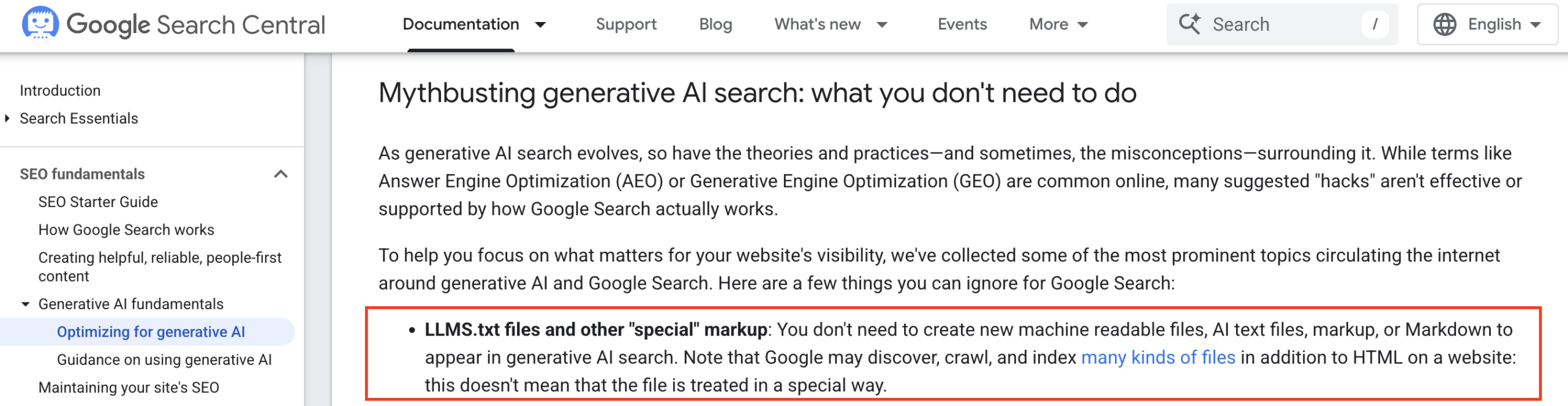
Google claims files like llms.txt or other ‘special’ markup files for AI agents do not impact AI search visibility
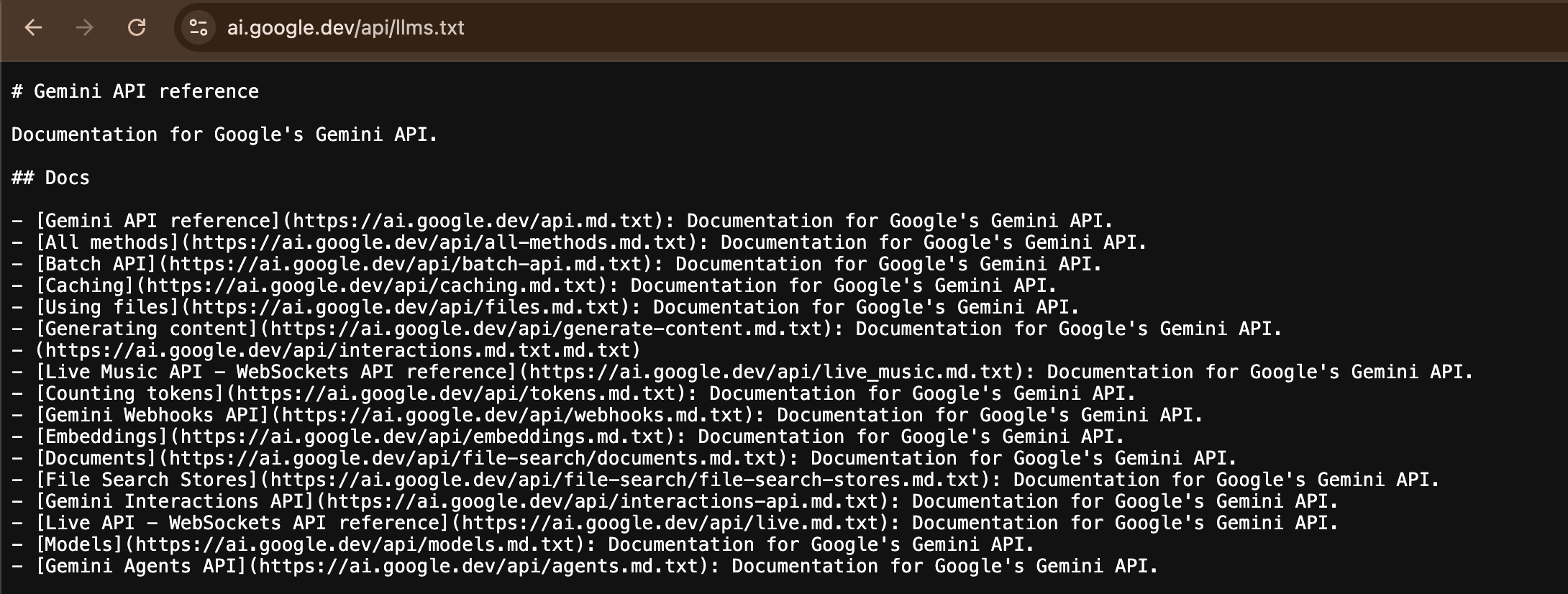
Google’s own site uses llms.txt
Google also tells businesses not to chase mentions and not to overfocus on structured data. Looking beyond this message, marketers must understand that both warnings aim at the manipulative versions.
The keynote showed agents pulling answers from crowdsourced research platforms, news sites, and social discussion, and showed a universal cart reading product data across the web to reason about what to surface. It’s clear that authentic presence is more critical now than ever. And clean, machine-readable structure becomes more valuable the moment an agent is parsing your site.
Plenty of the tactics still look like SEO, and the foundations still matter. But ‘still SEO’ is the reassuring half of the message that gets brands caught out. AI search is a distinct channel now, with its own retrieval, its own metrics, and its own ways to lose without noticing. B2B brands that treat the search space as a moving product, and start investing before AI visibility stops being optional, are the ones who compound an advantage while it’s still cheap. Those that keep running their old playbook are losing in the exact places their buyers now make decisions.
The trap in ‘it’s still SEO’
The reason ‘still SEO’ can be disastrous for AI visibility is that the systems digesting your content changed, and so did their evaluation criteria. A brand can hold every keyword ranking it had last year and still be missing from the AI answers its buyers now read first. There’s no position drop to investigate, and nothing in a standard report flags the loss. Brands simply get left out at the consideration stage, and the buyer never knows they were an option in the first place.
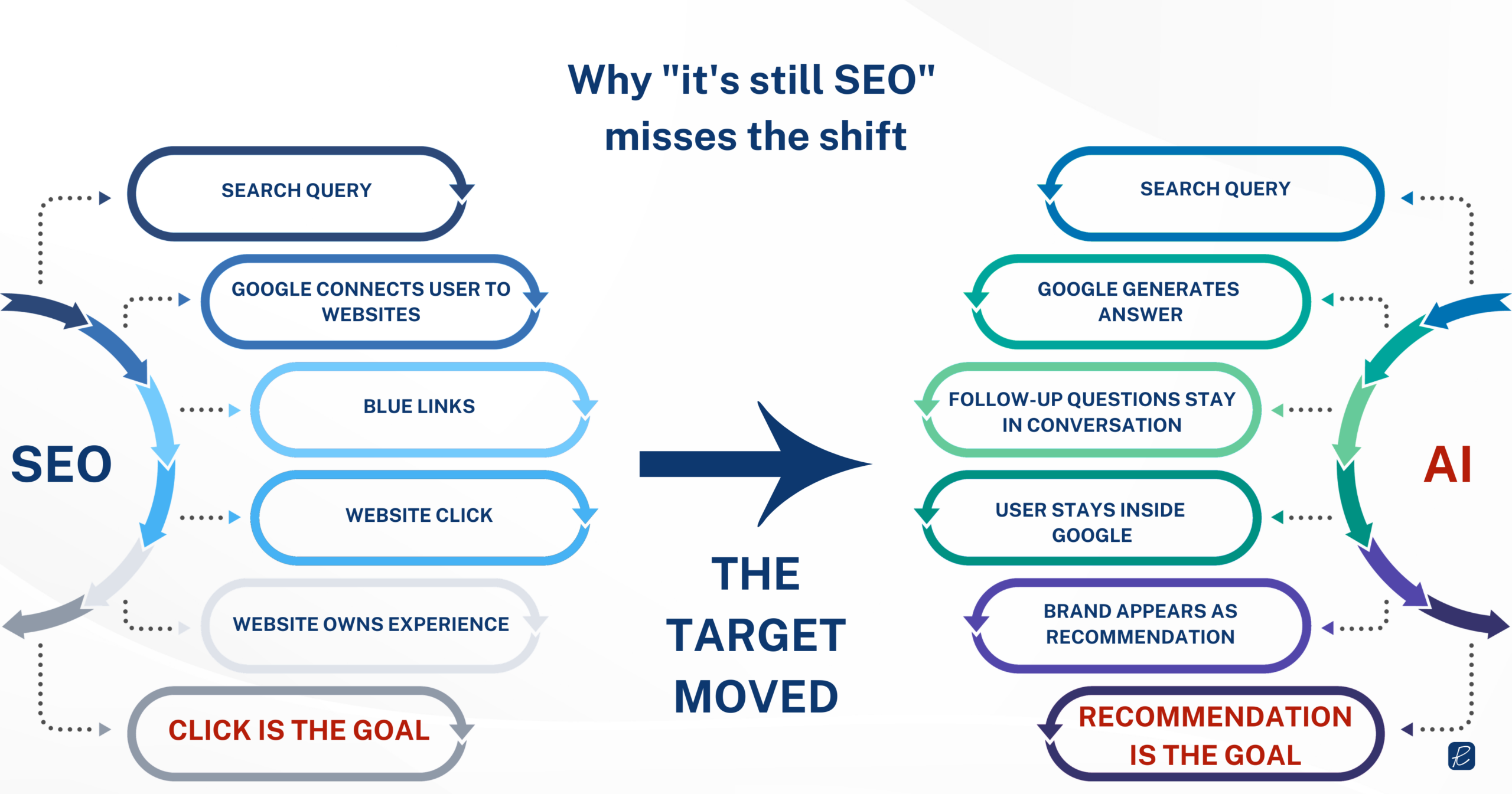
The shift the two Google messages add up to is that SEO best practices make you eligible to show up in AI search. But knowing whether you actually appear, and winning the citation when a competitor is fighting for the same answer, runs on signals that don’t apply to traditional SEO.