When leadership is already asking about AI search
In this case, you’re going to do little budget justification, and your real work is mainly a vendor comparison. The linked post lays out the key factors to look for in an AI search agency, but the most important one is whether they can show you, with their own tooling, where you stand today, and their track record driving growth in this channel.
Avoid treating the conversation as budget justification because the want already exists. Your only real risk is hiring a partner who can talk about AI search and can’t measure or influence it. These are the questions to ask potential AI search agencies.
| What to ask |
Why? |
| Can you show us where we stand in AI answers today? |
An agency that cannot audit current visibility is guessing. |
| Which platforms do you optimize for, and how? |
Google AI Overviews, AI Mode, ChatGPT and Perplexity each behave differently. |
| What tools do you use to measure progress month over month? |
No measurement stack means no accountability. Treat this as a dealbreaker. |
| How do you connect the work to pipeline, not just citations? |
Citations are an input. Leadership pays for deals. |
| What does month three look like after the first audit? |
A one-time audit and ongoing visibility work are different commitments. |
If a vendor cannot answer the measurement question, stop there. You will not be able to defend the spend later if they cannot show movement.
When you identify the need and propose the investment
In this case, leadership is not asking yet, but you can see something shifting and you want budget before it becomes obvious to everyone. This is the harder, more valuable position, and it’s where we focus the rest of this guide.
If you are bringing up investment in AI search, you have to build the case from scratch. Fortunately, although your leadership didn’t bring this up, they would have noticed the change in how people search online, and they themselves may be using AI more than traditional search.
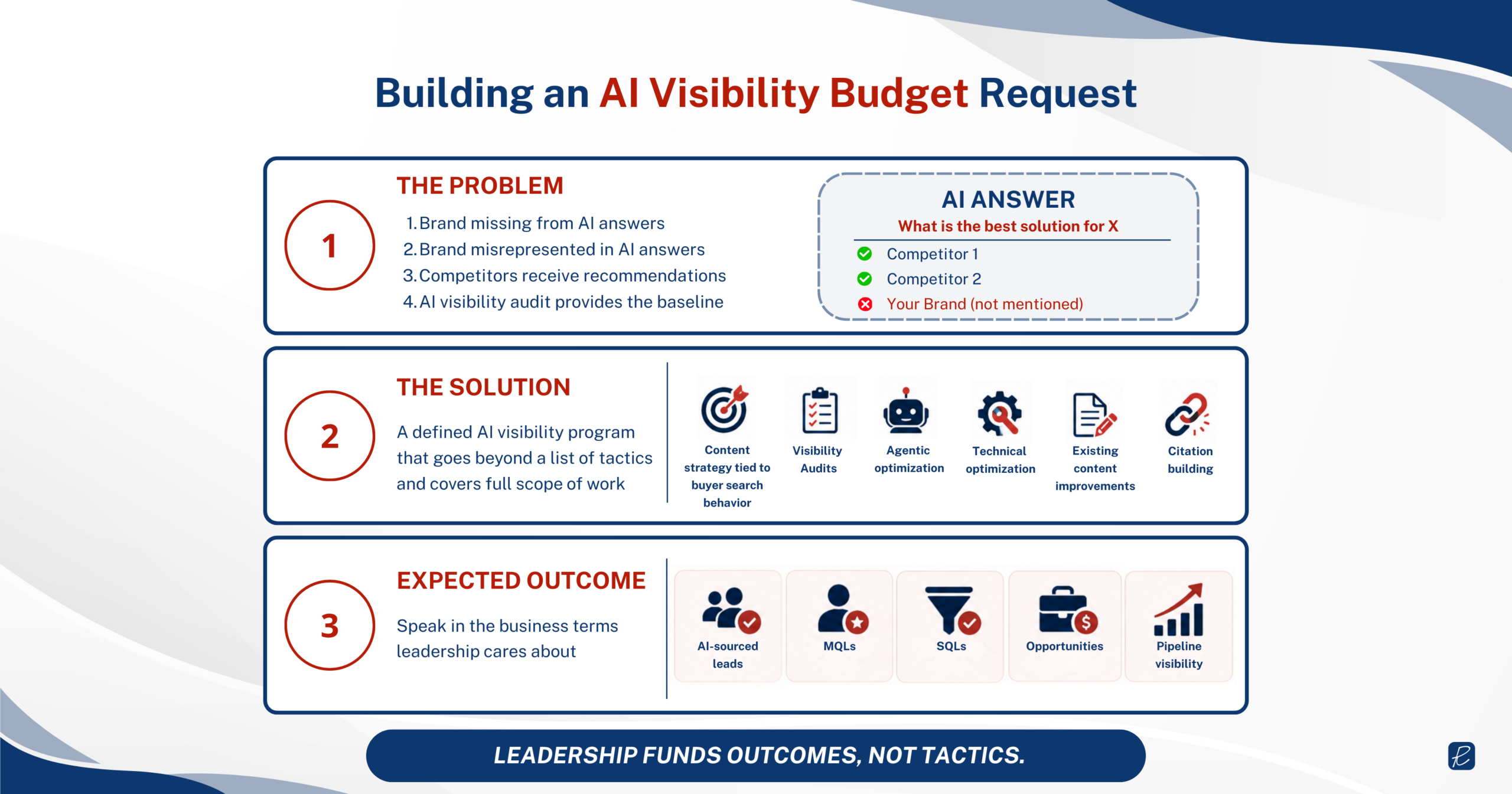
The budget request you present would be structured the same as any other request with explanation of the problem, the solution, and the expected outcomes. The main challenge would be in evidencing each one for a channel that most of your leadership probably haven’t been watching. Here is how we recommend addressing these parts:
1. The problem
Begin with what’s already visible in your own analytics and CRM, because it’s the part leadership can’t wave away.
Look for:
- Organic search traffic shifting in a way your existing content strategies can’t explain
- Direct traffic growing or behaving oddly
- AI platforms now showing up as their own traffic sources in analytics
- Leads saying they heard about your brand through AI platforms
Then make the AI search budget request more concrete by running real buyer questions through a few AI platforms and record what comes back. Ensure to include ChatGPT, Perplexity, Claude, Google AI Overviews, and AI Mode.
If your results identify any of the following AI visibility gaps, that shows a problem worth funding:
- Your brand is absent from answers where you should appear
- You’re present but positioned wrong
- AI answers reinforce negative sentiments about your brand
- Your competitors are named, and you aren’t
- Narratives are unaligned with your brand’s arguments
A quick spot-check like this justifies the inclusion of a comprehensive AI search audit in the budget as a defined piece of work. The audit is the cleanest way to move from “I think we have a problem” into a benchmarked picture of exactly where you stand against named competitors.
2. The solution
Leadership approves plans that are complete, so the solution section of your AI visibility budget request should read as a coherent program with clear parts.
The high-level markers should include:
- The comprehensive AI visibility audit as the first deliverable, benchmarking where you stand against competitors
- A strategy grounded in how your buyers typically search
- Optimization of your site and content for both human readers and AI agents
- Citation and authority building in third-party sources AI systems trust
- Measurement systems installed from day one for defending spend in the next cycle
- AI search training for your in-house SEO or marketing teams
You don’t need to have a marketing team proficient in each of these to ask for budget for them. That’s the point of bringing in an experienced partner, and it’s a legitimate part of the pitch.
AI search is a new and fast-moving channel where the people doing it daily are years ahead of any team learning it on the side. Point your request to a defined program here rather than a loose set of activities. Rampiq’s AI Visibility Optimization program is built around exactly these components, which makes it a useful reference point for what “complete” looks like.
3. The expected outcome
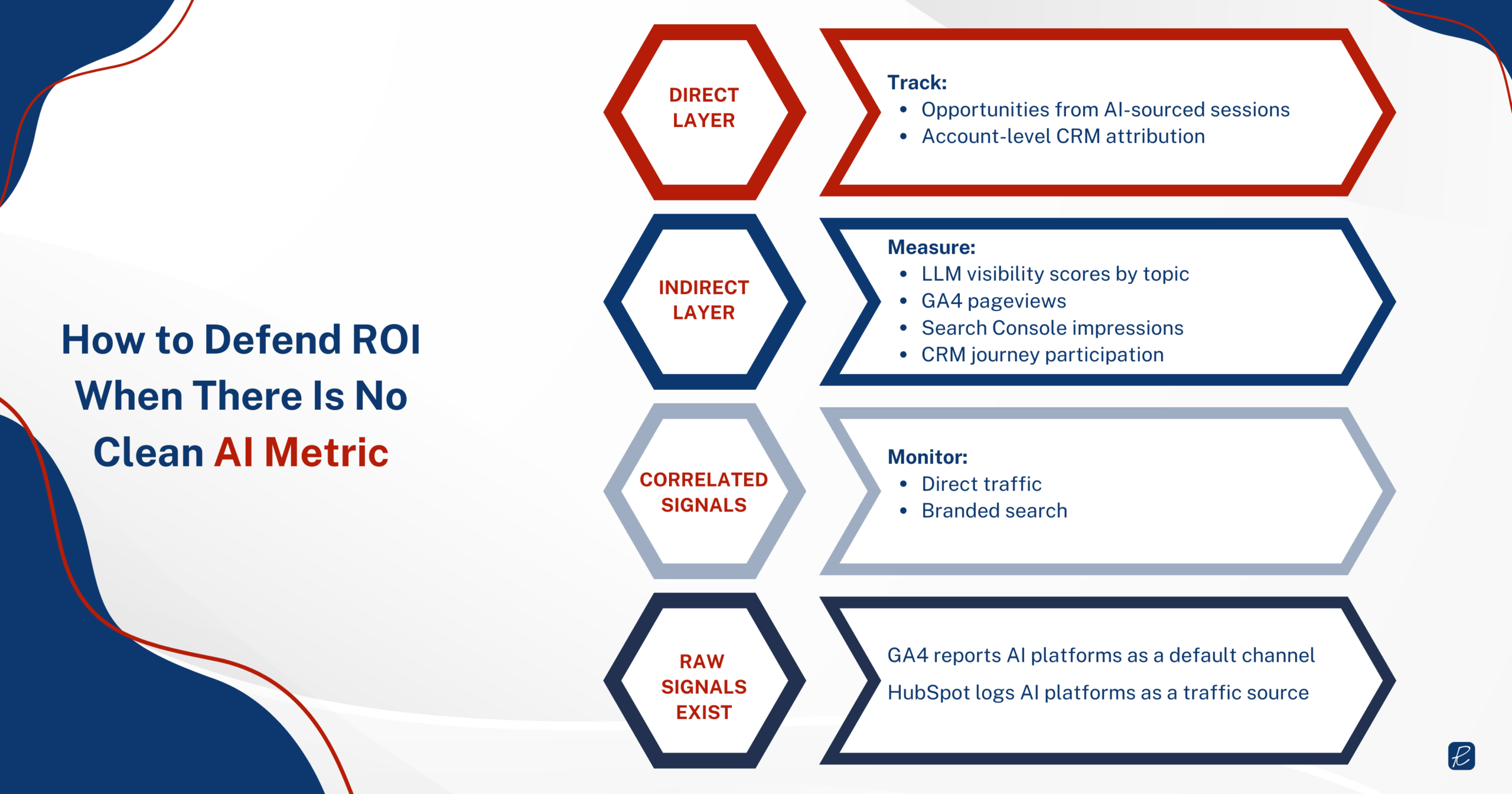
The headline outcome of your budget request should be a defined contribution to leads, MQLs, SQLs, and opportunities from AI-sourced demand. The new AI search visibility metrics like share of voice, citations, or visibility scores are worth naming, but position them as leading indicators that predict the pipeline outcome, never as the outcome itself.
Promise outcomes on two lanes, so the request survives a long B2B sales cycle. Set the expectation that early wins are visibility and influence gains, and that pipeline contribution compounds behind them as those gains feed a buying cycle that runs for months. Naming both stops leadership expecting closed revenue too soon and gives you defensible milestones to report against in the meantime.
Commit to measured (not perfect) attribution. AI answer attribution is not fully trackable, and no honest partner would claim otherwise.
Promise what you can stand behind:
- A direct pipeline from AI-sourced sessions
- The indirect influence of owned content across and citations the buying journey
Note that these should be measured from the account level because B2B committees move as groups. Framing that limit yourself pre-empts the objection that sinks these requests, “you can’t even prove it works.”
If you want the mechanics behind these outcomes, which tools capture each signal and how the tracking is wired, read our guide on measuring AI search visibility.